

Plant Demand Adapted Fertilization in Organic and Precision …
147
yield target or residue management in previous crop etc. Some workers also reported
the lack of correlation between soil-test based data for available nutrients and crop
yield [24] or the approaches for developing integrated nutrient recommendations
from soil test data [95]. Due to this, nutrient management in developing countries
like India is characterised by abuse of nitrogen, disuse of potassium, coupled with
overuse of phosphorus. These outmoded blanket prescriptions are the chief reason for
imbalanced plant nutrition. Farmers own perception compounds the problem further
and leads to over application in many cases, for example the overuse of zinc in sodic
soils of Punjab and Haryana in north India.
The Indian Council of Agricultural Research’s Project on Soil Test Crop Response
(STCR) uses multiple regression approach to develop relationships between the levels
of soil nutrients determined in the laboratory test and crop response to fertilizers in the
field that permits balanced fertilization through right kind and amount of fertilizers
to achieve a given yield target. It is unique because it predicts the level of yield the
farmer can hope to achieve if good agronomic practices are followed in raising the
crop. The resultant fertilizer adjustment equations have been tested in follow up and
frontline demonstrations conducted in different parts of the country. This targeted
yield concept strikes a balance between ‘fertilizing the crop’ and ‘fertilizing the soil’
and provides a scientific basis for balanced fertilization and strikes a balance between
applied nutrients and soil available nutrients. In the STCR targeted yield approach, it
is assumed that there is a linear relationship between grain yield and nutrient uptake
by the crop, and for obtaining a particular yield, a definite amount of nutrients are
taken up by the plant. Once this requirement is known for a given yield level, the
fertilizer needed can be estimated taking into consideration the contribution from
soil available nutrients. Several thousand demonstrations have been conducted all
over India that attest to the superiority of STCR-based fertilizer recommendation
for different crops over blanket recommendation and yield targets within ±10%
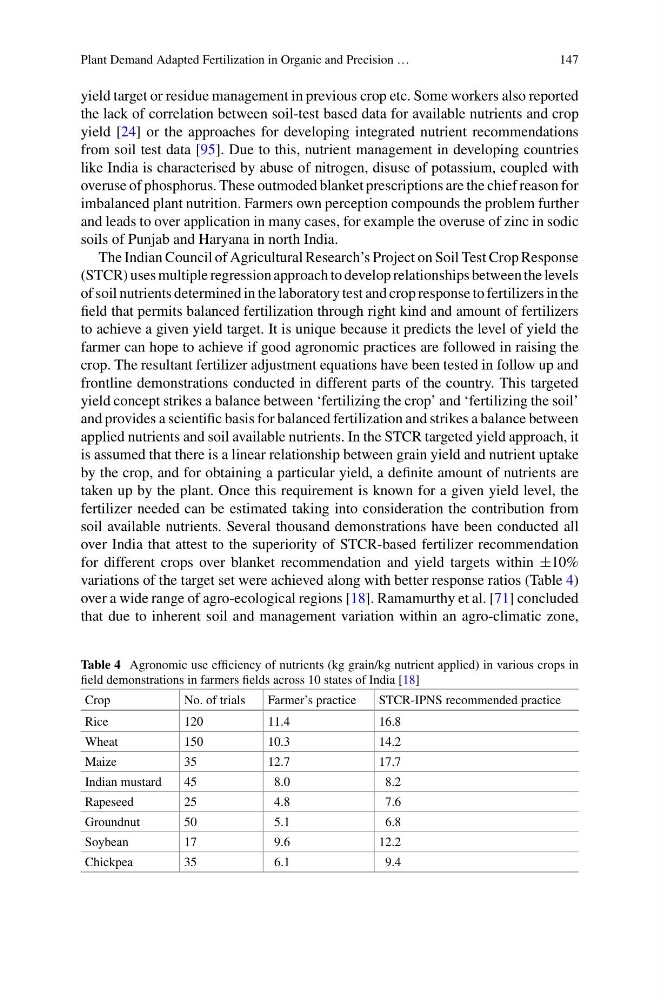
variations of the target set were achieved along with better response ratios (Table 4)
over a wide range of agro-ecological regions [18]. Ramamurthy et al. [71] concluded
that due to inherent soil and management variation within an agro-climatic zone,
Table 4 Agronomic use efficiency of nutrients (kg grain/kg nutrient applied) in various crops in
field demonstrations in farmers fields across 10 states of India [18]
Crop
No. of trials
Farmer’s practice
STCR-IPNS recommended practice
Rice
120
11.4
16.8
Wheat
150
10.3
14.2
Maize
35
12.7
17.7
Indian mustard
45
8.0
8.2
Rapeseed
25
4.8
7.6
Groundnut
50
5.1
6.8
Soybean
17
9.6
12.2
Chickpea
35
6.1
9.4
147
yield target or residue management in previous crop etc. Some workers also reported
the lack of correlation between soil-test based data for available nutrients and crop
yield [24] or the approaches for developing integrated nutrient recommendations
from soil test data [95]. Due to this, nutrient management in developing countries
like India is characterised by abuse of nitrogen, disuse of potassium, coupled with
overuse of phosphorus. These outmoded blanket prescriptions are the chief reason for
imbalanced plant nutrition. Farmers own perception compounds the problem further
and leads to over application in many cases, for example the overuse of zinc in sodic
soils of Punjab and Haryana in north India.
The Indian Council of Agricultural Research’s Project on Soil Test Crop Response
(STCR) uses multiple regression approach to develop relationships between the levels
of soil nutrients determined in the laboratory test and crop response to fertilizers in the
field that permits balanced fertilization through right kind and amount of fertilizers
to achieve a given yield target. It is unique because it predicts the level of yield the
farmer can hope to achieve if good agronomic practices are followed in raising the
crop. The resultant fertilizer adjustment equations have been tested in follow up and
frontline demonstrations conducted in different parts of the country. This targeted
yield concept strikes a balance between ‘fertilizing the crop’ and ‘fertilizing the soil’
and provides a scientific basis for balanced fertilization and strikes a balance between
applied nutrients and soil available nutrients. In the STCR targeted yield approach, it
is assumed that there is a linear relationship between grain yield and nutrient uptake
by the crop, and for obtaining a particular yield, a definite amount of nutrients are
taken up by the plant. Once this requirement is known for a given yield level, the
fertilizer needed can be estimated taking into consideration the contribution from
soil available nutrients. Several thousand demonstrations have been conducted all
over India that attest to the superiority of STCR-based fertilizer recommendation
for different crops over blanket recommendation and yield targets within ±10%
variations of the target set were achieved along with better response ratios (Table 4)
over a wide range of agro-ecological regions [18]. Ramamurthy et al. [71] concluded
that due to inherent soil and management variation within an agro-climatic zone,
Table 4 Agronomic use efficiency of nutrients (kg grain/kg nutrient applied) in various crops in
field demonstrations in farmers fields across 10 states of India [18]
Crop
No. of trials
Farmer’s practice
STCR-IPNS recommended practice
Rice
120
11.4
16.8
Wheat
150
10.3
14.2
Maize
35
12.7
17.7
Indian mustard
45
8.0
8.2
Rapeseed
25
4.8
7.6
Groundnut
50
5.1
6.8
Soybean
17
9.6
12.2
Chickpea
35
6.1
9.4