

116
L. Schorr et al.
1 Nitrogen Pollution and Health Effects
Wastewater disposal and plant demand surpassing N fertilization in form of urea
(CH 4 N 2 O), ammonium (NH
+
4 ) and nitrate (NO
−
3 ) pollute surface and groundwater,
landscapes and the atmosphere. Thus, organisms, evolutionary adapted to N shortage,
are forced to come along with N overloads. Microbes have the potential to oxidize
NH
+
4 to NO
−
3 and to respire NO
−
3 to NO
−
2 , further to climate change contributing NO x
and nitrous oxide (N 2 O) greenhouse gases, to N 2 and even to ammonia (NH 3 ) [7,
69, 90]. Water soluble nitrate and toxic NO
−
2 , if available or applied in plant demand
surpassing amounts, pollute surface and ground waters. Nitrate sources are agricultural and non-agricultural spreaders, which produce increasing amounts of wastewater that reaches wastewater treatment plants (WWTPs) and leads to huge amounts
of sewage sludge [105, 111]. For preventing high nitrate levels in the drinking water,
the world health organisation (WHO) has issued that groundwater NO
−
3 should not
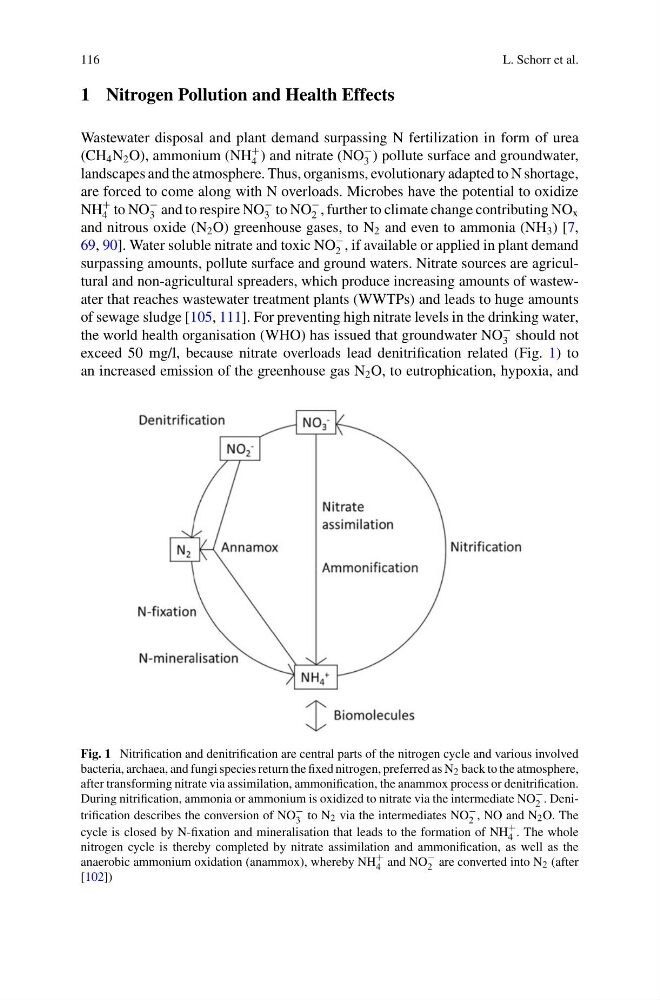
exceed 50 mg/l, because nitrate overloads lead denitrification related (Fig. 1) to
an increased emission of the greenhouse gas N 2 O, to eutrophication, hypoxia, and
Fig. 1 Nitrification and denitrification are central parts of the nitrogen cycle and various involved
bacteria, archaea, and fungi species return the fixed nitrogen, preferred as N 2 back to the atmosphere,
after transforming nitrate via assimilation, ammonification, the anammox process or denitrification.
During nitrification, ammonia or ammonium is oxidized to nitrate via the intermediate NO
−
2 . Denitrification describes the conversion of NO
−
3 to N 2 via the intermediates NO
−
2 , NO and N 2 O. The
cycle is closed by N-fixation and mineralisation that leads to the formation of NH
+
4 . The whole
nitrogen cycle is thereby completed by nitrate assimilation and ammonification, as well as the
anaerobic ammonium oxidation (anammox), whereby NH
+
4 and NO
−
2 are converted into N 2 (after
[102])
L. Schorr et al.
1 Nitrogen Pollution and Health Effects
Wastewater disposal and plant demand surpassing N fertilization in form of urea
(CH 4 N 2 O), ammonium (NH
+
4 ) and nitrate (NO
−
3 ) pollute surface and groundwater,
landscapes and the atmosphere. Thus, organisms, evolutionary adapted to N shortage,
are forced to come along with N overloads. Microbes have the potential to oxidize
NH
+
4 to NO
−
3 and to respire NO
−
3 to NO
−
2 , further to climate change contributing NO x
and nitrous oxide (N 2 O) greenhouse gases, to N 2 and even to ammonia (NH 3 ) [7,
69, 90]. Water soluble nitrate and toxic NO
−
2 , if available or applied in plant demand
surpassing amounts, pollute surface and ground waters. Nitrate sources are agricultural and non-agricultural spreaders, which produce increasing amounts of wastewater that reaches wastewater treatment plants (WWTPs) and leads to huge amounts
of sewage sludge [105, 111]. For preventing high nitrate levels in the drinking water,
the world health organisation (WHO) has issued that groundwater NO
−
3 should not
exceed 50 mg/l, because nitrate overloads lead denitrification related (Fig. 1) to
an increased emission of the greenhouse gas N 2 O, to eutrophication, hypoxia, and
Fig. 1 Nitrification and denitrification are central parts of the nitrogen cycle and various involved
bacteria, archaea, and fungi species return the fixed nitrogen, preferred as N 2 back to the atmosphere,
after transforming nitrate via assimilation, ammonification, the anammox process or denitrification.
During nitrification, ammonia or ammonium is oxidized to nitrate via the intermediate NO
−
2 . Denitrification describes the conversion of NO
−
3 to N 2 via the intermediates NO
−
2 , NO and N 2 O. The
cycle is closed by N-fixation and mineralisation that leads to the formation of NH
+
4 . The whole
nitrogen cycle is thereby completed by nitrate assimilation and ammonification, as well as the
anaerobic ammonium oxidation (anammox), whereby NH
+
4 and NO
−
2 are converted into N 2 (after
[102])