

98
E. Vavoulidou et al.
Peloponnese
Crete
Thessaly
Prefectures
1: Larissa
2:Lamia Ftiotida
3: Viotia
4: Attika
5: Galatas
6: Nemea
7: Arkadia
8: Achaia-Egeio
9: Ilia
10:Messinia
11:Arta
12:Santorini
13:Chania
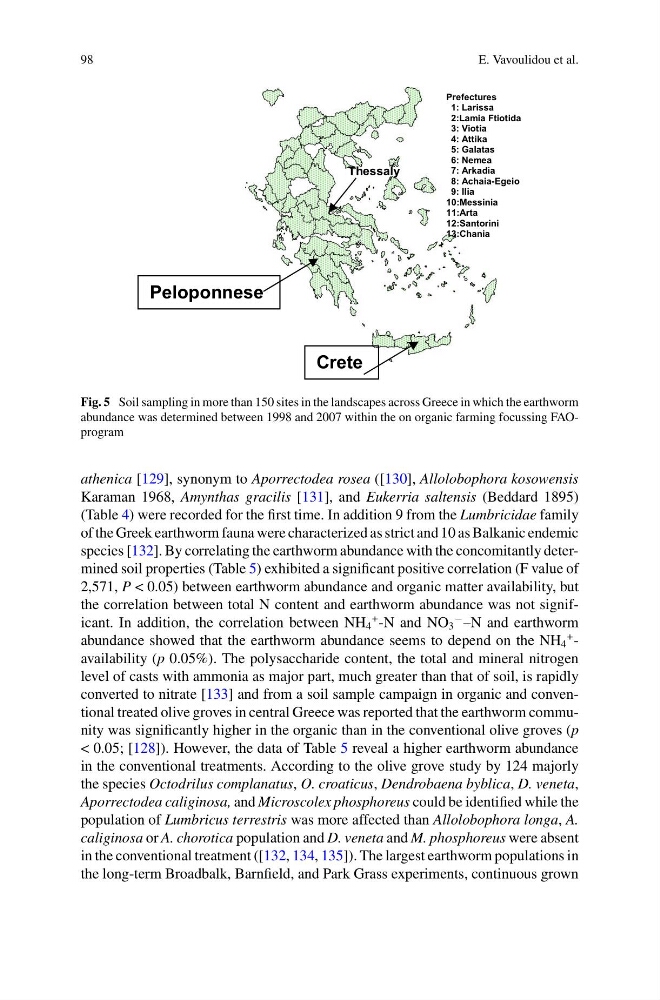
Fig. 5 Soil sampling in more than 150 sites in the landscapes across Greece in which the earthworm
abundance was determined between 1998 and 2007 within the on organic farming focussing FAOprogram
athenica [129], synonym to Aporrectodea rosea ([130], Allolobophora kosowensis
Karaman 1968, Amynthas gracilis [131], and Eukerria saltensis (Beddard 1895)
(Table 4) were recorded for the first time. In addition 9 from the Lumbricidae family
of the Greek earthworm fauna were characterized as strict and 10 as Balkanic endemic
species [132]. By correlating the earthworm abundance with the concomitantly determined soil properties (Table 5) exhibited a significant positive correlation (F value of
2,571, P < 0.05) between earthworm abundance and organic matter availability, but
the correlation between total N content and earthworm abundance was not significant. In addition, the correlation between NH 4
+ -N and NO 3
− –N and earthworm
abundance showed that the earthworm abundance seems to depend on the NH 4
+ -
availability (p 0.05%). The polysaccharide content, the total and mineral nitrogen
level of casts with ammonia as major part, much greater than that of soil, is rapidly
converted to nitrate [133] and from a soil sample campaign in organic and conventional treated olive groves in central Greece was reported that the earthworm community was significantly higher in the organic than in the conventional olive groves (p
< 0.05; [128]). However, the data of Table 5 reveal a higher earthworm abundance
in the conventional treatments. According to the olive grove study by 124 majorly
the species Octodrilus complanatus, O. croaticus, Dendrobaena byblica, D. veneta,
Aporrectodea caliginosa, and Microscolex phosphoreus could be identified while the
population of Lumbricus terrestris was more affected than Allolobophora longa, A.
caliginosa or A. chorotica population and D. veneta and M. phosphoreus were absent
in the conventional treatment ([132, 134, 135]). The largest earthworm populations in
the long-term Broadbalk, Barnfield, and Park Grass experiments, continuous grown
E. Vavoulidou et al.
Peloponnese
Crete
Thessaly
Prefectures
1: Larissa
2:Lamia Ftiotida
3: Viotia
4: Attika
5: Galatas
6: Nemea
7: Arkadia
8: Achaia-Egeio
9: Ilia
10:Messinia
11:Arta
12:Santorini
13:Chania
Fig. 5 Soil sampling in more than 150 sites in the landscapes across Greece in which the earthworm
abundance was determined between 1998 and 2007 within the on organic farming focussing FAOprogram
athenica [129], synonym to Aporrectodea rosea ([130], Allolobophora kosowensis
Karaman 1968, Amynthas gracilis [131], and Eukerria saltensis (Beddard 1895)
(Table 4) were recorded for the first time. In addition 9 from the Lumbricidae family
of the Greek earthworm fauna were characterized as strict and 10 as Balkanic endemic
species [132]. By correlating the earthworm abundance with the concomitantly determined soil properties (Table 5) exhibited a significant positive correlation (F value of
2,571, P < 0.05) between earthworm abundance and organic matter availability, but
the correlation between total N content and earthworm abundance was not significant. In addition, the correlation between NH 4
+ -N and NO 3
− –N and earthworm
abundance showed that the earthworm abundance seems to depend on the NH 4
+ -
availability (p 0.05%). The polysaccharide content, the total and mineral nitrogen
level of casts with ammonia as major part, much greater than that of soil, is rapidly
converted to nitrate [133] and from a soil sample campaign in organic and conventional treated olive groves in central Greece was reported that the earthworm community was significantly higher in the organic than in the conventional olive groves (p
< 0.05; [128]). However, the data of Table 5 reveal a higher earthworm abundance
in the conventional treatments. According to the olive grove study by 124 majorly
the species Octodrilus complanatus, O. croaticus, Dendrobaena byblica, D. veneta,
Aporrectodea caliginosa, and Microscolex phosphoreus could be identified while the
population of Lumbricus terrestris was more affected than Allolobophora longa, A.
caliginosa or A. chorotica population and D. veneta and M. phosphoreus were absent
in the conventional treatment ([132, 134, 135]). The largest earthworm populations in
the long-term Broadbalk, Barnfield, and Park Grass experiments, continuous grown