

71
Technical and Societal Challenges
• To ensure data privacy and location privacy.
• Certain law enforcement is required for enhancing technologies.
• Trust should be established for communication among objects.
Major issue in IoT privacy and confidentiality is about the data and the user involved.
To ensure confidentiality, numerous standard encryption technologies exist. The challenge behind is (1) the speed at which the encryption algorithm works and (2) the amount
of energy it consumes. In IoT, the heterogeneity and mobility of things will create more
complexity in privacy-preserving technology. Network and data anonymity can provide the basis for privacy but certain technologies are supported with high bandwidth
and computing power. A similar question arises for authentication of devices and for
establishing trust.
Organizations have to identify the risk levels which are exposed to IoT and should think
about the privacy and security requirements associated with volume of data. Trust in data
privacy and protection should be taken into consideration for further research in IoT.
4.5 Socio-Ethical Considerations
Technological developments in this digital era will have an impact on the society either
directly or indirectly. Although technologies like sensors, nano, and RFID have a role in
threatening the privacy of data, these are also factors to be considered in socio- ethical
issues. The issue at stake is that although recorded video, navigation, and biometric records
are used for the purpose of observation, they still create a fear about the usage of data.
Communication between people is influenced by technology, as people prefer to text rather
Legal/regulatory
Consumer consent
Collection limitation
Openness
Accountability
Economic/market
Self-regulation
Codes of conduct
Privacy certification
Consumer education
Socio-ethical
Consumer rights
Public awareness
Disclosure
Consumer advocacy
Technical
Encryption
ID management
Privacy-enhancing
Technologies
Privacy
protection
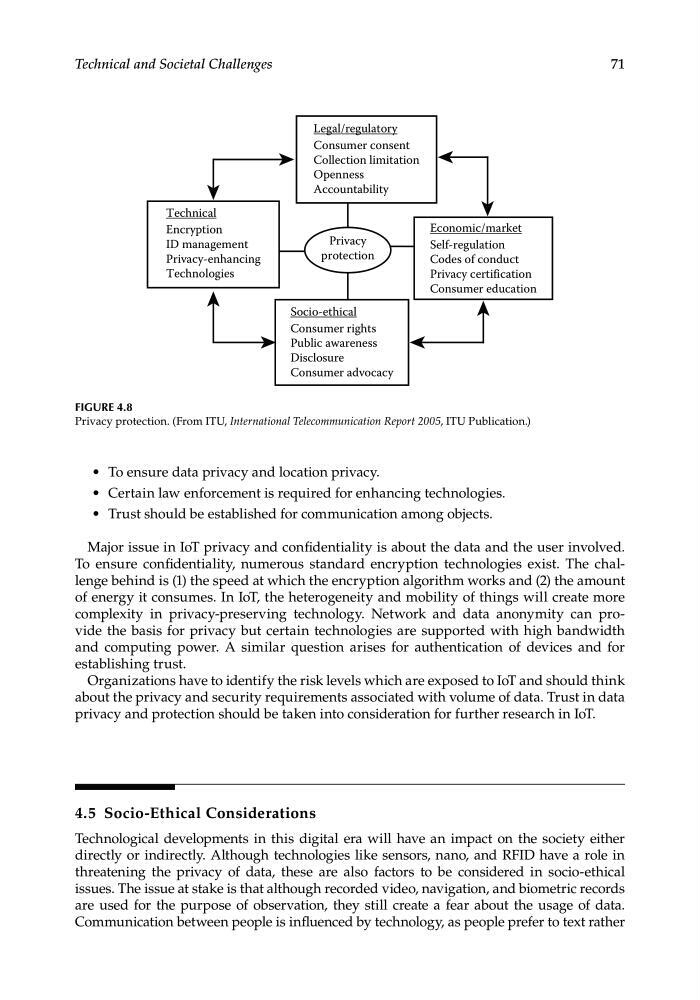
FIGURE 4.8
Privacy protection. (From ITU, International Telecommunication Report 2005, ITU Publication.)
Technical and Societal Challenges
• To ensure data privacy and location privacy.
• Certain law enforcement is required for enhancing technologies.
• Trust should be established for communication among objects.
Major issue in IoT privacy and confidentiality is about the data and the user involved.
To ensure confidentiality, numerous standard encryption technologies exist. The challenge behind is (1) the speed at which the encryption algorithm works and (2) the amount
of energy it consumes. In IoT, the heterogeneity and mobility of things will create more
complexity in privacy-preserving technology. Network and data anonymity can provide the basis for privacy but certain technologies are supported with high bandwidth
and computing power. A similar question arises for authentication of devices and for
establishing trust.
Organizations have to identify the risk levels which are exposed to IoT and should think
about the privacy and security requirements associated with volume of data. Trust in data
privacy and protection should be taken into consideration for further research in IoT.
4.5 Socio-Ethical Considerations
Technological developments in this digital era will have an impact on the society either
directly or indirectly. Although technologies like sensors, nano, and RFID have a role in
threatening the privacy of data, these are also factors to be considered in socio- ethical
issues. The issue at stake is that although recorded video, navigation, and biometric records
are used for the purpose of observation, they still create a fear about the usage of data.
Communication between people is influenced by technology, as people prefer to text rather
Legal/regulatory
Consumer consent
Collection limitation
Openness
Accountability
Economic/market
Self-regulation
Codes of conduct
Privacy certification
Consumer education
Socio-ethical
Consumer rights
Public awareness
Disclosure
Consumer advocacy
Technical
Encryption
ID management
Privacy-enhancing
Technologies
Privacy
protection
FIGURE 4.8
Privacy protection. (From ITU, International Telecommunication Report 2005, ITU Publication.)