

63
Technical and Societal Challenges
4.2.1 Integration Issues
IoT is challenged in using mixture of devices interacting low-power devices with low capabilities high end machines. This requires standards to enable a platform to communicate
and operate, and program devices regardless of their model, manufacture, and industry
application.
Devices with sensing capabilities are in the form of smart objects, where wireless sensor
in IoT is expected to play a significant role. Integrating IoT with sensor networks raises
challenges in terms of communication and collaboration.
The following section will explore ways and challenges faced in integrating IoT with
sensor networks.
4.2.1.1 Network-Based Integration
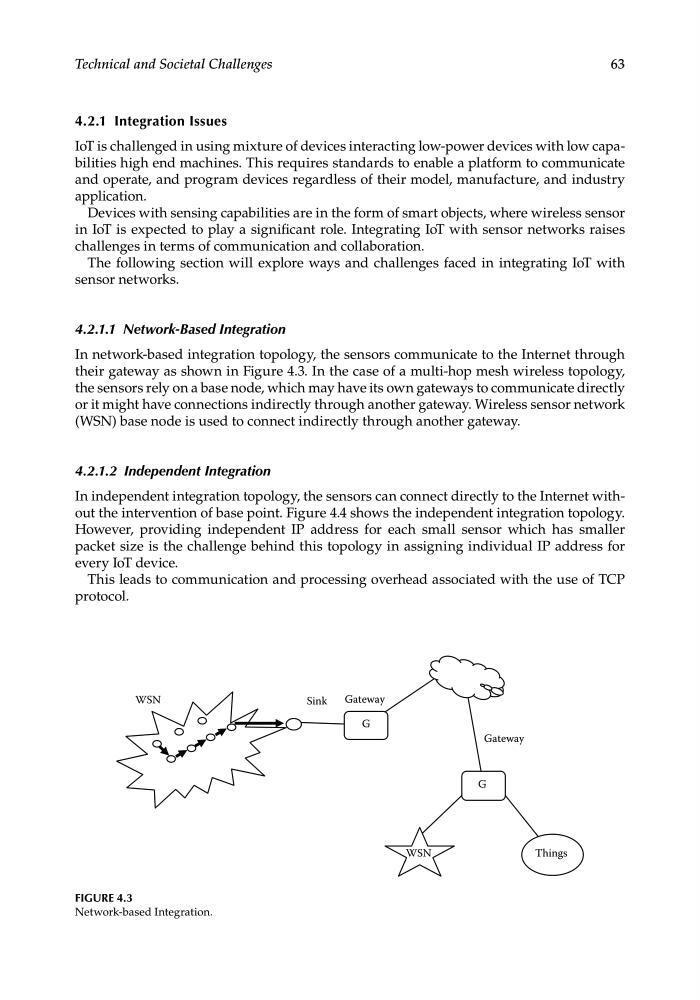
In network-based integration topology, the sensors communicate to the Internet through
their gateway as shown in Figure 4.3. In the case of a multi-hop mesh wireless topology,
the sensors rely on a base node, which may have its own gateways to communicate directly
or it might have connections indirectly through another gateway. Wireless sensor network
(WSN) base node is used to connect indirectly through another gateway.
4.2.1.2 Independent Integration
In independent integration topology, the sensors can connect directly to the Internet without the intervention of base point. Figure 4.4 shows the independent integration topology.
However, providing independent IP address for each small sensor which has smaller
packet size is the challenge behind this topology in assigning individual IP address for
every IoT device.
This leads to communication and processing overhead associated with the use of TCP
protocol.
WSN
Sink
Gateway
Gateway
G
G
Things
WSN
FIGURE 4.3
Network-based Integration.
Technical and Societal Challenges
4.2.1 Integration Issues
IoT is challenged in using mixture of devices interacting low-power devices with low capabilities high end machines. This requires standards to enable a platform to communicate
and operate, and program devices regardless of their model, manufacture, and industry
application.
Devices with sensing capabilities are in the form of smart objects, where wireless sensor
in IoT is expected to play a significant role. Integrating IoT with sensor networks raises
challenges in terms of communication and collaboration.
The following section will explore ways and challenges faced in integrating IoT with
sensor networks.
4.2.1.1 Network-Based Integration
In network-based integration topology, the sensors communicate to the Internet through
their gateway as shown in Figure 4.3. In the case of a multi-hop mesh wireless topology,
the sensors rely on a base node, which may have its own gateways to communicate directly
or it might have connections indirectly through another gateway. Wireless sensor network
(WSN) base node is used to connect indirectly through another gateway.
4.2.1.2 Independent Integration
In independent integration topology, the sensors can connect directly to the Internet without the intervention of base point. Figure 4.4 shows the independent integration topology.
However, providing independent IP address for each small sensor which has smaller
packet size is the challenge behind this topology in assigning individual IP address for
every IoT device.
This leads to communication and processing overhead associated with the use of TCP
protocol.
WSN
Sink
Gateway
Gateway
G
G
Things
WSN
FIGURE 4.3
Network-based Integration.