

44
Internet of Things (IoT)
3.3 IoT Basics
IoT is considered to be the next step in the Internet evolution. As per European Commission,
in the coming years, the integration of Internet with wireless communications and embedded
wireless sensor networks will provide a paradigm shift in transforming our everyday devices
into intelligent and context-aware ones (EU_Commission, 2009). Due to its technological
structures, market shares, values, and earnings, it has found its place in almost all facets of
human life, which can be unavoidable (Bandyopadhyay and Sen, 2011; Jain et al., 2011).
It is also envisaged that, in the near future, Internet will be integrated into a multitude of things such as clothes, toothbrush, and food packaging (Liu and Tong, 2010), with
context awareness capability, pseudo-intelligence on processing capability among the
connected things; also, efficient consumption of limited available power demands new
forms of communication between things and people as well as between things themselves
(Castellani et al., 2010; Mao et al., 2010).
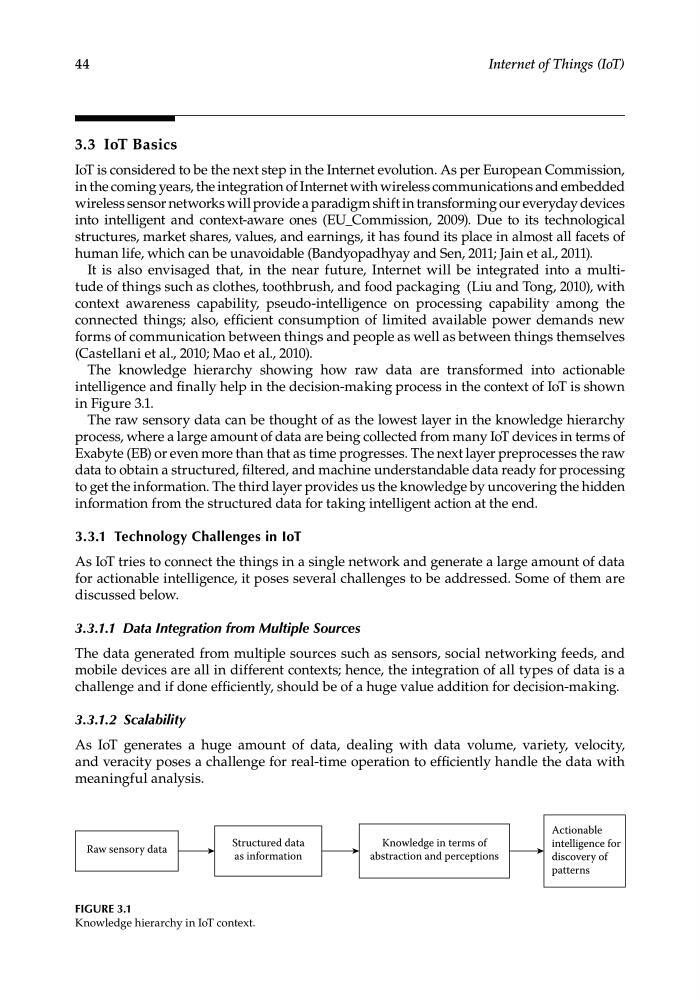
The knowledge hierarchy showing how raw data are transformed into actionable
intelligence and finally help in the decision-making process in the context of IoT is shown
in Figure 3.1.
The raw sensory data can be thought of as the lowest layer in the knowledge hierarchy
process, where a large amount of data are being collected from many IoT devices in terms of
Exabyte (EB) or even more than that as time progresses. The next layer preprocesses the raw
data to obtain a structured, filtered, and machine understandable data ready for processing
to get the information. The third layer provides us the knowledge by uncovering the hidden
information from the structured data for taking intelligent action at the end.
3.3.1 Technology Challenges in IoT
As IoT tries to connect the things in a single network and generate a large amount of data
for actionable intelligence, it poses several challenges to be addressed. Some of them are
discussed below.
3.3.1.1 Data Integration from Multiple Sources
The data generated from multiple sources such as sensors, social networking feeds, and
mobile devices are all in different contexts; hence, the integration of all types of data is a
challenge and if done efficiently, should be of a huge value addition for decision-making.
3.3.1.2 Scalability
As IoT generates a huge amount of data, dealing with data volume, variety, velocity,
and veracity poses a challenge for real-time operation to efficiently handle the data with
meaningful analysis.
Raw sensory data
Structured data
as information
Knowledge in terms of
abstraction and perceptions
Actionable
intelligence for
discovery of
patterns
FIGURE 3.1
Knowledge hierarchy in IoT context.
Internet of Things (IoT)
3.3 IoT Basics
IoT is considered to be the next step in the Internet evolution. As per European Commission,
in the coming years, the integration of Internet with wireless communications and embedded
wireless sensor networks will provide a paradigm shift in transforming our everyday devices
into intelligent and context-aware ones (EU_Commission, 2009). Due to its technological
structures, market shares, values, and earnings, it has found its place in almost all facets of
human life, which can be unavoidable (Bandyopadhyay and Sen, 2011; Jain et al., 2011).
It is also envisaged that, in the near future, Internet will be integrated into a multitude of things such as clothes, toothbrush, and food packaging (Liu and Tong, 2010), with
context awareness capability, pseudo-intelligence on processing capability among the
connected things; also, efficient consumption of limited available power demands new
forms of communication between things and people as well as between things themselves
(Castellani et al., 2010; Mao et al., 2010).
The knowledge hierarchy showing how raw data are transformed into actionable
intelligence and finally help in the decision-making process in the context of IoT is shown
in Figure 3.1.
The raw sensory data can be thought of as the lowest layer in the knowledge hierarchy
process, where a large amount of data are being collected from many IoT devices in terms of
Exabyte (EB) or even more than that as time progresses. The next layer preprocesses the raw
data to obtain a structured, filtered, and machine understandable data ready for processing
to get the information. The third layer provides us the knowledge by uncovering the hidden
information from the structured data for taking intelligent action at the end.
3.3.1 Technology Challenges in IoT
As IoT tries to connect the things in a single network and generate a large amount of data
for actionable intelligence, it poses several challenges to be addressed. Some of them are
discussed below.
3.3.1.1 Data Integration from Multiple Sources
The data generated from multiple sources such as sensors, social networking feeds, and
mobile devices are all in different contexts; hence, the integration of all types of data is a
challenge and if done efficiently, should be of a huge value addition for decision-making.
3.3.1.2 Scalability
As IoT generates a huge amount of data, dealing with data volume, variety, velocity,
and veracity poses a challenge for real-time operation to efficiently handle the data with
meaningful analysis.
Raw sensory data
Structured data
as information
Knowledge in terms of
abstraction and perceptions
Actionable
intelligence for
discovery of
patterns
FIGURE 3.1
Knowledge hierarchy in IoT context.