

14
Internet of Things (IoT)
plate information, the contact details of the owner is identified and ticket is issued with
necessary proof or evidence.
1.6 Scope for Future Studies
The proposed tint level detection system has been designed using ordinary cameras
which work in the visible region of the electromagnetic spectrum. In reality, we drive our
vehicles during early mornings, late evenings, and night times as well. If one wants to use
the proposed system, then one has to use infrared cameras during those poor lighting conditions. Then, the proposed algorithm needs to be modified. The designed algorithm has
been tested while the vehicles were moving at low speeds. One has to test the algorithm
while vehicles are moving at high speeds.
Acknowledgments
This work forms part of the Research and Development activities of TIFAC-CORE in
Automotive Infotronics at VIT University, Vellore, India. The author would like to thank
the Department of Science and Technology, Government of India, for providing the necessary software and hardware facilities for successfully carrying out the present work.
(a)
(b)
(c)
(d)
( e)
(f )
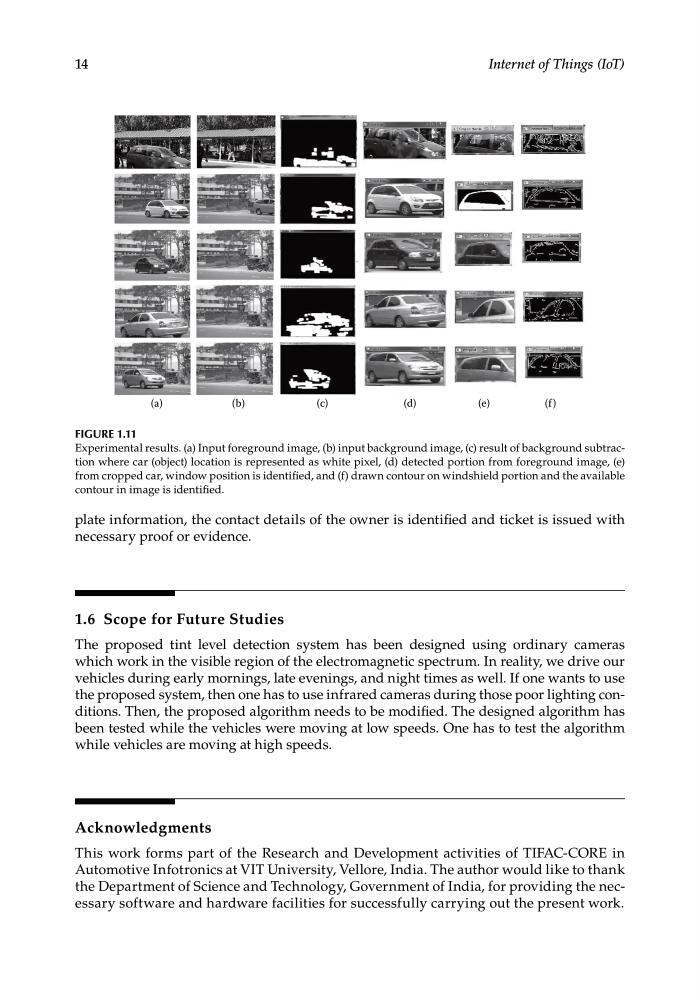
FIGURE 1.11
Experimental results. (a) Input foreground image, (b) input background image, (c) result of background subtraction where car (object) location is represented as white pixel, (d) detected portion from foreground image, (e)
from cropped car, window position is identified, and (f) drawn contour on windshield portion and the available
contour in image is identified.
Internet of Things (IoT)
plate information, the contact details of the owner is identified and ticket is issued with
necessary proof or evidence.
1.6 Scope for Future Studies
The proposed tint level detection system has been designed using ordinary cameras
which work in the visible region of the electromagnetic spectrum. In reality, we drive our
vehicles during early mornings, late evenings, and night times as well. If one wants to use
the proposed system, then one has to use infrared cameras during those poor lighting conditions. Then, the proposed algorithm needs to be modified. The designed algorithm has
been tested while the vehicles were moving at low speeds. One has to test the algorithm
while vehicles are moving at high speeds.
Acknowledgments
This work forms part of the Research and Development activities of TIFAC-CORE in
Automotive Infotronics at VIT University, Vellore, India. The author would like to thank
the Department of Science and Technology, Government of India, for providing the necessary software and hardware facilities for successfully carrying out the present work.
(a)
(b)
(c)
(d)
( e)
(f )
FIGURE 1.11
Experimental results. (a) Input foreground image, (b) input background image, (c) result of background subtraction where car (object) location is represented as white pixel, (d) detected portion from foreground image, (e)
from cropped car, window position is identified, and (f) drawn contour on windshield portion and the available
contour in image is identified.