

322
Internet of Things (IoT)
14.1.9 Benefits of Using Assistive IoT Technologies to Support ASD Children
IoT assistive technology is a service that specifically helps (Garretson et al. 1990) a child with
an inability in the determination, procurement, or utilization of general assistive gadgets.
By handling of individual assistive gadgets that are designed for them as indicated by their
capability and inability, children can enhance their quality of learning and increase new
aptitudes. The instructors, parents, and experts can also use and suggest such IoT assistive
gadgets by knowing the ability and inability of the autistic children for their better learning. This smart environment can help children with ASD to upgrade them, and children
will have the capacity to learn new dialect abilities, social attitudes, proper conduct, and
scholarly aptitudes to enable them for performing and completing day-to-day activities.
14.1.10 Future Scope
Researchers keep on dedicating themselves to disentangling and finding the causes
behind extreme ASD children cases every day. Sometimes, the symptoms of autism are
very difficult to differentiate for the parents of such children.
Keeping this in view, in far future, billions of data spouting devices will be connected
with the Internet. The real work that can be taken lies in outlining minimal, nonintruding
wearable gadgets. Better and more grounded calculations and algorithms can be developed to enhance the productivity of grouping and diminish the idleness. Currently, there
is no particular diagnosis for autism; in any case, with proper preparing, training, and
instruction by support of today’s IoT gadgets, children with other disabilities and children
with extreme autistic syndrome can learn and make themselves feel comfortable. With the
rapid growth of smart wearable technology in the health sector, industry has leveraged
the level of healthcare management for individuals with autism. New technologies can
improve communication, help in the skill development, and enhance the ability to learn.
14.1.11 Conclusion
There has been advance in using the IoT structure for assistive technologies in various fields, for example, incorporation and autonomous living for seniors. Such smart
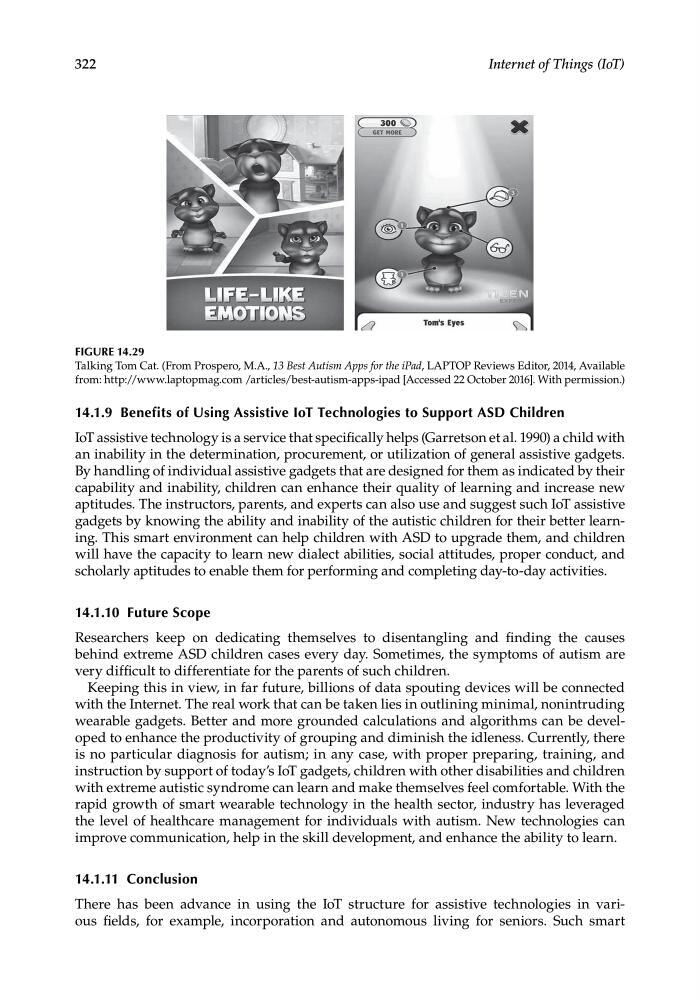
FIGURE 14.29
Talking Tom Cat. (From Prospero, M.A., 13 Best Autism Apps for the iPad, LAPTOP Reviews Editor, 2014, Available
from: http://www.laptopmag.com /articles/best-autism-apps-ipad [Accessed 22 October 2016]. With permission.)
Internet of Things (IoT)
14.1.9 Benefits of Using Assistive IoT Technologies to Support ASD Children
IoT assistive technology is a service that specifically helps (Garretson et al. 1990) a child with
an inability in the determination, procurement, or utilization of general assistive gadgets.
By handling of individual assistive gadgets that are designed for them as indicated by their
capability and inability, children can enhance their quality of learning and increase new
aptitudes. The instructors, parents, and experts can also use and suggest such IoT assistive
gadgets by knowing the ability and inability of the autistic children for their better learning. This smart environment can help children with ASD to upgrade them, and children
will have the capacity to learn new dialect abilities, social attitudes, proper conduct, and
scholarly aptitudes to enable them for performing and completing day-to-day activities.
14.1.10 Future Scope
Researchers keep on dedicating themselves to disentangling and finding the causes
behind extreme ASD children cases every day. Sometimes, the symptoms of autism are
very difficult to differentiate for the parents of such children.
Keeping this in view, in far future, billions of data spouting devices will be connected
with the Internet. The real work that can be taken lies in outlining minimal, nonintruding
wearable gadgets. Better and more grounded calculations and algorithms can be developed to enhance the productivity of grouping and diminish the idleness. Currently, there
is no particular diagnosis for autism; in any case, with proper preparing, training, and
instruction by support of today’s IoT gadgets, children with other disabilities and children
with extreme autistic syndrome can learn and make themselves feel comfortable. With the
rapid growth of smart wearable technology in the health sector, industry has leveraged
the level of healthcare management for individuals with autism. New technologies can
improve communication, help in the skill development, and enhance the ability to learn.
14.1.11 Conclusion
There has been advance in using the IoT structure for assistive technologies in various fields, for example, incorporation and autonomous living for seniors. Such smart
FIGURE 14.29
Talking Tom Cat. (From Prospero, M.A., 13 Best Autism Apps for the iPad, LAPTOP Reviews Editor, 2014, Available
from: http://www.laptopmag.com /articles/best-autism-apps-ipad [Accessed 22 October 2016]. With permission.)