

316
Internet of Things (IoT)
14.1.7 Head-Mounted Display Products: Google Glass
Children with ASDs are facing problems in social communication, facial expression, and
eye contacts during face-to-face interaction. So the Stanford specialists created a facial recognition programming, particularly for Glass. The software is a mentor for helping the
children to judge the correct emotions on people’s face.
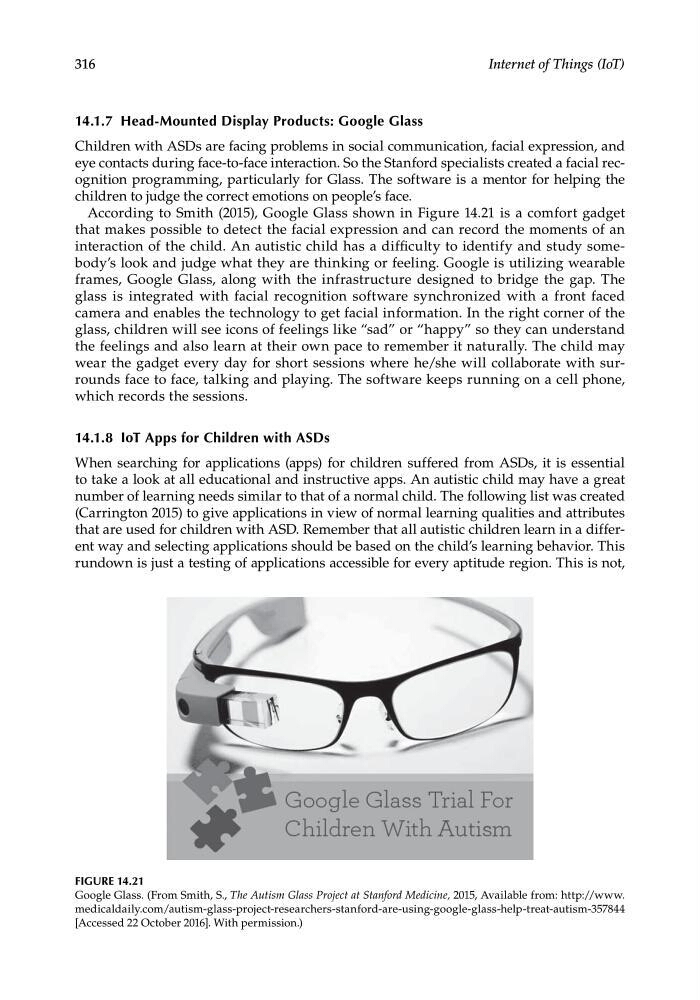
According to Smith (2015), Google Glass shown in Figure 14.21 is a comfort gadget
that makes possible to detect the facial expression and can record the moments of an
interaction of the child. An autistic child has a difficulty to identify and study somebody’s look and judge what they are thinking or feeling. Google is utilizing wearable
frames, Google Glass, along with the infrastructure designed to bridge the gap. The
glass is integrated with facial recognition software synchronized with a front faced
camera and enables the technology to get facial information. In the right corner of the
glass, children will see icons of feelings like “sad” or “happy” so they can understand
the feelings and also learn at their own pace to remember it naturally. The child may
wear the gadget every day for short sessions where he/she will collaborate with surrounds face to face, talking and playing. The software keeps running on a cell phone,
which records the sessions.
14.1.8 IoT Apps for Children with ASDs
When searching for applications (apps) for children suffered from ASDs, it is essential
to take a look at all educational and instructive apps. An autistic child may have a great
number of learning needs similar to that of a normal child. The following list was created
(Carrington 2015) to give applications in view of normal learning qualities and attributes
that are used for children with ASD. Remember that all autistic children learn in a different way and selecting applications should be based on the child’s learning behavior. This
rundown is just a testing of applications accessible for every aptitude region. This is not,
FIGURE 14.21
Google Glass. (From Smith, S., The Autism Glass Project at Stanford Medicine, 2015, Available from: http://www.
medicaldaily.com/autism-glass-project-researchers-stanford-are-using-google-glass-help-treat-autism-357844
[Accessed 22 October 2016]. With permission.)
Internet of Things (IoT)
14.1.7 Head-Mounted Display Products: Google Glass
Children with ASDs are facing problems in social communication, facial expression, and
eye contacts during face-to-face interaction. So the Stanford specialists created a facial recognition programming, particularly for Glass. The software is a mentor for helping the
children to judge the correct emotions on people’s face.
According to Smith (2015), Google Glass shown in Figure 14.21 is a comfort gadget
that makes possible to detect the facial expression and can record the moments of an
interaction of the child. An autistic child has a difficulty to identify and study somebody’s look and judge what they are thinking or feeling. Google is utilizing wearable
frames, Google Glass, along with the infrastructure designed to bridge the gap. The
glass is integrated with facial recognition software synchronized with a front faced
camera and enables the technology to get facial information. In the right corner of the
glass, children will see icons of feelings like “sad” or “happy” so they can understand
the feelings and also learn at their own pace to remember it naturally. The child may
wear the gadget every day for short sessions where he/she will collaborate with surrounds face to face, talking and playing. The software keeps running on a cell phone,
which records the sessions.
14.1.8 IoT Apps for Children with ASDs
When searching for applications (apps) for children suffered from ASDs, it is essential
to take a look at all educational and instructive apps. An autistic child may have a great
number of learning needs similar to that of a normal child. The following list was created
(Carrington 2015) to give applications in view of normal learning qualities and attributes
that are used for children with ASD. Remember that all autistic children learn in a different way and selecting applications should be based on the child’s learning behavior. This
rundown is just a testing of applications accessible for every aptitude region. This is not,
FIGURE 14.21
Google Glass. (From Smith, S., The Autism Glass Project at Stanford Medicine, 2015, Available from: http://www.
medicaldaily.com/autism-glass-project-researchers-stanford-are-using-google-glass-help-treat-autism-357844
[Accessed 22 October 2016]. With permission.)