

7
IoT-Enabled Vision System for Detection of Tint Level
other is foreground image which is represented as “Fg” and its intensity value Fg(p) is also
mapped in Z 2 plane at p = (Px, Py). The mapping of both images is the same because they
have the same property.
1.4.1 Noise Removal
Most of the dynamic scenes exhibit persistent motion characteristics. Therefore, in order to
reduce noise, image must be preprocessed with an appropriate filter. In our case, we used
Gaussian kernel filter. Gaussian filtering is done by convolving each point in the input
array with a Gaussian kernel and then summing them all to produce the output array.
Gaussian kernel for N (N = 1, 2, 3,…) dimension is given by
;
1
2
ND
2
2
2
G
x
e
N
x
)
(
)
( σ =
πσ
− σ
(1.1)
Here, σ determines the width of the Gaussian kernel. In statistics, when we consider the
Gaussian probability density function, it is called the standard deviation, and the square
of it namely, σ 2 , is called the variance. The normalized Gaussian kernel has an area under
the curve of unity, that is, as a filter it does not multiply the operand with an accidental
multiplication factor.
The output of Gaussian filter is converted to a format (image format) which is easy
to process. For this purpose, we use gray-scale range of shades wherein the darkest
possible shade is black, which is the total absence of transmitted or reflected light and
the lightest possible shade is white, which has the total transmission or reflection of
light at all visible wavelengths. Intermediate shades of gray are represented by equal
Start
Foreground image (Fg)
Apply filter
Color to gray conversion
Hist equalization
Bg(p) – Fg(p)
>thresh
Fg(p) = 255
Fg(p) = 0
Bg(p) = Fg(p)
Bg(p) > Fg(p)
Bg(p) – 1
Bg(p) + 1
Next
Background
image (Bg)
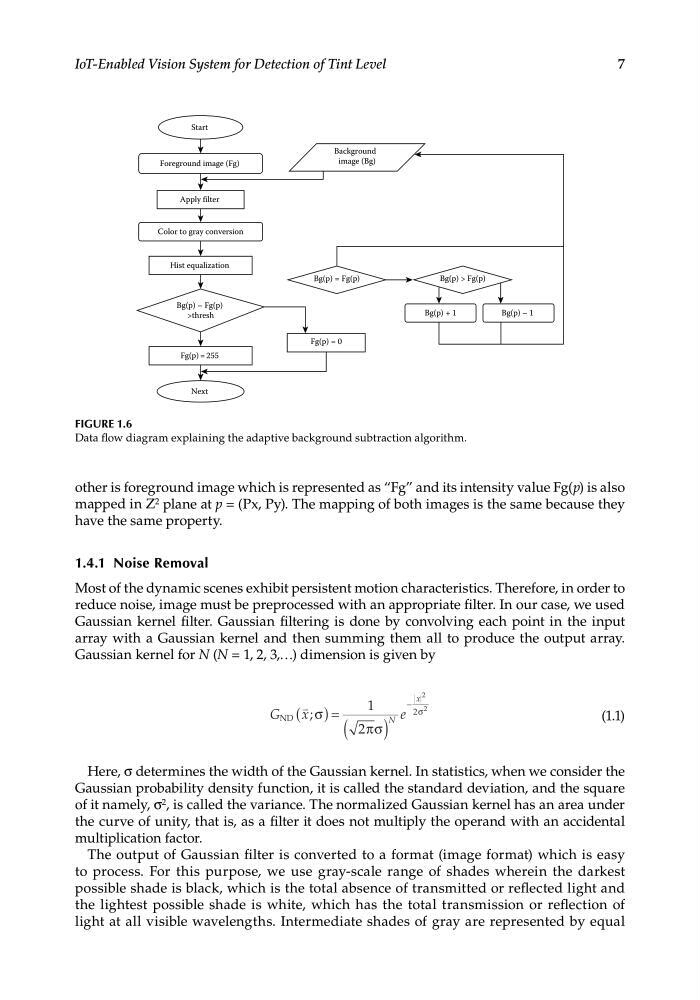
FIGURE 1.6
Data flow diagram explaining the adaptive background subtraction algorithm.
IoT-Enabled Vision System for Detection of Tint Level
other is foreground image which is represented as “Fg” and its intensity value Fg(p) is also
mapped in Z 2 plane at p = (Px, Py). The mapping of both images is the same because they
have the same property.
1.4.1 Noise Removal
Most of the dynamic scenes exhibit persistent motion characteristics. Therefore, in order to
reduce noise, image must be preprocessed with an appropriate filter. In our case, we used
Gaussian kernel filter. Gaussian filtering is done by convolving each point in the input
array with a Gaussian kernel and then summing them all to produce the output array.
Gaussian kernel for N (N = 1, 2, 3,…) dimension is given by
;
1
2
ND
2
2
2
G
x
e
N
x
)
(
)
( σ =
πσ
− σ
(1.1)
Here, σ determines the width of the Gaussian kernel. In statistics, when we consider the
Gaussian probability density function, it is called the standard deviation, and the square
of it namely, σ 2 , is called the variance. The normalized Gaussian kernel has an area under
the curve of unity, that is, as a filter it does not multiply the operand with an accidental
multiplication factor.
The output of Gaussian filter is converted to a format (image format) which is easy
to process. For this purpose, we use gray-scale range of shades wherein the darkest
possible shade is black, which is the total absence of transmitted or reflected light and
the lightest possible shade is white, which has the total transmission or reflection of
light at all visible wavelengths. Intermediate shades of gray are represented by equal
Start
Foreground image (Fg)
Apply filter
Color to gray conversion
Hist equalization
Bg(p) – Fg(p)
>thresh
Fg(p) = 255
Fg(p) = 0
Bg(p) = Fg(p)
Bg(p) > Fg(p)
Bg(p) – 1
Bg(p) + 1
Next
Background
image (Bg)
FIGURE 1.6
Data flow diagram explaining the adaptive background subtraction algorithm.