

279
Semantic Technologies for IoT
unleash it as “Linked Sensor Data.” Ontologies and alternative semantic technologies are
often key enabling technologies for sensor networks, as they facilitate semantic interoperability and integration, reasoning, classification, different kinds of assurance, and automation not addressed within the OGC standards. A Semantic Sensor Network has to be
organized, installed and managed, queried, understood, and controlled through highlevel specifications. Further, when reasoning regarding sensors, complicated physical constraints like restricted power availability, restricted memory, variable information quality,
and loose connectivity ought to be taken into consideration. Once these constraints are
formally depicted in an ontology, reasoning techniques are more readily applied and utilized. They enable classification and reasoning on the capabilities and measurements of
sensors, the origin of measurements, and also the association of a variety of sensors as a
macro instrument. Following W3C recommendation, OWL 2 dl is the designated language
for ontology specification. There are excellent sensor ontologies, few of which are coupled
with one another and are obtainable online. The sensor ontologies, to some extent, reflect
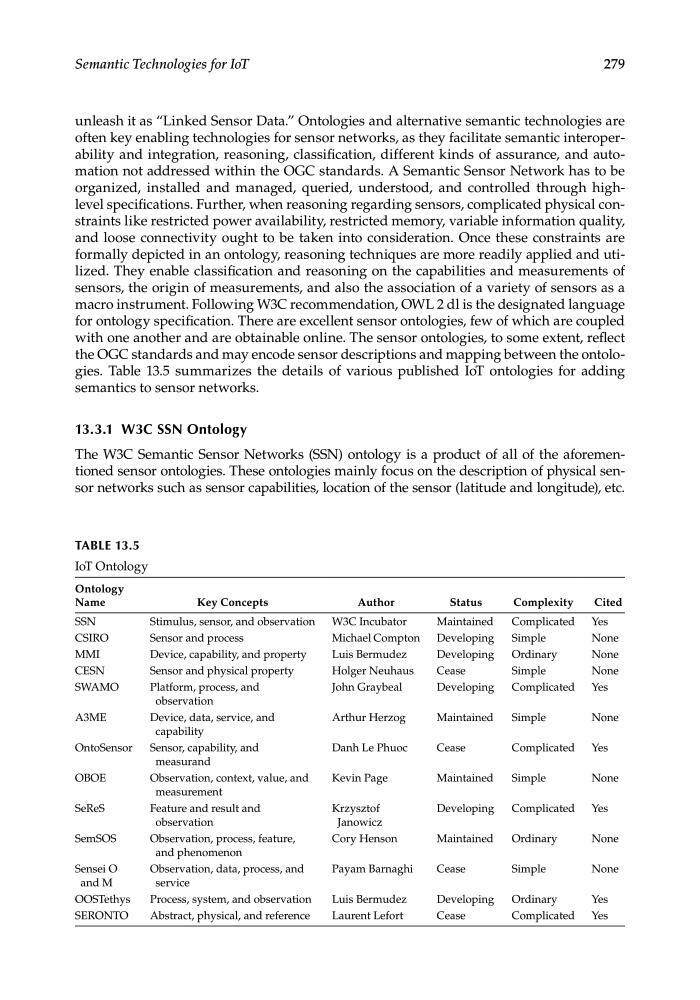
the OGC standards and may encode sensor descriptions and mapping between the ontologies. Table 13.5 summarizes the details of various published IoT ontologies for adding
semantics to sensor networks.
13.3.1 W3C SSN Ontology
The W3C Semantic Sensor Networks (SSN) ontology is a product of all of the aforementioned sensor ontologies. These ontologies mainly focus on the description of physical sensor networks such as sensor capabilities, location of the sensor (latitude and longitude), etc.
TABLE 13.5
IoT Ontology
Ontology
Name
Key Concepts
Author
Status
Complexity
Cited
SSN
Stimulus, sensor, and observation
W3C Incubator
Maintained
Complicated
Yes
CSIRO
Sensor and process
Michael Compton
Developing
Simple
None
MMI
Device, capability, and property
Luis Bermudez
Developing
Ordinary
None
CESN
Sensor and physical property
Holger Neuhaus
Cease
Simple
None
SWAMO
Platform, process, and
observation
John Graybeal
Developing
Complicated
Yes
A3ME
Device, data, service, and
capability
Arthur Herzog
Maintained
Simple
None
OntoSensor
Sensor, capability, and
measurand
Danh Le Phuoc
Cease
Complicated
Yes
OBOE
Observation, context, value, and
measurement
Kevin Page
Maintained
Simple
None
SeReS
Feature and result and
observation
Krzysztof
Janowicz
Developing
Complicated
Yes
SemSOS
Observation, process, feature,
and phenomenon
Cory Henson
Maintained
Ordinary
None
Sensei O
and M
Observation, data, process, and
service
Payam Barnaghi
Cease
Simple
None
OOSTethys
Process, system, and observation
Luis Bermudez
Developing
Ordinary
Yes
SERONTO
Abstract, physical, and reference
Laurent Lefort
Cease
Complicated
Yes
Semantic Technologies for IoT
unleash it as “Linked Sensor Data.” Ontologies and alternative semantic technologies are
often key enabling technologies for sensor networks, as they facilitate semantic interoperability and integration, reasoning, classification, different kinds of assurance, and automation not addressed within the OGC standards. A Semantic Sensor Network has to be
organized, installed and managed, queried, understood, and controlled through highlevel specifications. Further, when reasoning regarding sensors, complicated physical constraints like restricted power availability, restricted memory, variable information quality,
and loose connectivity ought to be taken into consideration. Once these constraints are
formally depicted in an ontology, reasoning techniques are more readily applied and utilized. They enable classification and reasoning on the capabilities and measurements of
sensors, the origin of measurements, and also the association of a variety of sensors as a
macro instrument. Following W3C recommendation, OWL 2 dl is the designated language
for ontology specification. There are excellent sensor ontologies, few of which are coupled
with one another and are obtainable online. The sensor ontologies, to some extent, reflect
the OGC standards and may encode sensor descriptions and mapping between the ontologies. Table 13.5 summarizes the details of various published IoT ontologies for adding
semantics to sensor networks.
13.3.1 W3C SSN Ontology
The W3C Semantic Sensor Networks (SSN) ontology is a product of all of the aforementioned sensor ontologies. These ontologies mainly focus on the description of physical sensor networks such as sensor capabilities, location of the sensor (latitude and longitude), etc.
TABLE 13.5
IoT Ontology
Ontology
Name
Key Concepts
Author
Status
Complexity
Cited
SSN
Stimulus, sensor, and observation
W3C Incubator
Maintained
Complicated
Yes
CSIRO
Sensor and process
Michael Compton
Developing
Simple
None
MMI
Device, capability, and property
Luis Bermudez
Developing
Ordinary
None
CESN
Sensor and physical property
Holger Neuhaus
Cease
Simple
None
SWAMO
Platform, process, and
observation
John Graybeal
Developing
Complicated
Yes
A3ME
Device, data, service, and
capability
Arthur Herzog
Maintained
Simple
None
OntoSensor
Sensor, capability, and
measurand
Danh Le Phuoc
Cease
Complicated
Yes
OBOE
Observation, context, value, and
measurement
Kevin Page
Maintained
Simple
None
SeReS
Feature and result and
observation
Krzysztof
Janowicz
Developing
Complicated
Yes
SemSOS
Observation, process, feature,
and phenomenon
Cory Henson
Maintained
Ordinary
None
Sensei O
and M
Observation, data, process, and
service
Payam Barnaghi
Cease
Simple
None
OOSTethys
Process, system, and observation
Luis Bermudez
Developing
Ordinary
Yes
SERONTO
Abstract, physical, and reference
Laurent Lefort
Cease
Complicated
Yes