

274
Internet of Things (IoT)
13.2.2 RDF Schema
RDF Schema is a semantic extension of RDF. RDF Schema is abbreviated in different ways
as RDFS, RDF(S), RDF-S, or RDF/S. RDFS provides a data-modeling vocabulary for RDF
data. It provides a way for describing groups of resources and the relationships between
these resources. These resources can be used to determine characteristics of other resources
such as the domains and ranges of properties.
RDFS uses the class to identify groups, and it can be used to group the resources.
The relationship between an individual and its class is represented by using property.
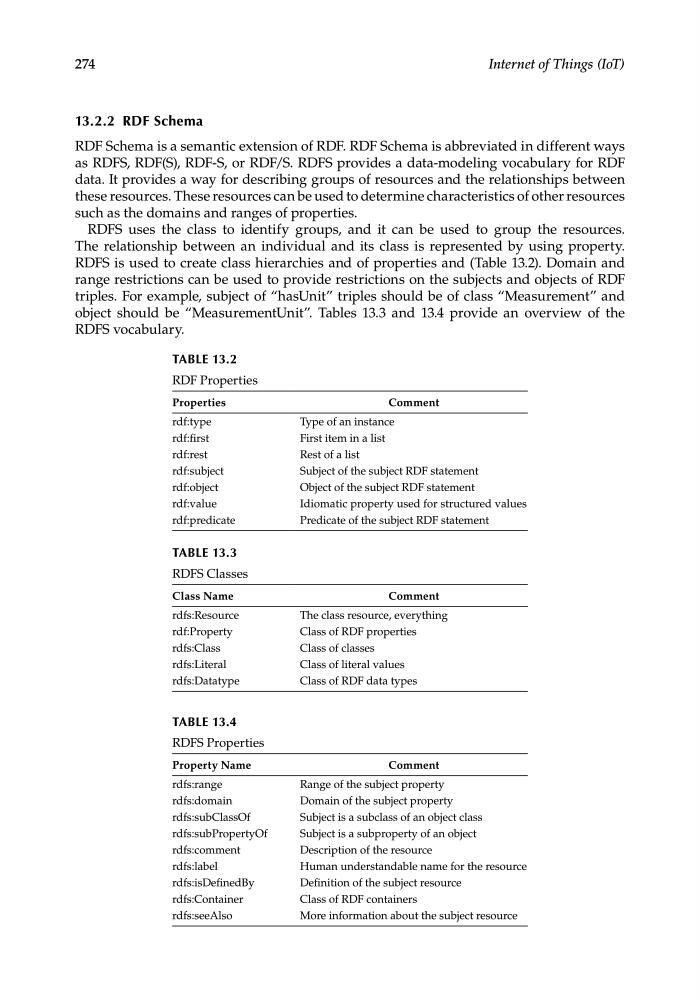
RDFS is used to create class hierarchies and of properties and (Table 13.2). Domain and
range restrictions can be used to provide restrictions on the subjects and objects of RDF
triples. For example, subject of “hasUnit” triples should be of class “Measurement” and
object should be “MeasurementUnit”. Tables 13.3 and 13.4 provide an overview of the
RDFS vocabulary.
TABLE 13.3
RDFS Classes
Class Name
Comment
rdfs:Resource
The class resource, everything
rdf:Property
Class of RDF properties
rdfs:Class
Class of classes
rdfs:Literal
Class of literal values
rdfs:Datatype
Class of RDF data types
TABLE 13.4
RDFS Properties
Property Name
Comment
rdfs:range
Range of the subject property
rdfs:domain
Domain of the subject property
rdfs:subClassOf
Subject is a subclass of an object class
rdfs:subPropertyOf
Subject is a subproperty of an object
rdfs:comment
Description of the resource
rdfs:label
Human understandable name for the resource
rdfs:isDefinedBy
Definition of the subject resource
rdfs:Container
Class of RDF containers
rdfs:seeAlso
More information about the subject resource
TABLE 13.2
RDF Properties
Properties
Comment
rdf:type
Type of an instance
rdf:first
First item in a list
rdf:rest
Rest of a list
rdf:subject
Subject of the subject RDF statement
rdf:object
Object of the subject RDF statement
rdf:value
Idiomatic property used for structured values
rdf:predicate
Predicate of the subject RDF statement
Internet of Things (IoT)
13.2.2 RDF Schema
RDF Schema is a semantic extension of RDF. RDF Schema is abbreviated in different ways
as RDFS, RDF(S), RDF-S, or RDF/S. RDFS provides a data-modeling vocabulary for RDF
data. It provides a way for describing groups of resources and the relationships between
these resources. These resources can be used to determine characteristics of other resources
such as the domains and ranges of properties.
RDFS uses the class to identify groups, and it can be used to group the resources.
The relationship between an individual and its class is represented by using property.
RDFS is used to create class hierarchies and of properties and (Table 13.2). Domain and
range restrictions can be used to provide restrictions on the subjects and objects of RDF
triples. For example, subject of “hasUnit” triples should be of class “Measurement” and
object should be “MeasurementUnit”. Tables 13.3 and 13.4 provide an overview of the
RDFS vocabulary.
TABLE 13.3
RDFS Classes
Class Name
Comment
rdfs:Resource
The class resource, everything
rdf:Property
Class of RDF properties
rdfs:Class
Class of classes
rdfs:Literal
Class of literal values
rdfs:Datatype
Class of RDF data types
TABLE 13.4
RDFS Properties
Property Name
Comment
rdfs:range
Range of the subject property
rdfs:domain
Domain of the subject property
rdfs:subClassOf
Subject is a subclass of an object class
rdfs:subPropertyOf
Subject is a subproperty of an object
rdfs:comment
Description of the resource
rdfs:label
Human understandable name for the resource
rdfs:isDefinedBy
Definition of the subject resource
rdfs:Container
Class of RDF containers
rdfs:seeAlso
More information about the subject resource
TABLE 13.2
RDF Properties
Properties
Comment
rdf:type
Type of an instance
rdf:first
First item in a list
rdf:rest
Rest of a list
rdf:subject
Subject of the subject RDF statement
rdf:object
Object of the subject RDF statement
rdf:value
Idiomatic property used for structured values
rdf:predicate
Predicate of the subject RDF statement