

4
Internet of Things (IoT)
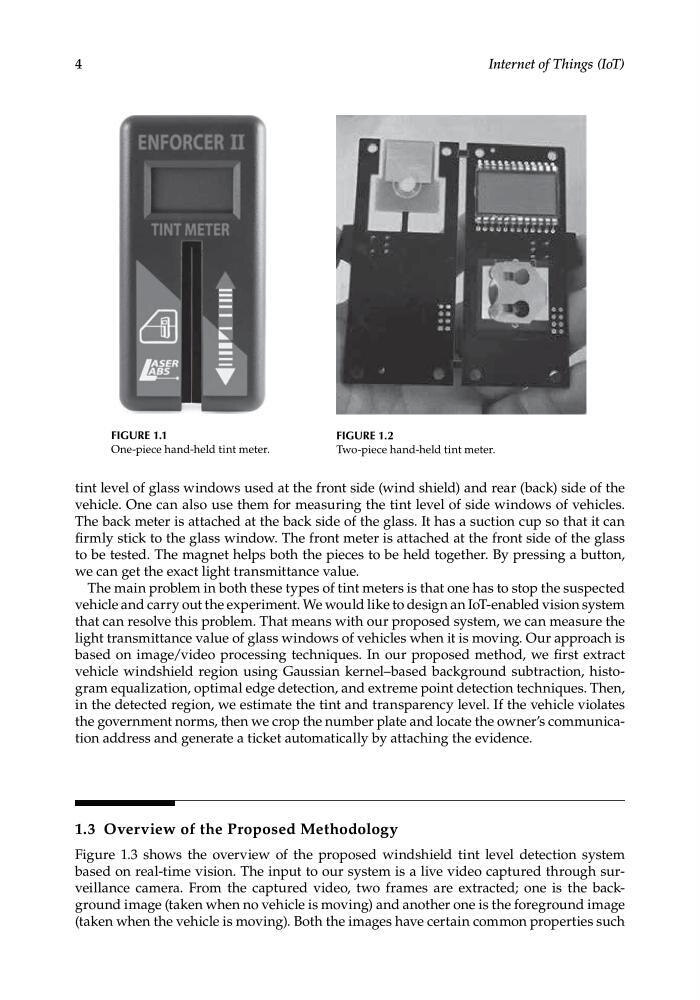
tint level of glass windows used at the front side (wind shield) and rear (back) side of the
vehicle. One can also use them for measuring the tint level of side windows of vehicles.
The back meter is attached at the back side of the glass. It has a suction cup so that it can
firmly stick to the glass window. The front meter is attached at the front side of the glass
to be tested. The magnet helps both the pieces to be held together. By pressing a button,
we can get the exact light transmittance value.
The main problem in both these types of tint meters is that one has to stop the suspected
vehicle and carry out the experiment. We would like to design an IoT-enabled vision system
that can resolve this problem. That means with our proposed system, we can measure the
light transmittance value of glass windows of vehicles when it is moving. Our approach is
based on image/video processing techniques. In our proposed method, we first extract
vehicle windshield region using Gaussian kernel–based background subtraction, histogram equalization, optimal edge detection, and extreme point detection techniques. Then,
in the detected region, we estimate the tint and transparency level. If the vehicle violates
the government norms, then we crop the number plate and locate the owner’s communication address and generate a ticket automatically by attaching the evidence.
1.3 Overview of the Proposed Methodology
Figure 1.3 shows the overview of the proposed windshield tint level detection system
based on real-time vision. The input to our system is a live video captured through surveillance camera. From the captured video, two frames are extracted; one is the background image (taken when no vehicle is moving) and another one is the foreground image
(taken when the vehicle is moving). Both the images have certain common properties such
FIGURE 1.2
Two-piece hand-held tint meter.
FIGURE 1.1
One-piece hand-held tint meter.
Internet of Things (IoT)
tint level of glass windows used at the front side (wind shield) and rear (back) side of the
vehicle. One can also use them for measuring the tint level of side windows of vehicles.
The back meter is attached at the back side of the glass. It has a suction cup so that it can
firmly stick to the glass window. The front meter is attached at the front side of the glass
to be tested. The magnet helps both the pieces to be held together. By pressing a button,
we can get the exact light transmittance value.
The main problem in both these types of tint meters is that one has to stop the suspected
vehicle and carry out the experiment. We would like to design an IoT-enabled vision system
that can resolve this problem. That means with our proposed system, we can measure the
light transmittance value of glass windows of vehicles when it is moving. Our approach is
based on image/video processing techniques. In our proposed method, we first extract
vehicle windshield region using Gaussian kernel–based background subtraction, histogram equalization, optimal edge detection, and extreme point detection techniques. Then,
in the detected region, we estimate the tint and transparency level. If the vehicle violates
the government norms, then we crop the number plate and locate the owner’s communication address and generate a ticket automatically by attaching the evidence.
1.3 Overview of the Proposed Methodology
Figure 1.3 shows the overview of the proposed windshield tint level detection system
based on real-time vision. The input to our system is a live video captured through surveillance camera. From the captured video, two frames are extracted; one is the background image (taken when no vehicle is moving) and another one is the foreground image
(taken when the vehicle is moving). Both the images have certain common properties such
FIGURE 1.2
Two-piece hand-held tint meter.
FIGURE 1.1
One-piece hand-held tint meter.