

260
Internet of Things (IoT)
individual or small group of physicians to acquire and adopt these systems
(Castillo et al. 2010).
14. Access to computers and computer literacy: The low level of electronic medical records
system use could be explained by a lack of available computers (Ross 2009).
15. Vendor trust: Physicians are concerned that vendors are not qualified to provide a proper service, or will go out of business and disappear from the market,
leading to a lack of technical support and a large financial loss (Boonstra and
Broekhuis 2010).
16. Expert support: Expert support refers to the assistance provided from a physician to
another physician. This can be divided in two aspects: (1) a physician with experience in EHRs usage assists with information about how to use the system to
another physician; (2) a physician has the knowledge to help another physician
accomplish a medical task. Such assistance can be given through personal contact
or via documents (Castillo et al. 2010).
17. Concern about data entry: Family physicians are sought after for their counseling
abilities. Time taken to make data entry is the largest potential obstacle to the
effective use of computers in family medicine (ibid).
18. Reliability: Reliability refers to the dependability of the technology systems that
comprise the EHR. As more vendors enter the lucrative healthcare market, the
number of competing systems will increase. Vendors will seek to differentiate
themselves from competitors using quality and reliability of their EHR systems as
evidence of their superiority (Rao et al. 2011).
19. Inadequate data exchange: Data are generated from physicians, pharmacy, lab, radiology, and referral to other hospitals. From patient point of view, policies should
hasten the creation of community-wide data exchange systems that allow clinicians to view all of their patients’ data, regardless of provider and care site (Meinert
2004).
20. Concern about patient acceptance: Physicians would spend more time interacting
with the computer than the patient (Ajami et al. 2011). This need not be so always.
With experience it will disappear.
21. Formal training: Physician style of learning and his/her clinical needs have to be
taken into account in training (Ford et al. 2006).
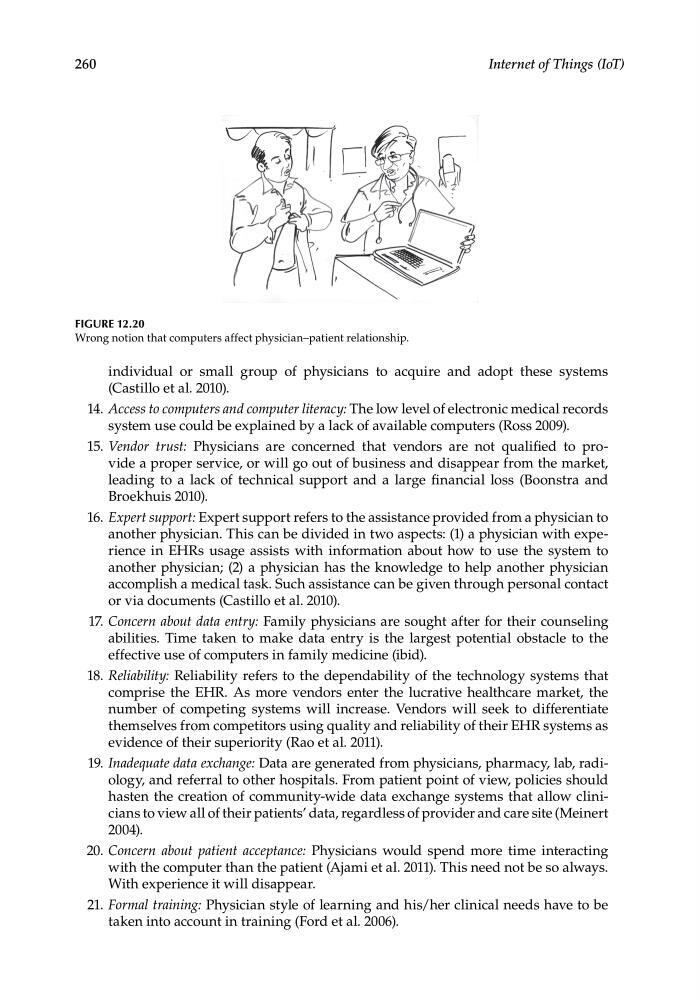
FIGURE 12.20
Wrong notion that computers affect physician–patient relationship.
Internet of Things (IoT)
individual or small group of physicians to acquire and adopt these systems
(Castillo et al. 2010).
14. Access to computers and computer literacy: The low level of electronic medical records
system use could be explained by a lack of available computers (Ross 2009).
15. Vendor trust: Physicians are concerned that vendors are not qualified to provide a proper service, or will go out of business and disappear from the market,
leading to a lack of technical support and a large financial loss (Boonstra and
Broekhuis 2010).
16. Expert support: Expert support refers to the assistance provided from a physician to
another physician. This can be divided in two aspects: (1) a physician with experience in EHRs usage assists with information about how to use the system to
another physician; (2) a physician has the knowledge to help another physician
accomplish a medical task. Such assistance can be given through personal contact
or via documents (Castillo et al. 2010).
17. Concern about data entry: Family physicians are sought after for their counseling
abilities. Time taken to make data entry is the largest potential obstacle to the
effective use of computers in family medicine (ibid).
18. Reliability: Reliability refers to the dependability of the technology systems that
comprise the EHR. As more vendors enter the lucrative healthcare market, the
number of competing systems will increase. Vendors will seek to differentiate
themselves from competitors using quality and reliability of their EHR systems as
evidence of their superiority (Rao et al. 2011).
19. Inadequate data exchange: Data are generated from physicians, pharmacy, lab, radiology, and referral to other hospitals. From patient point of view, policies should
hasten the creation of community-wide data exchange systems that allow clinicians to view all of their patients’ data, regardless of provider and care site (Meinert
2004).
20. Concern about patient acceptance: Physicians would spend more time interacting
with the computer than the patient (Ajami et al. 2011). This need not be so always.
With experience it will disappear.
21. Formal training: Physician style of learning and his/her clinical needs have to be
taken into account in training (Ford et al. 2006).
FIGURE 12.20
Wrong notion that computers affect physician–patient relationship.