

237
Non-Physician Primary Healthcare Workers
12.1.2 Control of Communicable Diseases with Environment
Manipulation and Anti-Microbials
The day we started to understand that the disease has a relationship with hygiene, toilets
were invented, antibiotics followed, vaccines were developed, etc. New way of healthcare
delivery became prominent over all the existing practices, which in many circumstances
were not scientific. In 1824, first public toilets were introduced in Paris. Subsequent decades
saw the birth of epidemiology, which proved the relationship of all diseases is with the
environment.
Eradication of infectious diseases became easy as we understood the bacteria and virus
more and more. Antibiotics and painkillers changed the very practice of medicine, by
providing more ammunition in the physician’s bag. Of course the science of medicine further progressed in the area of surgical treatment and issues related to child birth. All
these contributed to the extension of human life by 30 years. But any further improvement
in longevity and quality of human life is becoming a bigger question and certainly not
possible in the near future. The life-span extension has been achieved by only curtailing
the communicable diseases, and controlling the contribution by non-communicable diseases was virtually nil. Chronic diseases like diabetes, cardiac issues, neurological issues,
psychology, oncology, etc., which are popularly called lifestyle diseases of the twentieth
century, have to be controlled to improve the quality of life.
12.1.3 Matching Health Budget to Disease Levels—Neither Possible nor Necessary
In India there are around 14,00,000 hospital beds and we need 2.5 times more beds to meet
world average and at least 20 times to meet Japan’s standards. The average cost of creating
a hospital bed is approximately Rs. 50 lakhs [24], including the infrastructure and optimal equipments inventory. That works out an investment of Rs 60,000 crores each year
for the next 20 years [25]. Current healthcare budget by government is Rs 30,000 crores,
which itself is few times more than previous years. This being the case, investment for
constructing the hospital beds looks practically impossible for now. We need alternative
technology in place [26]. Although we need physicians and hospitals in place immediately,
we neither have time or money waiting for. Fortunately, we have 106 crore cell phone connections [27] for 74 crore adults (aged between 15 and 64 years) [28]. There are 46 crore
internet users, and this is growing at 30 to 50% every year [29]. We have 1.4 cell phones per
adult and 0.6 internet connection per adult. By 2020 India will have one internet connection per each adult [30]. All these happen without any investment from the health budget.
Monitoring the health can be done with right application, right platform, along with the right IoT
sensors connected to the experienced and sophisticated regional tertiary healthcare centers.
Disease
Host
E n v i r o n m
e n t
P a t h o g e n
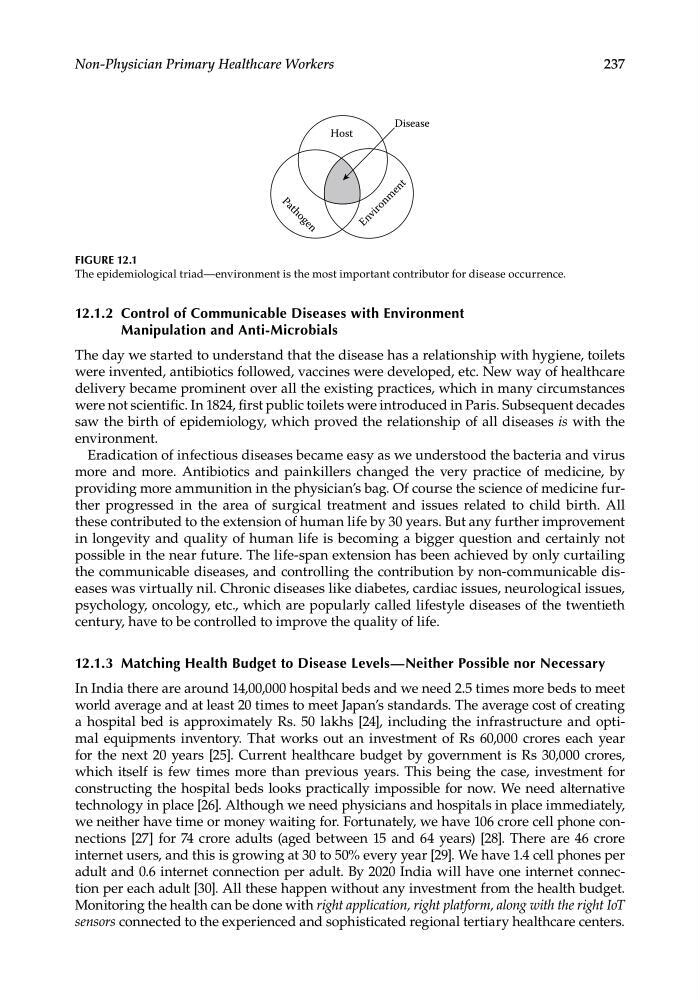
FIGURE 12.1
The epidemiological triad—environment is the most important contributor for disease occurrence.
Non-Physician Primary Healthcare Workers
12.1.2 Control of Communicable Diseases with Environment
Manipulation and Anti-Microbials
The day we started to understand that the disease has a relationship with hygiene, toilets
were invented, antibiotics followed, vaccines were developed, etc. New way of healthcare
delivery became prominent over all the existing practices, which in many circumstances
were not scientific. In 1824, first public toilets were introduced in Paris. Subsequent decades
saw the birth of epidemiology, which proved the relationship of all diseases is with the
environment.
Eradication of infectious diseases became easy as we understood the bacteria and virus
more and more. Antibiotics and painkillers changed the very practice of medicine, by
providing more ammunition in the physician’s bag. Of course the science of medicine further progressed in the area of surgical treatment and issues related to child birth. All
these contributed to the extension of human life by 30 years. But any further improvement
in longevity and quality of human life is becoming a bigger question and certainly not
possible in the near future. The life-span extension has been achieved by only curtailing
the communicable diseases, and controlling the contribution by non-communicable diseases was virtually nil. Chronic diseases like diabetes, cardiac issues, neurological issues,
psychology, oncology, etc., which are popularly called lifestyle diseases of the twentieth
century, have to be controlled to improve the quality of life.
12.1.3 Matching Health Budget to Disease Levels—Neither Possible nor Necessary
In India there are around 14,00,000 hospital beds and we need 2.5 times more beds to meet
world average and at least 20 times to meet Japan’s standards. The average cost of creating
a hospital bed is approximately Rs. 50 lakhs [24], including the infrastructure and optimal equipments inventory. That works out an investment of Rs 60,000 crores each year
for the next 20 years [25]. Current healthcare budget by government is Rs 30,000 crores,
which itself is few times more than previous years. This being the case, investment for
constructing the hospital beds looks practically impossible for now. We need alternative
technology in place [26]. Although we need physicians and hospitals in place immediately,
we neither have time or money waiting for. Fortunately, we have 106 crore cell phone connections [27] for 74 crore adults (aged between 15 and 64 years) [28]. There are 46 crore
internet users, and this is growing at 30 to 50% every year [29]. We have 1.4 cell phones per
adult and 0.6 internet connection per adult. By 2020 India will have one internet connection per each adult [30]. All these happen without any investment from the health budget.
Monitoring the health can be done with right application, right platform, along with the right IoT
sensors connected to the experienced and sophisticated regional tertiary healthcare centers.
Disease
Host
E n v i r o n m
e n t
P a t h o g e n
FIGURE 12.1
The epidemiological triad—environment is the most important contributor for disease occurrence.