

218
Internet of Things (IoT)
Whitelisting is the pre-acceptance of the favorable and source instead of the denial of a
pernicious one. Although there are some applications are derived from some new applications which that give rise to new applications which make it impracticable to detect
by the whitelisting due to the lack of knowledge of dealing with it and its absence in the
whitelisting database. In that case, the whitelisting would trust the application if it was
originated and promoted by a trustworthy and reliable source, and it would be categorized as trusted. This technique is termed as “Trust Chain” (https://blog.kaspersky.com/
wonders-of-whitelisting/6367/). There are certain variations in the algorithms blacklisting
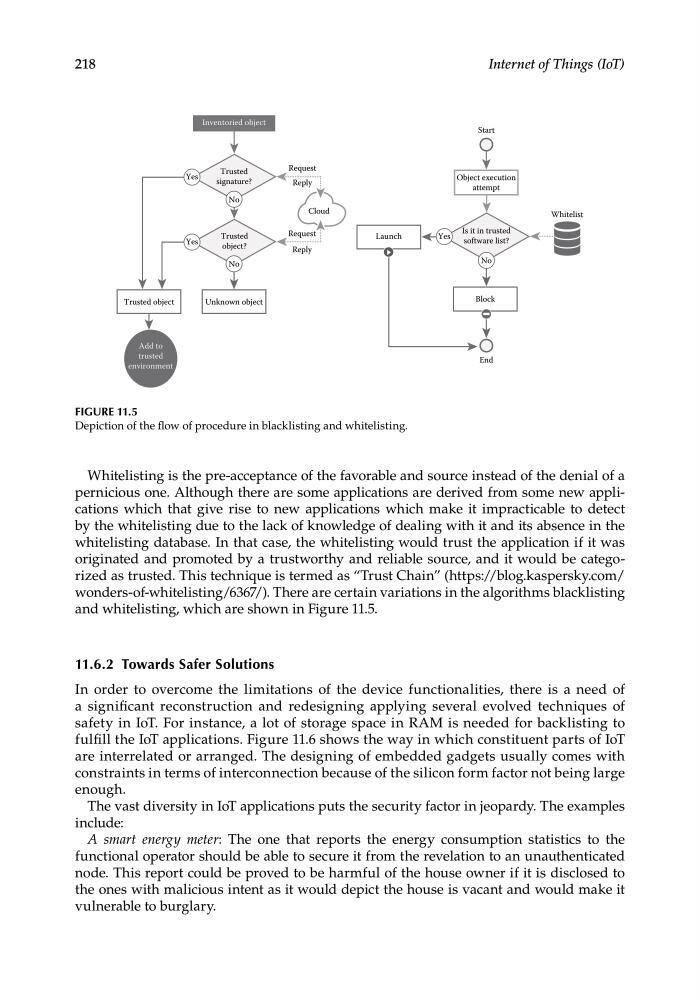
and whitelisting, which are shown in Figure 11.5.
11.6.2 Towards Safer Solutions
In order to overcome the limitations of the device functionalities, there is a need of
a significant reconstruction and redesigning applying several evolved techniques of
safety in IoT. For instance, a lot of storage space in RAM is needed for backlisting to
fulfill the IoT applications. Figure 11.6 shows the way in which constituent parts of IoT
are interrelated or arranged. The designing of embedded gadgets usually comes with
constraints in terms of interconnection because of the silicon form factor not being large
enough.
The vast diversity in IoT applications puts the security factor in jeopardy. The examples
include:
A smart energy meter: The one that reports the energy consumption statistics to the
functional operator should be able to secure it from the revelation to an unauthenticated
node. This report could be proved to be harmful of the house owner if it is disclosed to
the ones with malicious intent as it would depict the house is vacant and would make it
vulnerable to burglary.
Request
Reply
Request
Reply
Trusted
signature?
Inventoried object
Trusted
object?
Yes
Yes
No
No
Yes
No
End
Start
Object execution
attempt
Is it in trusted
software list?
Cloud
Launch
Trusted object
Add to
trusted
environment
Whitelist
Block
Unknown object
FIGURE 11.5
Depiction of the flow of procedure in blacklisting and whitelisting.
Internet of Things (IoT)
Whitelisting is the pre-acceptance of the favorable and source instead of the denial of a
pernicious one. Although there are some applications are derived from some new applications which that give rise to new applications which make it impracticable to detect
by the whitelisting due to the lack of knowledge of dealing with it and its absence in the
whitelisting database. In that case, the whitelisting would trust the application if it was
originated and promoted by a trustworthy and reliable source, and it would be categorized as trusted. This technique is termed as “Trust Chain” (https://blog.kaspersky.com/
wonders-of-whitelisting/6367/). There are certain variations in the algorithms blacklisting
and whitelisting, which are shown in Figure 11.5.
11.6.2 Towards Safer Solutions
In order to overcome the limitations of the device functionalities, there is a need of
a significant reconstruction and redesigning applying several evolved techniques of
safety in IoT. For instance, a lot of storage space in RAM is needed for backlisting to
fulfill the IoT applications. Figure 11.6 shows the way in which constituent parts of IoT
are interrelated or arranged. The designing of embedded gadgets usually comes with
constraints in terms of interconnection because of the silicon form factor not being large
enough.
The vast diversity in IoT applications puts the security factor in jeopardy. The examples
include:
A smart energy meter: The one that reports the energy consumption statistics to the
functional operator should be able to secure it from the revelation to an unauthenticated
node. This report could be proved to be harmful of the house owner if it is disclosed to
the ones with malicious intent as it would depict the house is vacant and would make it
vulnerable to burglary.
Request
Reply
Request
Reply
Trusted
signature?
Inventoried object
Trusted
object?
Yes
Yes
No
No
Yes
No
End
Start
Object execution
attempt
Is it in trusted
software list?
Cloud
Launch
Trusted object
Add to
trusted
environment
Whitelist
Block
Unknown object
FIGURE 11.5
Depiction of the flow of procedure in blacklisting and whitelisting.