

199
Review on Communication Security Issues in IoT Medical Devices
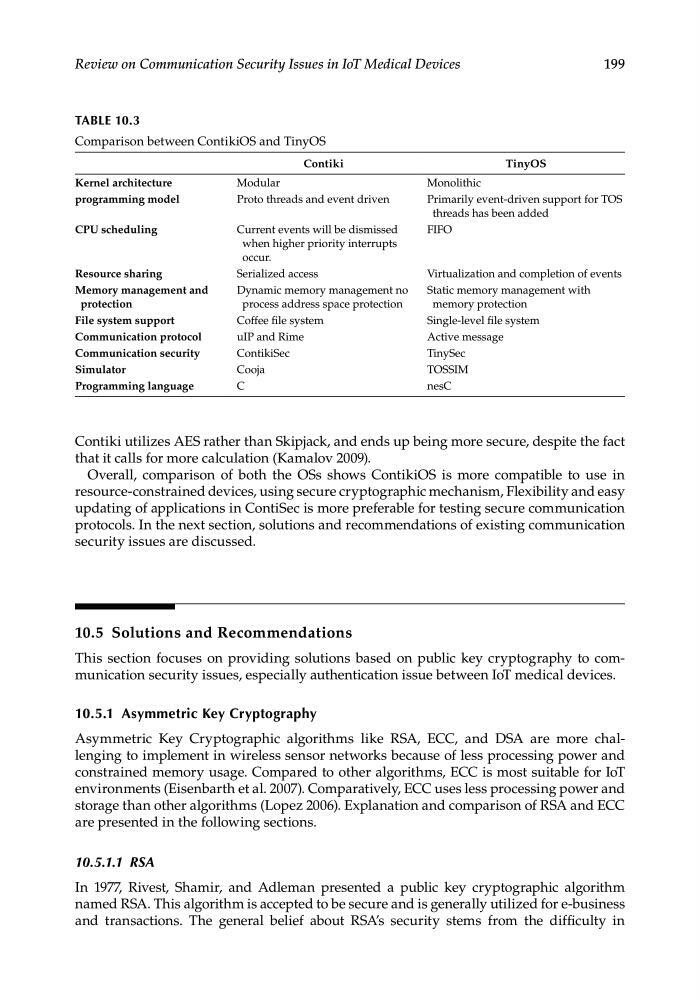
Contiki utilizes AES rather than Skipjack, and ends up being more secure, despite the fact
that it calls for more calculation (Kamalov 2009).
Overall, comparison of both the OSs shows ContikiOS is more compatible to use in
resource-constrained devices, using secure cryptographic mechanism, Flexibility and easy
updating of applications in ContiSec is more preferable for testing secure communication
protocols. In the next section, solutions and recommendations of existing communication
security issues are discussed.
10.5 Solutions and Recommendations
This section focuses on providing solutions based on public key cryptography to communication security issues, especially authentication issue between IoT medical devices.
10.5.1 Asymmetric Key Cryptography
Asymmetric Key Cryptographic algorithms like RSA, ECC, and DSA are more challenging to implement in wireless sensor networks because of less processing power and
constrained memory usage. Compared to other algorithms, ECC is most suitable for IoT
environments (Eisenbarth et al. 2007). Comparatively, ECC uses less processing power and
storage than other algorithms (Lopez 2006). Explanation and comparison of RSA and ECC
are presented in the following sections.
10.5.1.1 RSA
In 1977, Rivest, Shamir, and Adleman presented a public key cryptographic algorithm
named RSA. This algorithm is accepted to be secure and is generally utilized for e-business
and transactions. The general belief about RSA’s security stems from the difficulty in
TABLE 10.3
Comparison between ContikiOS and TinyOS
Contiki
TinyOS
Kernel architecture
Modular
Monolithic
programming model
Proto threads and event driven
Primarily event-driven support for TOS
threads has been added
CPU scheduling
Current events will be dismissed
when higher priority interrupts
occur.
FIFO
Resource sharing
Serialized access
Virtualization and completion of events
Memory management and
protection
Dynamic memory management no
process address space protection
Static memory management with
memory protection
File system support
Coffee file system
Single-level file system
Communication protocol
uIP and Rime
Active message
Communication security
ContikiSec
TinySec
Simulator
Cooja
TOSSIM
Programming language
C
nesC
Review on Communication Security Issues in IoT Medical Devices
Contiki utilizes AES rather than Skipjack, and ends up being more secure, despite the fact
that it calls for more calculation (Kamalov 2009).
Overall, comparison of both the OSs shows ContikiOS is more compatible to use in
resource-constrained devices, using secure cryptographic mechanism, Flexibility and easy
updating of applications in ContiSec is more preferable for testing secure communication
protocols. In the next section, solutions and recommendations of existing communication
security issues are discussed.
10.5 Solutions and Recommendations
This section focuses on providing solutions based on public key cryptography to communication security issues, especially authentication issue between IoT medical devices.
10.5.1 Asymmetric Key Cryptography
Asymmetric Key Cryptographic algorithms like RSA, ECC, and DSA are more challenging to implement in wireless sensor networks because of less processing power and
constrained memory usage. Compared to other algorithms, ECC is most suitable for IoT
environments (Eisenbarth et al. 2007). Comparatively, ECC uses less processing power and
storage than other algorithms (Lopez 2006). Explanation and comparison of RSA and ECC
are presented in the following sections.
10.5.1.1 RSA
In 1977, Rivest, Shamir, and Adleman presented a public key cryptographic algorithm
named RSA. This algorithm is accepted to be secure and is generally utilized for e-business
and transactions. The general belief about RSA’s security stems from the difficulty in
TABLE 10.3
Comparison between ContikiOS and TinyOS
Contiki
TinyOS
Kernel architecture
Modular
Monolithic
programming model
Proto threads and event driven
Primarily event-driven support for TOS
threads has been added
CPU scheduling
Current events will be dismissed
when higher priority interrupts
occur.
FIFO
Resource sharing
Serialized access
Virtualization and completion of events
Memory management and
protection
Dynamic memory management no
process address space protection
Static memory management with
memory protection
File system support
Coffee file system
Single-level file system
Communication protocol
uIP and Rime
Active message
Communication security
ContikiSec
TinySec
Simulator
Cooja
TOSSIM
Programming language
C
nesC