

180
Internet of Things (IoT)
(e.g., 1734.809453.sgtin.id.onsepc.com) by following a well-defined procedure. This name
belongs to a subdomain of the domain onsepc.com, which is reserved for ONS use.
The current ONS specification states that the serial part (item level, in the example:
108265) of the EPC, which differentiates between objects of the same kind and brand,
should not be encoded as of now, but it leaves room for such a possibility: The ability to
specify an ONS query at the serial number level of granularity as well as the architectural
and economic impacts of that capability is an open issue that will be addressed in subsequent versions of this document. Its lack of mention here should not be construed as making that behavior legal or illegal. This newly created domain name is now queried for by
using the common DNS protocol, possibly involving a recursive query to a local DNS or
service provider. DNS server that then queries iteratively across the Internet.
In addition to this primary ONS use of the DNS, note a secondary dependency on the
existing DNS hierarchy: The names stored in ONS records and returned by the ONS
query process will again have to be resolved into IP addresses—using the standard DNS
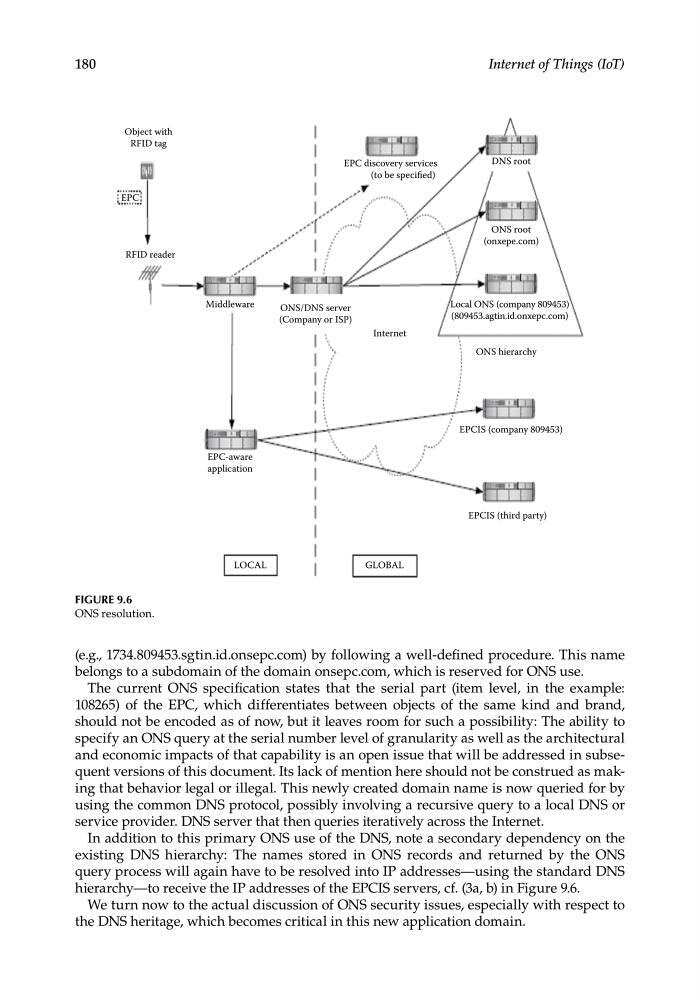
hierarchy—to receive the IP addresses of the EPCIS servers, cf. (3a, b) in Figure 9.6.
We turn now to the actual discussion of ONS security issues, especially with respect to
the DNS heritage, which becomes critical in this new application domain.
Object with
RFID tag
RFID reader
Middleware
Internet
ONS/DNS server
(Company or ISP)
EPC discovery services
(to be specified)
ONS root
(onxepe.com)
DNS root
ONS hierarchy
Local ONS (company 809453)
(809453.agtin.id.onxepc.com)
EPC
EPCIS (company 809453)
EPCIS (third party)
GLOBAL
LOCAL
EPC-aware
application
FIGURE 9.6
ONS resolution.
Internet of Things (IoT)
(e.g., 1734.809453.sgtin.id.onsepc.com) by following a well-defined procedure. This name
belongs to a subdomain of the domain onsepc.com, which is reserved for ONS use.
The current ONS specification states that the serial part (item level, in the example:
108265) of the EPC, which differentiates between objects of the same kind and brand,
should not be encoded as of now, but it leaves room for such a possibility: The ability to
specify an ONS query at the serial number level of granularity as well as the architectural
and economic impacts of that capability is an open issue that will be addressed in subsequent versions of this document. Its lack of mention here should not be construed as making that behavior legal or illegal. This newly created domain name is now queried for by
using the common DNS protocol, possibly involving a recursive query to a local DNS or
service provider. DNS server that then queries iteratively across the Internet.
In addition to this primary ONS use of the DNS, note a secondary dependency on the
existing DNS hierarchy: The names stored in ONS records and returned by the ONS
query process will again have to be resolved into IP addresses—using the standard DNS
hierarchy—to receive the IP addresses of the EPCIS servers, cf. (3a, b) in Figure 9.6.
We turn now to the actual discussion of ONS security issues, especially with respect to
the DNS heritage, which becomes critical in this new application domain.
Object with
RFID tag
RFID reader
Middleware
Internet
ONS/DNS server
(Company or ISP)
EPC discovery services
(to be specified)
ONS root
(onxepe.com)
DNS root
ONS hierarchy
Local ONS (company 809453)
(809453.agtin.id.onxepc.com)
EPC
EPCIS (company 809453)
EPCIS (third party)
GLOBAL
LOCAL
EPC-aware
application
FIGURE 9.6
ONS resolution.