

169
Naming Services in the Internet of Things
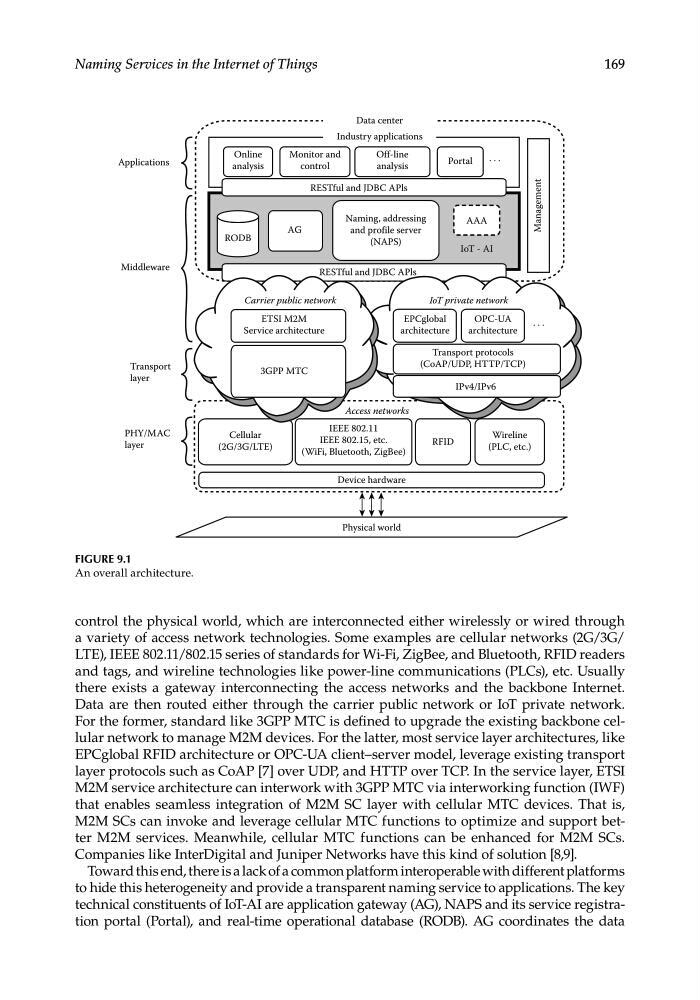
control the physical world, which are interconnected either wirelessly or wired through
a variety of access network technologies. Some examples are cellular networks (2G/3G/
LTE), IEEE 802.11/802.15 series of standards for Wi-Fi, ZigBee, and Bluetooth, RFID readers
and tags, and wireline technologies like power-line communications (PLCs), etc. Usually
there exists a gateway interconnecting the access networks and the backbone Internet.
Data are then routed either through the carrier public network or IoT private network.
For the former, standard like 3GPP MTC is defined to upgrade the existing backbone cellular network to manage M2M devices. For the latter, most service layer architectures, like
EPCglobal RFID architecture or OPC-UA client–server model, leverage existing transport
layer protocols such as CoAP [7] over UDP, and HTTP over TCP. In the service layer, ETSI
M2M service architecture can interwork with 3GPP MTC via interworking function (IWF)
that enables seamless integration of M2M SC layer with cellular MTC devices. That is,
M2M SCs can invoke and leverage cellular MTC functions to optimize and support better M2M services. Meanwhile, cellular MTC functions can be enhanced for M2M SCs.
Companies like InterDigital and Juniper Networks have this kind of solution [8,9].
Toward this end, there is a lack of a common platform interoperable with different platforms
to hide this heterogeneity and provide a transparent naming service to applications. The key
technical constituents of IoT-AI are application gateway (AG), NAPS and its service registration portal (Portal), and real-time operational database (RODB). AG coordinates the data
Data center
Industry applications
Off-line
analysis
Online
analysis
Monitor and
control
RESTful and JDBC APls
RODB
Applications
Middleware
PHY/MAC
layer
AG
Naming, addressing
and profile server
(NAPS)
RESTful and JDBC APls
Cellular
(2G/3G/LTE)
IEEE 802.11
IEEE 802.15, etc.
(WiFi, Bluetooth, ZigBee)
Device hardware
Physical world
RFID
Wireline
(PLC, etc.)
Access networks
AAA
IoT - AI
Portal
. . .
. . .
Management
Transport
layer
Carrier public network
I oT private network
OPC-UA
architecture
Transport protocols
(CoAP/UDP, HTTP/TCP)
IPv4/IPv6
EPCglobal
architecture
ETSI M2M
Service architecture
3GPP MTC
FIGURE 9.1
An overall architecture.
Naming Services in the Internet of Things
control the physical world, which are interconnected either wirelessly or wired through
a variety of access network technologies. Some examples are cellular networks (2G/3G/
LTE), IEEE 802.11/802.15 series of standards for Wi-Fi, ZigBee, and Bluetooth, RFID readers
and tags, and wireline technologies like power-line communications (PLCs), etc. Usually
there exists a gateway interconnecting the access networks and the backbone Internet.
Data are then routed either through the carrier public network or IoT private network.
For the former, standard like 3GPP MTC is defined to upgrade the existing backbone cellular network to manage M2M devices. For the latter, most service layer architectures, like
EPCglobal RFID architecture or OPC-UA client–server model, leverage existing transport
layer protocols such as CoAP [7] over UDP, and HTTP over TCP. In the service layer, ETSI
M2M service architecture can interwork with 3GPP MTC via interworking function (IWF)
that enables seamless integration of M2M SC layer with cellular MTC devices. That is,
M2M SCs can invoke and leverage cellular MTC functions to optimize and support better M2M services. Meanwhile, cellular MTC functions can be enhanced for M2M SCs.
Companies like InterDigital and Juniper Networks have this kind of solution [8,9].
Toward this end, there is a lack of a common platform interoperable with different platforms
to hide this heterogeneity and provide a transparent naming service to applications. The key
technical constituents of IoT-AI are application gateway (AG), NAPS and its service registration portal (Portal), and real-time operational database (RODB). AG coordinates the data
Data center
Industry applications
Off-line
analysis
Online
analysis
Monitor and
control
RESTful and JDBC APls
RODB
Applications
Middleware
PHY/MAC
layer
AG
Naming, addressing
and profile server
(NAPS)
RESTful and JDBC APls
Cellular
(2G/3G/LTE)
IEEE 802.11
IEEE 802.15, etc.
(WiFi, Bluetooth, ZigBee)
Device hardware
Physical world
RFID
Wireline
(PLC, etc.)
Access networks
AAA
IoT - AI
Portal
. . .
. . .
Management
Transport
layer
Carrier public network
I oT private network
OPC-UA
architecture
Transport protocols
(CoAP/UDP, HTTP/TCP)
IPv4/IPv6
EPCglobal
architecture
ETSI M2M
Service architecture
3GPP MTC
FIGURE 9.1
An overall architecture.