

160
Internet of Things (IoT)
as cognitive deterioration, leads to an increase in patient dependency. Neuropsychiatric
symptoms are common features and include psychosis (delusions and hallucinations),
depressive mood, anxiety, irritability/lability, apathy, euphoria, dis-inhibition, agitation/
aggression, aberrant motor activities, sleep disturbance, and eating disorder (Segal-Gidan
et al. 2011). In particular, cognitive impaired patients need constant monitoring to ensure
their well-being and that they do not harm themselves. Additionally, they have a tendency
to wander and misplace objects. Situation awareness requires the environment be able
to analyze the behavior of patients with cognitive impairments, which is extremely challenging. Indeed, traditional behavioral and situation analysis techniques assume “rational” behaviors, in the sense that behaviors are led by clear goals, and rely on matching
the observed activities with predefined behavioral patterns (Ye et al. 2012). The cognitive
sciences began as an intellectual movement in the 1950s, called the cognitive revolution,
arguably initiated by Noam Chomsky. Cognitive science is mainly concerned with artificial intelligence, attention, knowledge and processing of language, learning and development, memory, perception and action, and consciousness.
Cognitive AAL is a cognitive development and function involving conscious intellectual
activity to support the elderly with their daily activities in order to help them be healthy
and safe while living independently. However, most current systems are ineffective in
actual situation, difficult to use, and have a low acceptance rate. There is a need for an
intelligent assisted living solution and also to resolve practical issues such as user acceptance and usability in order to truly assist the elderly. Small, inexpensive, and low-powered
Class
diagram
Composite
structure
diagram
Timed
state
diagram
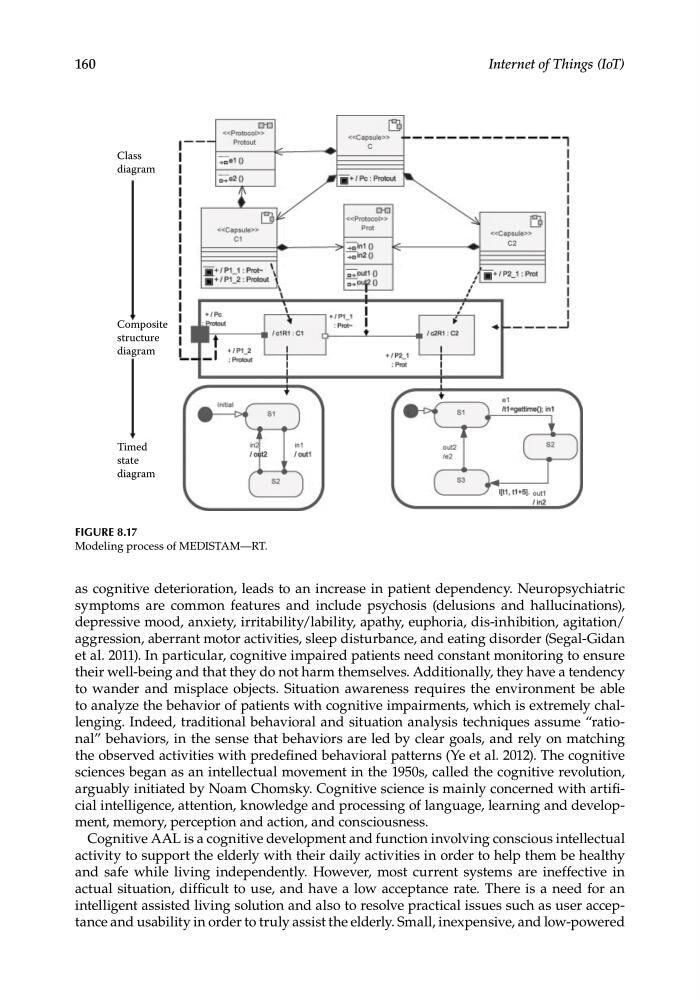
FIGURE 8.17
Modeling process of MEDISTAM—RT.
Internet of Things (IoT)
as cognitive deterioration, leads to an increase in patient dependency. Neuropsychiatric
symptoms are common features and include psychosis (delusions and hallucinations),
depressive mood, anxiety, irritability/lability, apathy, euphoria, dis-inhibition, agitation/
aggression, aberrant motor activities, sleep disturbance, and eating disorder (Segal-Gidan
et al. 2011). In particular, cognitive impaired patients need constant monitoring to ensure
their well-being and that they do not harm themselves. Additionally, they have a tendency
to wander and misplace objects. Situation awareness requires the environment be able
to analyze the behavior of patients with cognitive impairments, which is extremely challenging. Indeed, traditional behavioral and situation analysis techniques assume “rational” behaviors, in the sense that behaviors are led by clear goals, and rely on matching
the observed activities with predefined behavioral patterns (Ye et al. 2012). The cognitive
sciences began as an intellectual movement in the 1950s, called the cognitive revolution,
arguably initiated by Noam Chomsky. Cognitive science is mainly concerned with artificial intelligence, attention, knowledge and processing of language, learning and development, memory, perception and action, and consciousness.
Cognitive AAL is a cognitive development and function involving conscious intellectual
activity to support the elderly with their daily activities in order to help them be healthy
and safe while living independently. However, most current systems are ineffective in
actual situation, difficult to use, and have a low acceptance rate. There is a need for an
intelligent assisted living solution and also to resolve practical issues such as user acceptance and usability in order to truly assist the elderly. Small, inexpensive, and low-powered
Class
diagram
Composite
structure
diagram
Timed
state
diagram
FIGURE 8.17
Modeling process of MEDISTAM—RT.