

132
Internet of Things (IoT)
7.3 Internet of Nano-Things Forensics
The digital forensic investigation process of internet of nano-things is called “IoNT
Forensics.” The IoNT represents a big challenge for digital investigators and examiners
to collect and extract digital evidence as admissible evidence about committed crime
in the IoNT environment. To the best of the author’s knowledge, in this area, very little
work is done to cover the IoNTF so that researchers and scientists who are working in
the digital forensics area have to work to develop and design new methods, procedures,
techniques, and tools to cope with new types of cybercrimes, attacks, and malicious
and illegal activities. The IoNTF can identify itself as a special branch of IoT forensics,
where the identification, collection, acquisition, analysis, examination, and presentation
phases of digital investigation process will apply to the IoNT infrastructures to establish
the facts about a crime that occurred. The digital forensic can be performed in the IoNT
environment as well as its new sub domains such as IoMNT and IoBNT, as shown in
Figure 7.10.
7.3.1 IoNT Forensics Definition
The IoNTF is the process of performing a digital forensics investigation in the IoNT.
The IoNTF is a cross-discipline that combines the IoNT and digital forensics. We identify
IoNTF as a combination of three digital forensics levels: nanodevice forensics level, internet forensics level, and IoNT services/application forensics level, which are illustrated in
Figure 7.11. Therefore, The IoNTF can follow the main phases of digital forensics according
to each level in the architecture of IoNT.
Microgateway
Molecular
communication
Nanosensor
System management
Application-level services
Programming abstractions
Data analysis
Gateway middleware
User terminal
EM communication
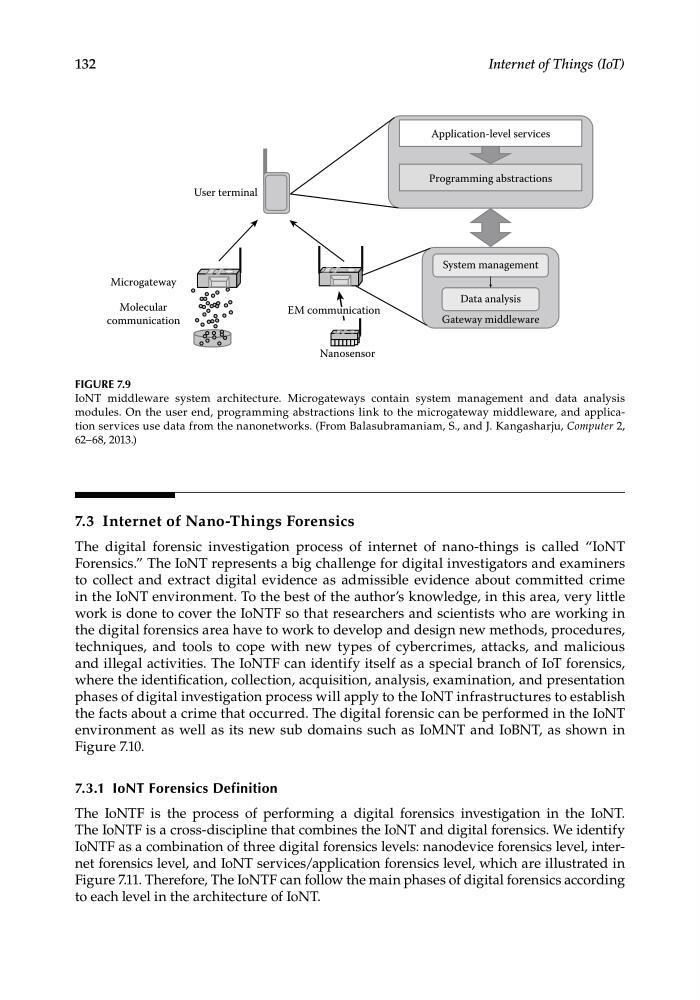
FIGURE 7.9
IoNT middleware system architecture. Microgateways contain system management and data analysis
modules. On the user end, programming abstractions link to the microgateway middleware, and application services use data from the nanonetworks. (From Balasubramaniam, S., and J. Kangasharju, Computer 2,
62–68, 2013.)
Internet of Things (IoT)
7.3 Internet of Nano-Things Forensics
The digital forensic investigation process of internet of nano-things is called “IoNT
Forensics.” The IoNT represents a big challenge for digital investigators and examiners
to collect and extract digital evidence as admissible evidence about committed crime
in the IoNT environment. To the best of the author’s knowledge, in this area, very little
work is done to cover the IoNTF so that researchers and scientists who are working in
the digital forensics area have to work to develop and design new methods, procedures,
techniques, and tools to cope with new types of cybercrimes, attacks, and malicious
and illegal activities. The IoNTF can identify itself as a special branch of IoT forensics,
where the identification, collection, acquisition, analysis, examination, and presentation
phases of digital investigation process will apply to the IoNT infrastructures to establish
the facts about a crime that occurred. The digital forensic can be performed in the IoNT
environment as well as its new sub domains such as IoMNT and IoBNT, as shown in
Figure 7.10.
7.3.1 IoNT Forensics Definition
The IoNTF is the process of performing a digital forensics investigation in the IoNT.
The IoNTF is a cross-discipline that combines the IoNT and digital forensics. We identify
IoNTF as a combination of three digital forensics levels: nanodevice forensics level, internet forensics level, and IoNT services/application forensics level, which are illustrated in
Figure 7.11. Therefore, The IoNTF can follow the main phases of digital forensics according
to each level in the architecture of IoNT.
Microgateway
Molecular
communication
Nanosensor
System management
Application-level services
Programming abstractions
Data analysis
Gateway middleware
User terminal
EM communication
FIGURE 7.9
IoNT middleware system architecture. Microgateways contain system management and data analysis
modules. On the user end, programming abstractions link to the microgateway middleware, and application services use data from the nanonetworks. (From Balasubramaniam, S., and J. Kangasharju, Computer 2,
62–68, 2013.)