

130
Internet of Things (IoT)
data traffic during transmission, particularly if sensing process is periodic; due to this,
each microgateway connects with many nanosensors in the nanonetworks. A suitable
solution for this problem is to think about another way that cannot be static but depends
on the dynamic process in data collection in the tree; therefore, it is needed for interactions from nano-node to another nano-node among microgateways. In both molecular
and EM nanonetworks, the microgateway has to integrate data from different nanosensors before sending it down the tree. However, the timing difference in data propagation
between nanomachines could lead to long delays for reaching messages to the sink. For
example, in molecular nanonetworks, information transmission could take a large time,
especially when queries expect feedback. And also in electromagnetic nanonetworks,
energy harvesting is a major constraint, as the harvesting process can take up to a minute before transmission can occur. An ideal, time-delayed data fusion process must be
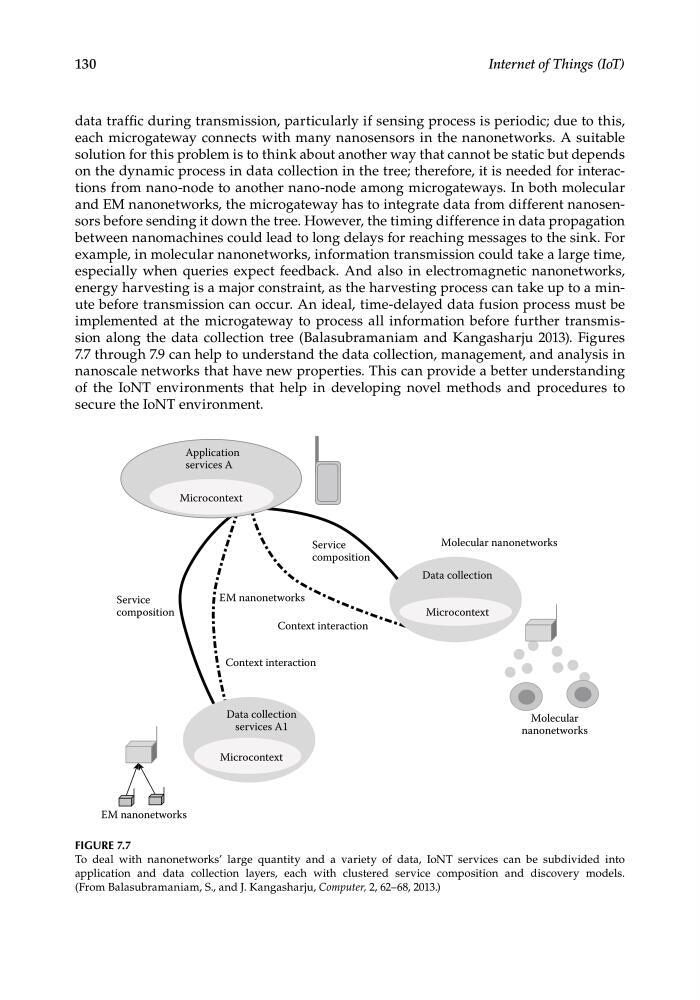
implemented at the microgateway to process all information before further transmission along the data collection tree (Balasubramaniam and Kangasharju 2013). Figures
7.7 through 7.9 can help to understand the data collection, management, and analysis in
nanoscale networks that have new properties. This can provide a better understanding
of the IoNT environments that help in developing novel methods and procedures to
secure the IoNT environment.
Application
services A
Service
composition
Molecular nanonetworks
Data collection
Data collection
services A1
EM nanonetworks
Molecular
nanonetworks
Microcontext
Microcontext
EM nanonetworks
Context interaction
Context interaction
Service
composition
Microcontext
FIGURE 7.7
To deal with nanonetworks’ large quantity and a variety of data, IoNT services can be subdivided into
application and data collection layers, each with clustered service composition and discovery models.
(From Balasubramaniam, S., and J. Kangasharju, Computer, 2, 62–68, 2013.)
Internet of Things (IoT)
data traffic during transmission, particularly if sensing process is periodic; due to this,
each microgateway connects with many nanosensors in the nanonetworks. A suitable
solution for this problem is to think about another way that cannot be static but depends
on the dynamic process in data collection in the tree; therefore, it is needed for interactions from nano-node to another nano-node among microgateways. In both molecular
and EM nanonetworks, the microgateway has to integrate data from different nanosensors before sending it down the tree. However, the timing difference in data propagation
between nanomachines could lead to long delays for reaching messages to the sink. For
example, in molecular nanonetworks, information transmission could take a large time,
especially when queries expect feedback. And also in electromagnetic nanonetworks,
energy harvesting is a major constraint, as the harvesting process can take up to a minute before transmission can occur. An ideal, time-delayed data fusion process must be
implemented at the microgateway to process all information before further transmission along the data collection tree (Balasubramaniam and Kangasharju 2013). Figures
7.7 through 7.9 can help to understand the data collection, management, and analysis in
nanoscale networks that have new properties. This can provide a better understanding
of the IoNT environments that help in developing novel methods and procedures to
secure the IoNT environment.
Application
services A
Service
composition
Molecular nanonetworks
Data collection
Data collection
services A1
EM nanonetworks
Molecular
nanonetworks
Microcontext
Microcontext
EM nanonetworks
Context interaction
Context interaction
Service
composition
Microcontext
FIGURE 7.7
To deal with nanonetworks’ large quantity and a variety of data, IoNT services can be subdivided into
application and data collection layers, each with clustered service composition and discovery models.
(From Balasubramaniam, S., and J. Kangasharju, Computer, 2, 62–68, 2013.)