

91
Evolution of Social IoT World
information such as connectedness, relative position, and relation with other nodes (identified in the same way) is exposed. This necessitates further anonymization processes so
that the knowledge about 1-neighborhood cannot be used to identify a node uniquely. In
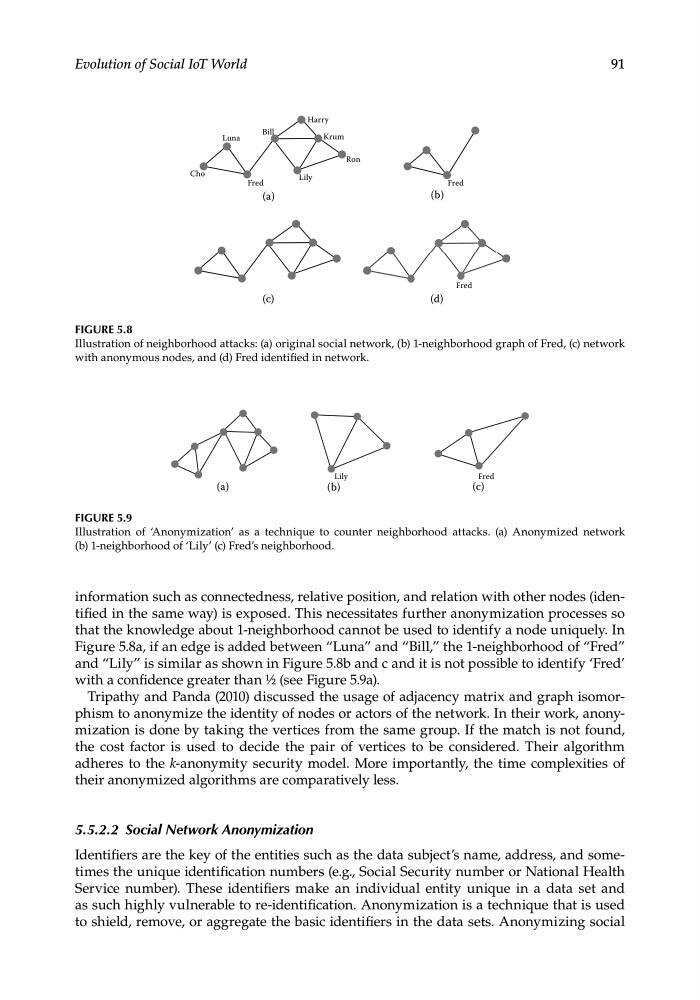
Figure 5.8a, if an edge is added between “Luna” and “Bill,” the 1-neighborhood of “Fred”
and “Lily” is similar as shown in Figure 5.8b and c and it is not possible to identify ‘Fred’
with a confidence greater than ½ (see Figure 5.9a).
Tripathy and Panda (2010) discussed the usage of adjacency matrix and graph isomorphism to anonymize the identity of nodes or actors of the network. In their work, anonymization is done by taking the vertices from the same group. If the match is not found,
the cost factor is used to decide the pair of vertices to be considered. Their algorithm
adheres to the k-anonymity security model. More importantly, the time complexities of
their anonymized algorithms are comparatively less.
5.5.2.2 Social Network Anonymization
Identifiers are the key of the entities such as the data subject’s name, address, and sometimes the unique identification numbers (e.g., Social Security number or National Health
Service number). These identifiers make an individual entity unique in a data set and
as such highly vulnerable to re-identification. Anonymization is a technique that is used
to shield, remove, or aggregate the basic identifiers in the data sets. Anonymizing social
(a)
(b)
(c)
(d)
Cho
Fred
Luna
Bill
Lily
Harry
Krum
Ron
Fred
Fred
FIGURE 5.8
Illustration of neighborhood attacks: (a) original social network, (b) 1-neighborhood graph of Fred, (c) network
with anonymous nodes, and (d) Fred identified in network.
Lily
(a)
(b)
(c)
Fred
FIGURE 5.9
Illustration of ‘Anonymization’ as a technique to counter neighborhood attacks. (a) Anonymized network
(b) 1-neighborhood of ‘Lily’ (c) Fred’s neighborhood.
Evolution of Social IoT World
information such as connectedness, relative position, and relation with other nodes (identified in the same way) is exposed. This necessitates further anonymization processes so
that the knowledge about 1-neighborhood cannot be used to identify a node uniquely. In
Figure 5.8a, if an edge is added between “Luna” and “Bill,” the 1-neighborhood of “Fred”
and “Lily” is similar as shown in Figure 5.8b and c and it is not possible to identify ‘Fred’
with a confidence greater than ½ (see Figure 5.9a).
Tripathy and Panda (2010) discussed the usage of adjacency matrix and graph isomorphism to anonymize the identity of nodes or actors of the network. In their work, anonymization is done by taking the vertices from the same group. If the match is not found,
the cost factor is used to decide the pair of vertices to be considered. Their algorithm
adheres to the k-anonymity security model. More importantly, the time complexities of
their anonymized algorithms are comparatively less.
5.5.2.2 Social Network Anonymization
Identifiers are the key of the entities such as the data subject’s name, address, and sometimes the unique identification numbers (e.g., Social Security number or National Health
Service number). These identifiers make an individual entity unique in a data set and
as such highly vulnerable to re-identification. Anonymization is a technique that is used
to shield, remove, or aggregate the basic identifiers in the data sets. Anonymizing social
(a)
(b)
(c)
(d)
Cho
Fred
Luna
Bill
Lily
Harry
Krum
Ron
Fred
Fred
FIGURE 5.8
Illustration of neighborhood attacks: (a) original social network, (b) 1-neighborhood graph of Fred, (c) network
with anonymous nodes, and (d) Fred identified in network.
Lily
(a)
(b)
(c)
Fred
FIGURE 5.9
Illustration of ‘Anonymization’ as a technique to counter neighborhood attacks. (a) Anonymized network
(b) 1-neighborhood of ‘Lily’ (c) Fred’s neighborhood.