

85
Evolution of Social IoT World
In a simple one, a dummy Object (e.g., either an RFID tag or a presence sensing device)
that is equipped with a functionality of the lowest layer is only enabled to send simple
signals to another element (the Gateway). The Gateway is equipped with the whole set of
functionalities of the three layers. In the second scenario, a device (e.g., a video camera)
is able to sense the physical world information and send the related data over an IP network. The object would then be set with the functionality of the network layer other than
that of the application one. Accordingly, there is no need for a Gateway with Application
Layer functionality. An Application Layer in a server, somewhere in the Internet, with the
Gateway application layer functionality would be good enough. According to the third
scenario, a smart object (e.g., a smartphone) may implement the functionality of the three
layers so that the Gateway is not needed, but for some communication facilities targeted
to maintain the Internet connectivity of the object. This is the case of a smartphone, which
has enough computational power to perform all the three-layer operations and may need
a Gateway for ubiquitous network connectivity.
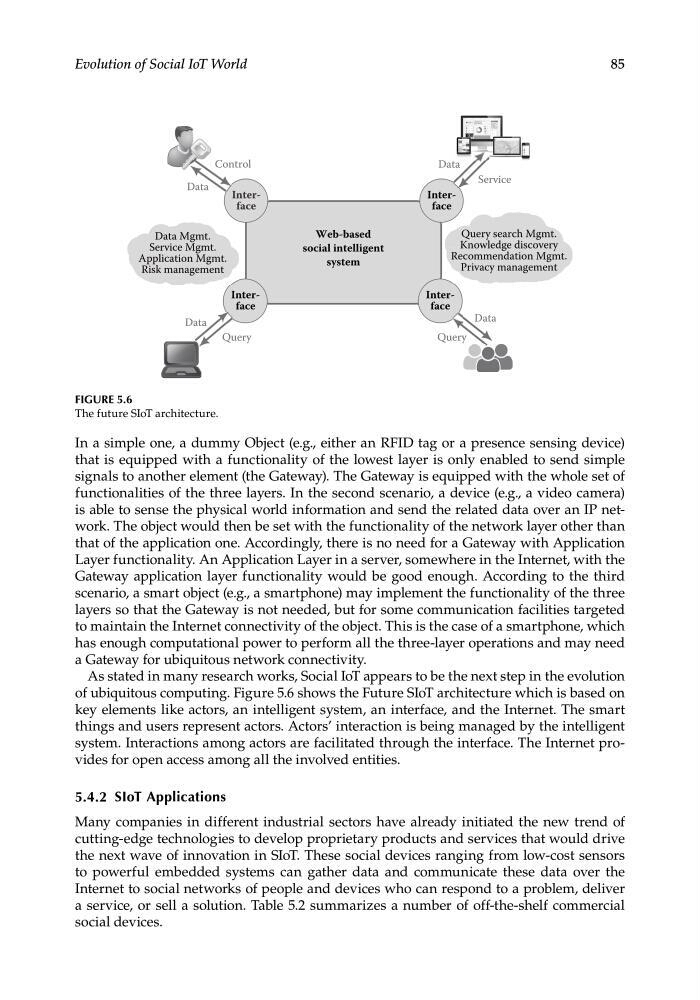
As stated in many research works, Social IoT appears to be the next step in the evolution
of ubiquitous computing. Figure 5.6 shows the Future SIoT architecture which is based on
key elements like actors, an intelligent system, an interface, and the Internet. The smart
things and users represent actors. Actors’ interaction is being managed by the intelligent
system. Interactions among actors are facilitated through the interface. The Internet provides for open access among all the involved entities.
5.4.2 SIoT Applications
Many companies in different industrial sectors have already initiated the new trend of
cutting-edge technologies to develop proprietary products and services that would drive
the next wave of innovation in SIoT. These social devices ranging from low-cost sensors
to powerful embedded systems can gather data and communicate these data over the
Internet to social networks of people and devices who can respond to a problem, deliver
a service, or sell a solution. Table 5.2 summarizes a number of off-the-shelf commercial
social devices.
Interface
Interface
Interface
Interface
Query search Mgmt.
Knowledge discovery
Recommendation Mgmt.
Privacy management
Data Mgmt.
Service Mgmt.
Application Mgmt.
Risk management
Web-based
social intelligent
system
Control
Data
Service
Data
Data
Query
Query
Data
FIGURE 5.6
The future SIoT architecture.
Evolution of Social IoT World
In a simple one, a dummy Object (e.g., either an RFID tag or a presence sensing device)
that is equipped with a functionality of the lowest layer is only enabled to send simple
signals to another element (the Gateway). The Gateway is equipped with the whole set of
functionalities of the three layers. In the second scenario, a device (e.g., a video camera)
is able to sense the physical world information and send the related data over an IP network. The object would then be set with the functionality of the network layer other than
that of the application one. Accordingly, there is no need for a Gateway with Application
Layer functionality. An Application Layer in a server, somewhere in the Internet, with the
Gateway application layer functionality would be good enough. According to the third
scenario, a smart object (e.g., a smartphone) may implement the functionality of the three
layers so that the Gateway is not needed, but for some communication facilities targeted
to maintain the Internet connectivity of the object. This is the case of a smartphone, which
has enough computational power to perform all the three-layer operations and may need
a Gateway for ubiquitous network connectivity.
As stated in many research works, Social IoT appears to be the next step in the evolution
of ubiquitous computing. Figure 5.6 shows the Future SIoT architecture which is based on
key elements like actors, an intelligent system, an interface, and the Internet. The smart
things and users represent actors. Actors’ interaction is being managed by the intelligent
system. Interactions among actors are facilitated through the interface. The Internet provides for open access among all the involved entities.
5.4.2 SIoT Applications
Many companies in different industrial sectors have already initiated the new trend of
cutting-edge technologies to develop proprietary products and services that would drive
the next wave of innovation in SIoT. These social devices ranging from low-cost sensors
to powerful embedded systems can gather data and communicate these data over the
Internet to social networks of people and devices who can respond to a problem, deliver
a service, or sell a solution. Table 5.2 summarizes a number of off-the-shelf commercial
social devices.
Interface
Interface
Interface
Interface
Query search Mgmt.
Knowledge discovery
Recommendation Mgmt.
Privacy management
Data Mgmt.
Service Mgmt.
Application Mgmt.
Risk management
Web-based
social intelligent
system
Control
Data
Service
Data
Data
Query
Query
Data
FIGURE 5.6
The future SIoT architecture.