
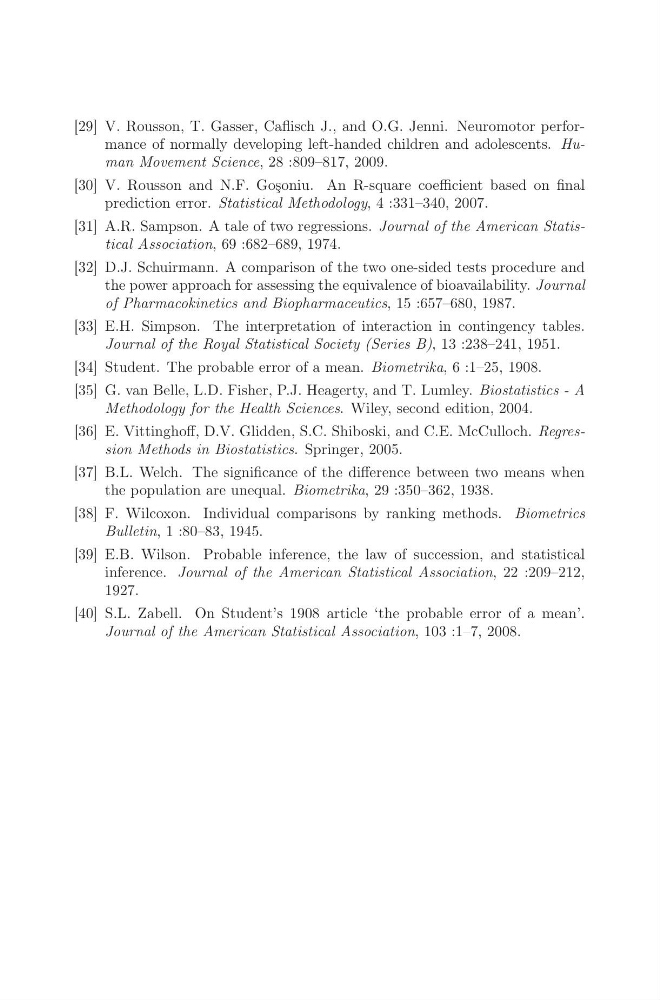
[29] V. Rousson, T. Gasser, Caflisch J., and O.G. Jenni. Neuromotor performance of normally developing left-handed children and adolescents. Human Movement Science, 28 :809–817, 2009.
[30] V. Rousson and N.F. Goşoniu. An R-square coefficient based on final
prediction error. Statistical Methodology, 4 :331–340, 2007.
[31] A.R. Sampson. A tale of two regressions. Journal of the American Statistical Association, 69 :682–689, 1974.
[32] D.J. Schuirmann. A comparison of the two one-sided tests procedure and
the power approach for assessing the equivalence of bioavailability. Journal
of Pharmacokinetics and Biopharmaceutics, 15 :657–680, 1987.
[33] E.H. Simpson. The interpretation of interaction in contingency tables.
Journal of the Royal Statistical Society (Series B), 13 :238–241, 1951.
[34] Student. The probable error of a mean. Biometrika, 6 :1–25, 1908.
[35] G. van Belle, L.D. Fisher, P.J. Heagerty, and T. Lumley. Biostatistics - A
Methodology for the Health Sciences. Wiley, second edition, 2004.
[36] E. Vittinghoff, D.V. Glidden, S.C. Shiboski, and C.E. McCulloch. Regression Methods in Biostatistics. Springer, 2005.
[37] B.L. Welch. The significance of the difference between two means when
the population are unequal. Biometrika, 29 :350–362, 1938.
[38] F. Wilcoxon. Individual comparisons by ranking methods. Biometrics
Bulletin, 1 :80–83, 1945.
[39] E.B. Wilson. Probable inference, the law of succession, and statistical
inference. Journal of the American Statistical Association, 22 :209–212,
1927.
[40] S.L. Zabell. On Student’s 1908 article ‘the probable error of a mean’.
Journal of the American Statistical Association, 103 :1–7, 2008.
[30] V. Rousson and N.F. Goşoniu. An R-square coefficient based on final
prediction error. Statistical Methodology, 4 :331–340, 2007.
[31] A.R. Sampson. A tale of two regressions. Journal of the American Statistical Association, 69 :682–689, 1974.
[32] D.J. Schuirmann. A comparison of the two one-sided tests procedure and
the power approach for assessing the equivalence of bioavailability. Journal
of Pharmacokinetics and Biopharmaceutics, 15 :657–680, 1987.
[33] E.H. Simpson. The interpretation of interaction in contingency tables.
Journal of the Royal Statistical Society (Series B), 13 :238–241, 1951.
[34] Student. The probable error of a mean. Biometrika, 6 :1–25, 1908.
[35] G. van Belle, L.D. Fisher, P.J. Heagerty, and T. Lumley. Biostatistics - A
Methodology for the Health Sciences. Wiley, second edition, 2004.
[36] E. Vittinghoff, D.V. Glidden, S.C. Shiboski, and C.E. McCulloch. Regression Methods in Biostatistics. Springer, 2005.
[37] B.L. Welch. The significance of the difference between two means when
the population are unequal. Biometrika, 29 :350–362, 1938.
[38] F. Wilcoxon. Individual comparisons by ranking methods. Biometrics
Bulletin, 1 :80–83, 1945.
[39] E.B. Wilson. Probable inference, the law of succession, and statistical
inference. Journal of the American Statistical Association, 22 :209–212,
1927.
[40] S.L. Zabell. On Student’s 1908 article ‘the probable error of a mean’.
Journal of the American Statistical Association, 103 :1–7, 2008.
Précédent