

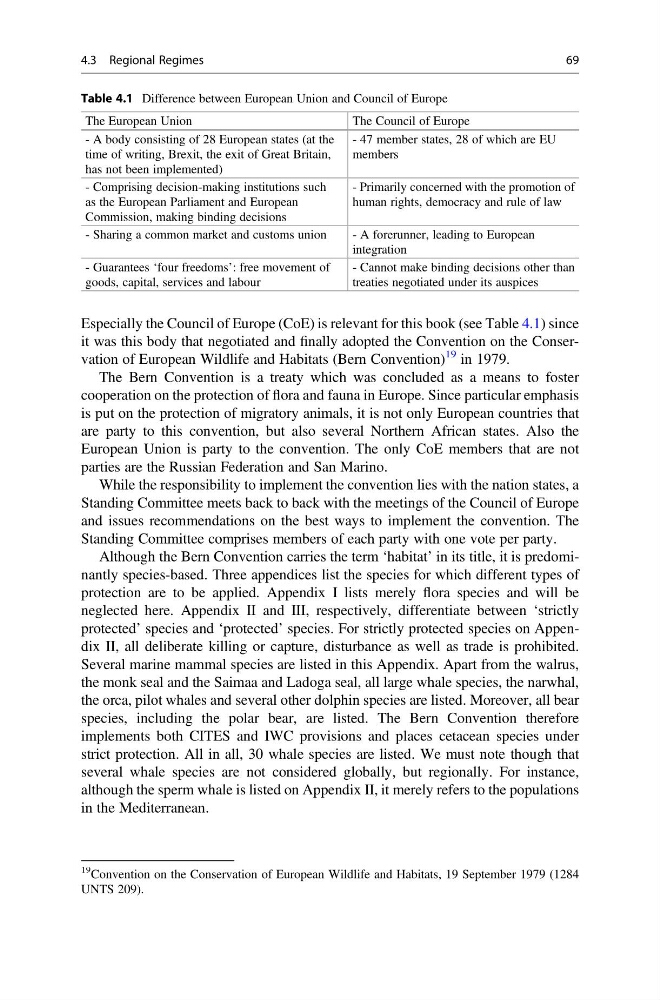
Especially the Council of Europe (CoE) is relevant for this book (see Table 4.1) since
it was this body that negotiated and finally adopted the Convention on the Conservation of European Wildlife and Habitats (Bern Convention)
19 in 1979.
The Bern Convention is a treaty which was concluded as a means to foster
cooperation on the protection of flora and fauna in Europe. Since particular emphasis
is put on the protection of migratory animals, it is not only European countries that
are party to this convention, but also several Northern African states. Also the
European Union is party to the convention. The only CoE members that are not
parties are the Russian Federation and San Marino.
While the responsibility to implement the convention lies with the nation states, a
Standing Committee meets back to back with the meetings of the Council of Europe
and issues recommendations on the best ways to implement the convention. The
Standing Committee comprises members of each party with one vote per party.
Although the Bern Convention carries the term ‘habitat’ in its title, it is predominantly species-based. Three appendices list the species for which different types of
protection are to be applied. Appendix I lists merely flora species and will be
neglected here. Appendix II and III, respectively, differentiate between ‘strictly
protected’ species and ‘protected’ species. For strictly protected species on Appendix II, all deliberate killing or capture, disturbance as well as trade is prohibited.
Several marine mammal species are listed in this Appendix. Apart from the walrus,
the monk seal and the Saimaa and Ladoga seal, all large whale species, the narwhal,
the orca, pilot whales and several other dolphin species are listed. Moreover, all bear
species, including the polar bear, are listed. The Bern Convention therefore
implements both CITES and IWC provisions and places cetacean species under
strict protection. All in all, 30 whale species are listed. We must note though that
several whale species are not considered globally, but regionally. For instance,
although the sperm whale is listed on Appendix II, it merely refers to the populations
in the Mediterranean.
Table 4.1 Difference between European Union and Council of Europe
The European Union
The Council of Europe
- A body consisting of 28 European states (at the
time of writing, Brexit, the exit of Great Britain,
has not been implemented)
- 47 member states, 28 of which are EU
members
- Comprising decision-making institutions such
as the European Parliament and European
Commission, making binding decisions
- Primarily concerned with the promotion of
human rights, democracy and rule of law
- Sharing a common market and customs union
- A forerunner, leading to European
integration
- Guarantees ‘four freedoms’: free movement of
goods, capital, services and labour
- Cannot make binding decisions other than
treaties negotiated under its auspices
19 Convention on the Conservation of European Wildlife and Habitats, 19 September 1979 (1284
UNTS 209).
4.3 Regional Regimes
69
it was this body that negotiated and finally adopted the Convention on the Conservation of European Wildlife and Habitats (Bern Convention)
19 in 1979.
The Bern Convention is a treaty which was concluded as a means to foster
cooperation on the protection of flora and fauna in Europe. Since particular emphasis
is put on the protection of migratory animals, it is not only European countries that
are party to this convention, but also several Northern African states. Also the
European Union is party to the convention. The only CoE members that are not
parties are the Russian Federation and San Marino.
While the responsibility to implement the convention lies with the nation states, a
Standing Committee meets back to back with the meetings of the Council of Europe
and issues recommendations on the best ways to implement the convention. The
Standing Committee comprises members of each party with one vote per party.
Although the Bern Convention carries the term ‘habitat’ in its title, it is predominantly species-based. Three appendices list the species for which different types of
protection are to be applied. Appendix I lists merely flora species and will be
neglected here. Appendix II and III, respectively, differentiate between ‘strictly
protected’ species and ‘protected’ species. For strictly protected species on Appendix II, all deliberate killing or capture, disturbance as well as trade is prohibited.
Several marine mammal species are listed in this Appendix. Apart from the walrus,
the monk seal and the Saimaa and Ladoga seal, all large whale species, the narwhal,
the orca, pilot whales and several other dolphin species are listed. Moreover, all bear
species, including the polar bear, are listed. The Bern Convention therefore
implements both CITES and IWC provisions and places cetacean species under
strict protection. All in all, 30 whale species are listed. We must note though that
several whale species are not considered globally, but regionally. For instance,
although the sperm whale is listed on Appendix II, it merely refers to the populations
in the Mediterranean.
Table 4.1 Difference between European Union and Council of Europe
The European Union
The Council of Europe
- A body consisting of 28 European states (at the
time of writing, Brexit, the exit of Great Britain,
has not been implemented)
- 47 member states, 28 of which are EU
members
- Comprising decision-making institutions such
as the European Parliament and European
Commission, making binding decisions
- Primarily concerned with the promotion of
human rights, democracy and rule of law
- Sharing a common market and customs union
- A forerunner, leading to European
integration
- Guarantees ‘four freedoms’: free movement of
goods, capital, services and labour
- Cannot make binding decisions other than
treaties negotiated under its auspices
19 Convention on the Conservation of European Wildlife and Habitats, 19 September 1979 (1284
UNTS 209).
4.3 Regional Regimes
69