

The harp seal shows a large black pattern on its back when adult, which resembles
a harp. Harp seals can only be found in the northern Atlantic and Arctic Ocean. The
overall population is subdivided into three distinct stocks: the northeastern stock in
the Barents and White Seas; the ‘Western’ population in the Greenland Sea and
around Jan Mayen; and the stock living and breeding in the northwest Atlantic along
the east coast of Canada and in the Gulf of St Lawrence.
Harp seals migrate between Arctic waters in the summer and more temperate
waters in the winter. In the spring season, they whelp their pups on the ice. This
particular season has triggered the large-scale hunts for harp seals in Canada and
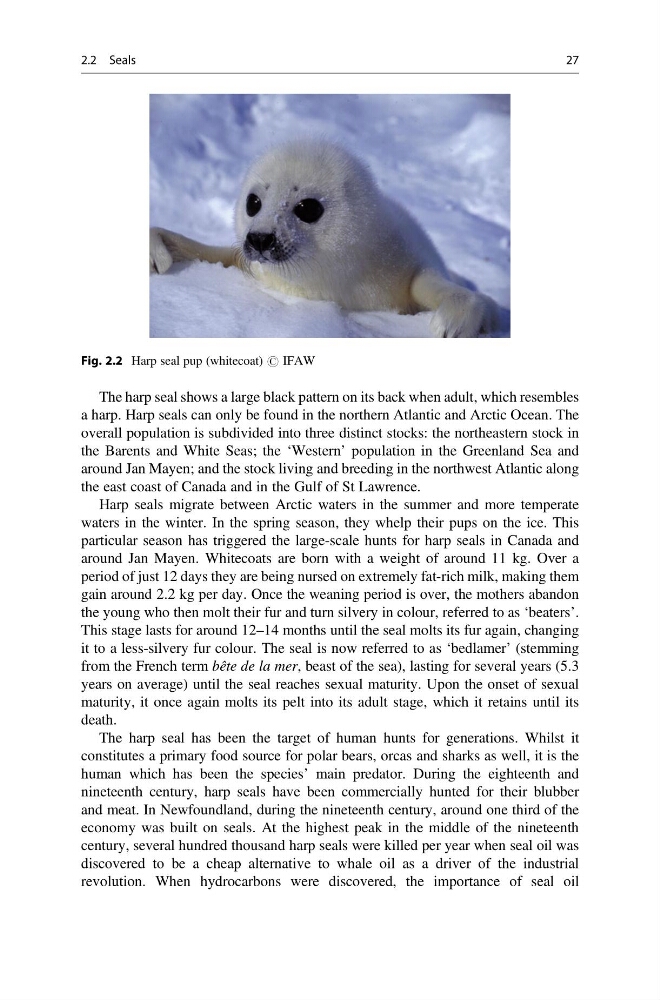
around Jan Mayen. Whitecoats are born with a weight of around 11 kg. Over a
period of just 12 days they are being nursed on extremely fat-rich milk, making them
gain around 2.2 kg per day. Once the weaning period is over, the mothers abandon
the young who then molt their fur and turn silvery in colour, referred to as ‘beaters’.
This stage lasts for around 12–14 months until the seal molts its fur again, changing
it to a less-silvery fur colour. The seal is now referred to as ‘bedlamer’ (stemming
from the French term bête de la mer, beast of the sea), lasting for several years (5.3
years on average) until the seal reaches sexual maturity. Upon the onset of sexual
maturity, it once again molts its pelt into its adult stage, which it retains until its
death.
The harp seal has been the target of human hunts for generations. Whilst it
constitutes a primary food source for polar bears, orcas and sharks as well, it is the
human which has been the species’ main predator. During the eighteenth and
nineteenth century, harp seals have been commercially hunted for their blubber
and meat. In Newfoundland, during the nineteenth century, around one third of the
economy was built on seals. At the highest peak in the middle of the nineteenth
century, several hundred thousand harp seals were killed per year when seal oil was
discovered to be a cheap alternative to whale oil as a driver of the industrial
revolution. When hydrocarbons were discovered, the importance of seal oil
Fig. 2.2 Harp seal pup (whitecoat) # IFAW
2.2 Seals
27
a harp. Harp seals can only be found in the northern Atlantic and Arctic Ocean. The
overall population is subdivided into three distinct stocks: the northeastern stock in
the Barents and White Seas; the ‘Western’ population in the Greenland Sea and
around Jan Mayen; and the stock living and breeding in the northwest Atlantic along
the east coast of Canada and in the Gulf of St Lawrence.
Harp seals migrate between Arctic waters in the summer and more temperate
waters in the winter. In the spring season, they whelp their pups on the ice. This
particular season has triggered the large-scale hunts for harp seals in Canada and
around Jan Mayen. Whitecoats are born with a weight of around 11 kg. Over a
period of just 12 days they are being nursed on extremely fat-rich milk, making them
gain around 2.2 kg per day. Once the weaning period is over, the mothers abandon
the young who then molt their fur and turn silvery in colour, referred to as ‘beaters’.
This stage lasts for around 12–14 months until the seal molts its fur again, changing
it to a less-silvery fur colour. The seal is now referred to as ‘bedlamer’ (stemming
from the French term bête de la mer, beast of the sea), lasting for several years (5.3
years on average) until the seal reaches sexual maturity. Upon the onset of sexual
maturity, it once again molts its pelt into its adult stage, which it retains until its
death.
The harp seal has been the target of human hunts for generations. Whilst it
constitutes a primary food source for polar bears, orcas and sharks as well, it is the
human which has been the species’ main predator. During the eighteenth and
nineteenth century, harp seals have been commercially hunted for their blubber
and meat. In Newfoundland, during the nineteenth century, around one third of the
economy was built on seals. At the highest peak in the middle of the nineteenth
century, several hundred thousand harp seals were killed per year when seal oil was
discovered to be a cheap alternative to whale oil as a driver of the industrial
revolution. When hydrocarbons were discovered, the importance of seal oil
Fig. 2.2 Harp seal pup (whitecoat) # IFAW
2.2 Seals
27