

The principle of integration considers that the protection of the environment, and
economic and social development cannot be separated. Organisations such as the
World Trade Organization (WTO), for example, did not consider this interlinkage
when they were established. Instead, the WTO, to stick with this example, merely
focused on free trade and associated economic growth. Only over time has the WTO
has started to consider environmental standards and principles and, as for example
Timo Koivurova argues, should also be considered within contexts of international
environmental law.
15 Indeed, the WTO is an international organisation which we
will also get to know in the controversies surrounding the European Union’s regime
on trade in seal products (see Sect. 6.6).
The principle of common but differentiated responsibilities is a principle which is
probably the oldest principle in international environmental law, even though it has
not been formulated as such until the Rio Conference. The principle in contemporary
discourse refers to the Global North-South axis, which aims to lift the burden of
developing nations to make due for the environmental harm caused by industrial
nations. We can find the same reasoning applied in other regimes, dating back more
than one hundred years in the form of ‘aboriginal/indigenous/native exemptions’ to
sealing regimes, as we will see in Chap. 6. The logic is essentially the same:
aboriginal peoples are to be spared from limits to the seal hunt since their smallscale subsistence hunt does not significantly contribute to the population decline of
seals. This is contrary to the large-scale hunts of commercial enterprises which
decimate the population. In other words, aboriginal peoples should carry a different
degree of responsibility towards seal conservation than commercial enterprises
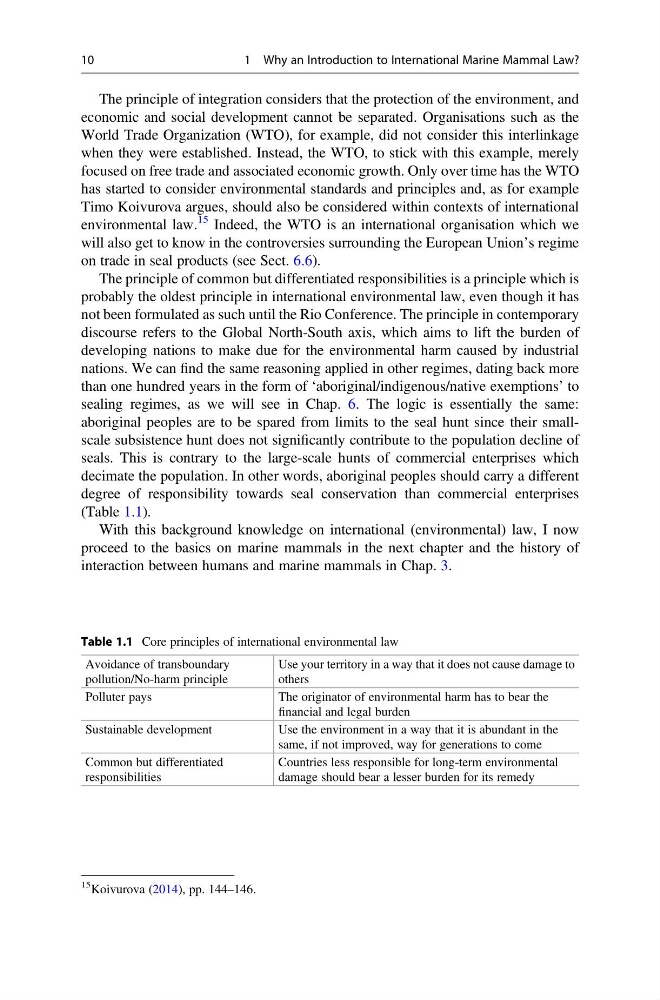
(Table 1.1).
With this background knowledge on international (environmental) law, I now
proceed to the basics on marine mammals in the next chapter and the history of
interaction between humans and marine mammals in Chap. 3.
Table 1.1 Core principles of international environmental law
Avoidance of transboundary
pollution/No-harm principle
Use your territory in a way that it does not cause damage to
others
Polluter pays
The originator of environmental harm has to bear the
financial and legal burden
Sustainable development
Use the environment in a way that it is abundant in the
same, if not improved, way for generations to come
Common but differentiated
responsibilities
Countries less responsible for long-term environmental
damage should bear a lesser burden for its remedy
15 Koivurova (2014), pp. 144–146.
10
1 Why an Introduction to International Marine Mammal Law?
economic and social development cannot be separated. Organisations such as the
World Trade Organization (WTO), for example, did not consider this interlinkage
when they were established. Instead, the WTO, to stick with this example, merely
focused on free trade and associated economic growth. Only over time has the WTO
has started to consider environmental standards and principles and, as for example
Timo Koivurova argues, should also be considered within contexts of international
environmental law.
15 Indeed, the WTO is an international organisation which we
will also get to know in the controversies surrounding the European Union’s regime
on trade in seal products (see Sect. 6.6).
The principle of common but differentiated responsibilities is a principle which is
probably the oldest principle in international environmental law, even though it has
not been formulated as such until the Rio Conference. The principle in contemporary
discourse refers to the Global North-South axis, which aims to lift the burden of
developing nations to make due for the environmental harm caused by industrial
nations. We can find the same reasoning applied in other regimes, dating back more
than one hundred years in the form of ‘aboriginal/indigenous/native exemptions’ to
sealing regimes, as we will see in Chap. 6. The logic is essentially the same:
aboriginal peoples are to be spared from limits to the seal hunt since their smallscale subsistence hunt does not significantly contribute to the population decline of
seals. This is contrary to the large-scale hunts of commercial enterprises which
decimate the population. In other words, aboriginal peoples should carry a different
degree of responsibility towards seal conservation than commercial enterprises
(Table 1.1).
With this background knowledge on international (environmental) law, I now
proceed to the basics on marine mammals in the next chapter and the history of
interaction between humans and marine mammals in Chap. 3.
Table 1.1 Core principles of international environmental law
Avoidance of transboundary
pollution/No-harm principle
Use your territory in a way that it does not cause damage to
others
Polluter pays
The originator of environmental harm has to bear the
financial and legal burden
Sustainable development
Use the environment in a way that it is abundant in the
same, if not improved, way for generations to come
Common but differentiated
responsibilities
Countries less responsible for long-term environmental
damage should bear a lesser burden for its remedy
15 Koivurova (2014), pp. 144–146.
10
1 Why an Introduction to International Marine Mammal Law?