

be implemented in light of the remote conduct of Inuit hunts, and in how far this
contradicts international standards of indigenous rights, goes beyond the scope of
this book.
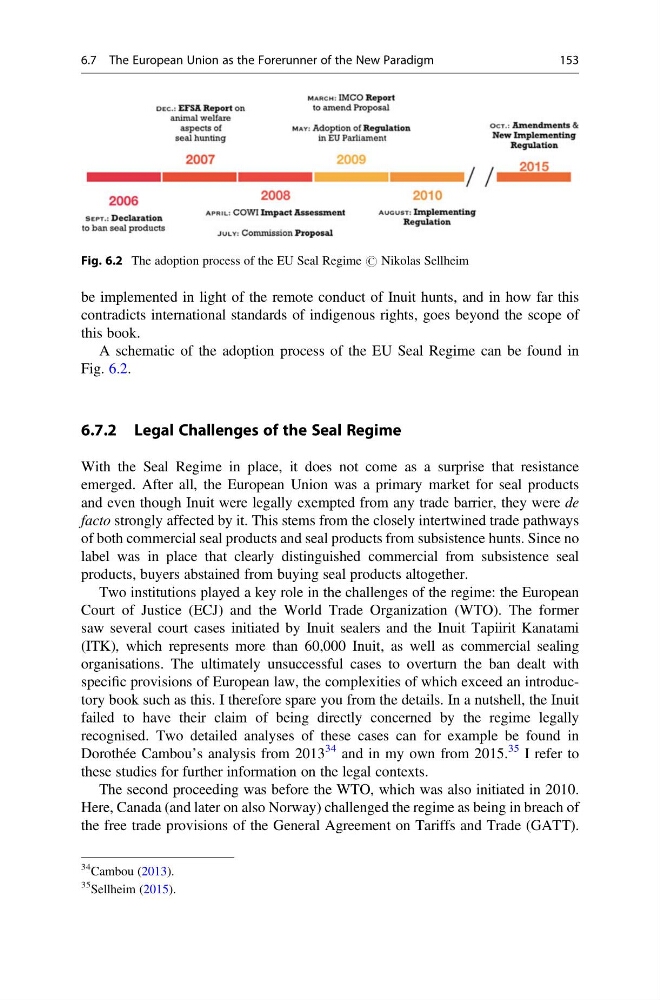
A schematic of the adoption process of the EU Seal Regime can be found in
Fig. 6.2.
6.7.2 Legal Challenges of the Seal Regime
With the Seal Regime in place, it does not come as a surprise that resistance
emerged. After all, the European Union was a primary market for seal products
and even though Inuit were legally exempted from any trade barrier, they were de
facto strongly affected by it. This stems from the closely intertwined trade pathways
of both commercial seal products and seal products from subsistence hunts. Since no
label was in place that clearly distinguished commercial from subsistence seal
products, buyers abstained from buying seal products altogether.
Two institutions played a key role in the challenges of the regime: the European
Court of Justice (ECJ) and the World Trade Organization (WTO). The former
saw several court cases initiated by Inuit sealers and the Inuit Tapiirit Kanatami
(ITK), which represents more than 60,000 Inuit, as well as commercial sealing
organisations. The ultimately unsuccessful cases to overturn the ban dealt with
specific provisions of European law, the complexities of which exceed an introductory book such as this. I therefore spare you from the details. In a nutshell, the Inuit
failed to have their claim of being directly concerned by the regime legally
recognised. Two detailed analyses of these cases can for example be found in
Dorothée Cambou’s analysis from 2013
34 and in my own from 2015.
35 I refer to
these studies for further information on the legal contexts.
The second proceeding was before the WTO, which was also initiated in 2010.
Here, Canada (and later on also Norway) challenged the regime as being in breach of
the free trade provisions of the General Agreement on Tariffs and Trade (GATT).
Fig. 6.2 The adoption process of the EU Seal Regime # Nikolas Sellheim
34 Cambou (2013).
35 Sellheim (2015).
6.7 The European Union as the Forerunner of the New Paradigm
153
contradicts international standards of indigenous rights, goes beyond the scope of
this book.
A schematic of the adoption process of the EU Seal Regime can be found in
Fig. 6.2.
6.7.2 Legal Challenges of the Seal Regime
With the Seal Regime in place, it does not come as a surprise that resistance
emerged. After all, the European Union was a primary market for seal products
and even though Inuit were legally exempted from any trade barrier, they were de
facto strongly affected by it. This stems from the closely intertwined trade pathways
of both commercial seal products and seal products from subsistence hunts. Since no
label was in place that clearly distinguished commercial from subsistence seal
products, buyers abstained from buying seal products altogether.
Two institutions played a key role in the challenges of the regime: the European
Court of Justice (ECJ) and the World Trade Organization (WTO). The former
saw several court cases initiated by Inuit sealers and the Inuit Tapiirit Kanatami
(ITK), which represents more than 60,000 Inuit, as well as commercial sealing
organisations. The ultimately unsuccessful cases to overturn the ban dealt with
specific provisions of European law, the complexities of which exceed an introductory book such as this. I therefore spare you from the details. In a nutshell, the Inuit
failed to have their claim of being directly concerned by the regime legally
recognised. Two detailed analyses of these cases can for example be found in
Dorothée Cambou’s analysis from 2013
34 and in my own from 2015.
35 I refer to
these studies for further information on the legal contexts.
The second proceeding was before the WTO, which was also initiated in 2010.
Here, Canada (and later on also Norway) challenged the regime as being in breach of
the free trade provisions of the General Agreement on Tariffs and Trade (GATT).
Fig. 6.2 The adoption process of the EU Seal Regime # Nikolas Sellheim
34 Cambou (2013).
35 Sellheim (2015).
6.7 The European Union as the Forerunner of the New Paradigm
153