

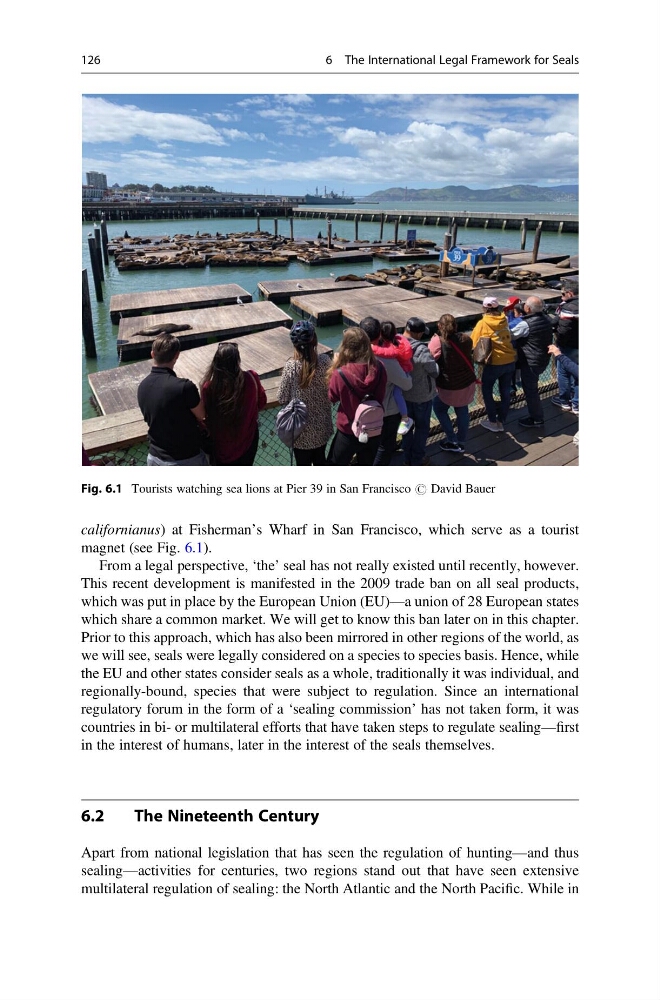
californianus) at Fisherman’s Wharf in San Francisco, which serve as a tourist
magnet (see Fig. 6.1).
From a legal perspective, ‘the’ seal has not really existed until recently, however.
This recent development is manifested in the 2009 trade ban on all seal products,
which was put in place by the European Union (EU)—a union of 28 European states
which share a common market. We will get to know this ban later on in this chapter.
Prior to this approach, which has also been mirrored in other regions of the world, as
we will see, seals were legally considered on a species to species basis. Hence, while
the EU and other states consider seals as a whole, traditionally it was individual, and
regionally-bound, species that were subject to regulation. Since an international
regulatory forum in the form of a ‘sealing commission’ has not taken form, it was
countries in bi- or multilateral efforts that have taken steps to regulate sealing—first
in the interest of humans, later in the interest of the seals themselves.
6.2
The Nineteenth Century
Apart from national legislation that has seen the regulation of hunting—and thus
sealing—activities for centuries, two regions stand out that have seen extensive
multilateral regulation of sealing: the North Atlantic and the North Pacific. While in
Fig. 6.1 Tourists watching sea lions at Pier 39 in San Francisco # David Bauer
126
6 The International Legal Framework for Seals
magnet (see Fig. 6.1).
From a legal perspective, ‘the’ seal has not really existed until recently, however.
This recent development is manifested in the 2009 trade ban on all seal products,
which was put in place by the European Union (EU)—a union of 28 European states
which share a common market. We will get to know this ban later on in this chapter.
Prior to this approach, which has also been mirrored in other regions of the world, as
we will see, seals were legally considered on a species to species basis. Hence, while
the EU and other states consider seals as a whole, traditionally it was individual, and
regionally-bound, species that were subject to regulation. Since an international
regulatory forum in the form of a ‘sealing commission’ has not taken form, it was
countries in bi- or multilateral efforts that have taken steps to regulate sealing—first
in the interest of humans, later in the interest of the seals themselves.
6.2
The Nineteenth Century
Apart from national legislation that has seen the regulation of hunting—and thus
sealing—activities for centuries, two regions stand out that have seen extensive
multilateral regulation of sealing: the North Atlantic and the North Pacific. While in
Fig. 6.1 Tourists watching sea lions at Pier 39 in San Francisco # David Bauer
126
6 The International Legal Framework for Seals