

time of conclusion of these regulations, all three countries had been actively engaged
in the pursuit of whales. Over time, and in particular in the 1970s to 1980s, the
countries ultimately changed their position on whaling and up to this day have
developed an outspoken anti-whaling position. Together with other Latin American
members of the IWC, Peru, Chile and Ecuador are now part of the so-called ‘Buenos
Aires Group’ which has streamlined its positions on whaling and which puts forth
strictly conservationist proposals at Commission meetings. It is hard to pinpoint
when the Buenos Aires Group was officially launched but official documentation of
the IWC reveals the first occurrence of the term in 2008. It is therefore reasonable to
assume that the group had formed some time in the early twenty-first century. While
the Regulations are legally speaking still in force, given that the three countries are
no longer engaged in whaling, they have become obsolete.
5.3
The International Whaling Commission, Whaling
and Whales
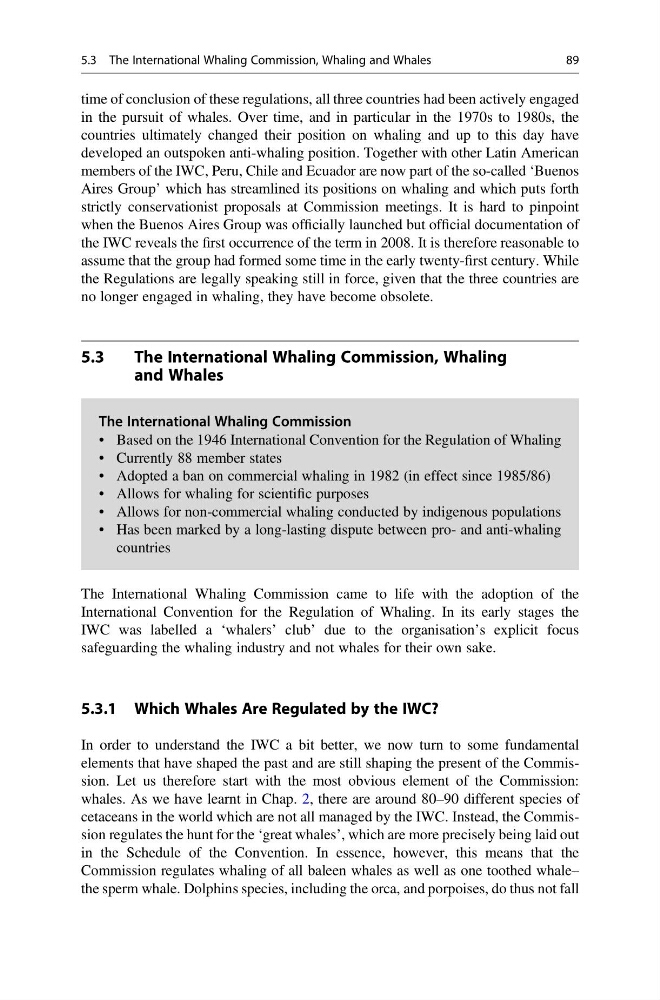
The International Whaling Commission
• Based on the 1946 International Convention for the Regulation of Whaling
• Currently 88 member states
• Adopted a ban on commercial whaling in 1982 (in effect since 1985/86)
• Allows for whaling for scientific purposes
• Allows for non-commercial whaling conducted by indigenous populations
• Has been marked by a long-lasting dispute between pro- and anti-whaling
countries
The International Whaling Commission came to life with the adoption of the
International Convention for the Regulation of Whaling. In its early stages the
IWC was labelled a ‘whalers’ club’ due to the organisation’s explicit focus
safeguarding the whaling industry and not whales for their own sake.
5.3.1 Which Whales Are Regulated by the IWC?
In order to understand the IWC a bit better, we now turn to some fundamental
elements that have shaped the past and are still shaping the present of the Commission. Let us therefore start with the most obvious element of the Commission:
whales. As we have learnt in Chap. 2, there are around 80–90 different species of
cetaceans in the world which are not all managed by the IWC. Instead, the Commission regulates the hunt for the ‘great whales’, which are more precisely being laid out
in the Schedule of the Convention. In essence, however, this means that the
Commission regulates whaling of all baleen whales as well as one toothed whale–
the sperm whale. Dolphins species, including the orca, and porpoises, do thus not fall
5.3 The International Whaling Commission, Whaling and Whales
89
in the pursuit of whales. Over time, and in particular in the 1970s to 1980s, the
countries ultimately changed their position on whaling and up to this day have
developed an outspoken anti-whaling position. Together with other Latin American
members of the IWC, Peru, Chile and Ecuador are now part of the so-called ‘Buenos
Aires Group’ which has streamlined its positions on whaling and which puts forth
strictly conservationist proposals at Commission meetings. It is hard to pinpoint
when the Buenos Aires Group was officially launched but official documentation of
the IWC reveals the first occurrence of the term in 2008. It is therefore reasonable to
assume that the group had formed some time in the early twenty-first century. While
the Regulations are legally speaking still in force, given that the three countries are
no longer engaged in whaling, they have become obsolete.
5.3
The International Whaling Commission, Whaling
and Whales
The International Whaling Commission
• Based on the 1946 International Convention for the Regulation of Whaling
• Currently 88 member states
• Adopted a ban on commercial whaling in 1982 (in effect since 1985/86)
• Allows for whaling for scientific purposes
• Allows for non-commercial whaling conducted by indigenous populations
• Has been marked by a long-lasting dispute between pro- and anti-whaling
countries
The International Whaling Commission came to life with the adoption of the
International Convention for the Regulation of Whaling. In its early stages the
IWC was labelled a ‘whalers’ club’ due to the organisation’s explicit focus
safeguarding the whaling industry and not whales for their own sake.
5.3.1 Which Whales Are Regulated by the IWC?
In order to understand the IWC a bit better, we now turn to some fundamental
elements that have shaped the past and are still shaping the present of the Commission. Let us therefore start with the most obvious element of the Commission:
whales. As we have learnt in Chap. 2, there are around 80–90 different species of
cetaceans in the world which are not all managed by the IWC. Instead, the Commission regulates the hunt for the ‘great whales’, which are more precisely being laid out
in the Schedule of the Convention. In essence, however, this means that the
Commission regulates whaling of all baleen whales as well as one toothed whale–
the sperm whale. Dolphins species, including the orca, and porpoises, do thus not fall
5.3 The International Whaling Commission, Whaling and Whales
89