

The Application of Monte Carlo Method …
79
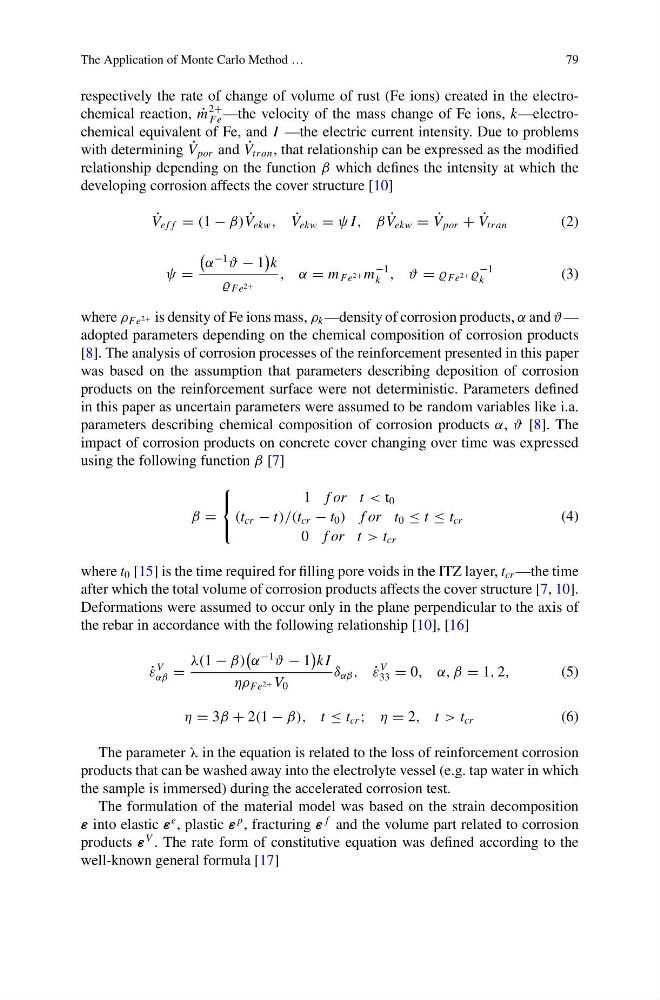
respectively the rate of change of volume of rust (Fe ions) created in the electrochemical reaction, ˙
m
2+
Fe —the velocity of the mass change of Fe ions, k—electrochemical equivalent of Fe, and I —the electric current intensity. Due to problems
with determining ˙
V por and ˙
V tran , that relationship can be expressed as the modified
relationship depending on the function β which defines the intensity at which the
developing corrosion affects the cover structure [10]
˙
V e f f = (1 − β) ˙
V ekw , ˙
V ekw = ψ I, β ˙
V ekw = ˙
V por + ˙
V tran
(2)
ψ =
α
−1
ϑ − 1
k
Fe 2+
, α = m Fe 2+ m
−1
k , ϑ = Fe 2+
−1
k
(3)
where ρ Fe 2+ is density of Fe ions mass, ρ k —density of corrosion products, α and ϑ—
adopted parameters depending on the chemical composition of corrosion products
[8]. The analysis of corrosion processes of the reinforcement presented in this paper
was based on the assumption that parameters describing deposition of corrosion
products on the reinforcement surface were not deterministic. Parameters defined
in this paper as uncertain parameters were assumed to be random variables like i.a.
parameters describing chemical composition of corrosion products α, ϑ [8]. The
impact of corrosion products on concrete cover changing over time was expressed
using the following function β [7]
β =
⎧
⎨
⎩
1 f or t < t 0
(t cr − t)/(t cr − t 0 ) f or t 0 ≤ t ≤ t cr
0 f or t > t cr
(4)
where t 0 [15] is the time required for filling pore voids in the ITZ layer, t cr —the time
after which the total volume of corrosion products affects the cover structure [7, 10].
Deformations were assumed to occur only in the plane perpendicular to the axis of
the rebar in accordance with the following relationship [10], [16]
˙
ε
V
αβ =
λ(1 − β)
α
−1
ϑ − 1
k I
ηρ Fe 2+ V 0
δ αβ , ˙
ε
V
33 = 0, α,β = 1, 2,
(5)
η = 3β + 2(1 − β), t ≤ t cr ; η = 2, t > t cr
(6)
The parameter λ in the equation is related to the loss of reinforcement corrosion
products that can be washed away into the electrolyte vessel (e.g. tap water in which
the sample is immersed) during the accelerated corrosion test.
The formulation of the material model was based on the strain decomposition
ε into elastic ε
e , plastic ε
p , fracturing ε
f and the volume part related to corrosion
products ε
V . The rate form of constitutive equation was defined according to the
well-known general formula [17]
79
respectively the rate of change of volume of rust (Fe ions) created in the electrochemical reaction, ˙
m
2+
Fe —the velocity of the mass change of Fe ions, k—electrochemical equivalent of Fe, and I —the electric current intensity. Due to problems
with determining ˙
V por and ˙
V tran , that relationship can be expressed as the modified
relationship depending on the function β which defines the intensity at which the
developing corrosion affects the cover structure [10]
˙
V e f f = (1 − β) ˙
V ekw , ˙
V ekw = ψ I, β ˙
V ekw = ˙
V por + ˙
V tran
(2)
ψ =
α
−1
ϑ − 1
k
Fe 2+
, α = m Fe 2+ m
−1
k , ϑ = Fe 2+
−1
k
(3)
where ρ Fe 2+ is density of Fe ions mass, ρ k —density of corrosion products, α and ϑ—
adopted parameters depending on the chemical composition of corrosion products
[8]. The analysis of corrosion processes of the reinforcement presented in this paper
was based on the assumption that parameters describing deposition of corrosion
products on the reinforcement surface were not deterministic. Parameters defined
in this paper as uncertain parameters were assumed to be random variables like i.a.
parameters describing chemical composition of corrosion products α, ϑ [8]. The
impact of corrosion products on concrete cover changing over time was expressed
using the following function β [7]
β =
⎧
⎨
⎩
1 f or t < t 0
(t cr − t)/(t cr − t 0 ) f or t 0 ≤ t ≤ t cr
0 f or t > t cr
(4)
where t 0 [15] is the time required for filling pore voids in the ITZ layer, t cr —the time
after which the total volume of corrosion products affects the cover structure [7, 10].
Deformations were assumed to occur only in the plane perpendicular to the axis of
the rebar in accordance with the following relationship [10], [16]
˙
ε
V
αβ =
λ(1 − β)
α
−1
ϑ − 1
k I
ηρ Fe 2+ V 0
δ αβ , ˙
ε
V
33 = 0, α,β = 1, 2,
(5)
η = 3β + 2(1 − β), t ≤ t cr ; η = 2, t > t cr
(6)
The parameter λ in the equation is related to the loss of reinforcement corrosion
products that can be washed away into the electrolyte vessel (e.g. tap water in which
the sample is immersed) during the accelerated corrosion test.
The formulation of the material model was based on the strain decomposition
ε into elastic ε
e , plastic ε
p , fracturing ε
f and the volume part related to corrosion
products ε
V . The rate form of constitutive equation was defined according to the
well-known general formula [17]