

Sustainability of Concrete Structures in Terms …
65
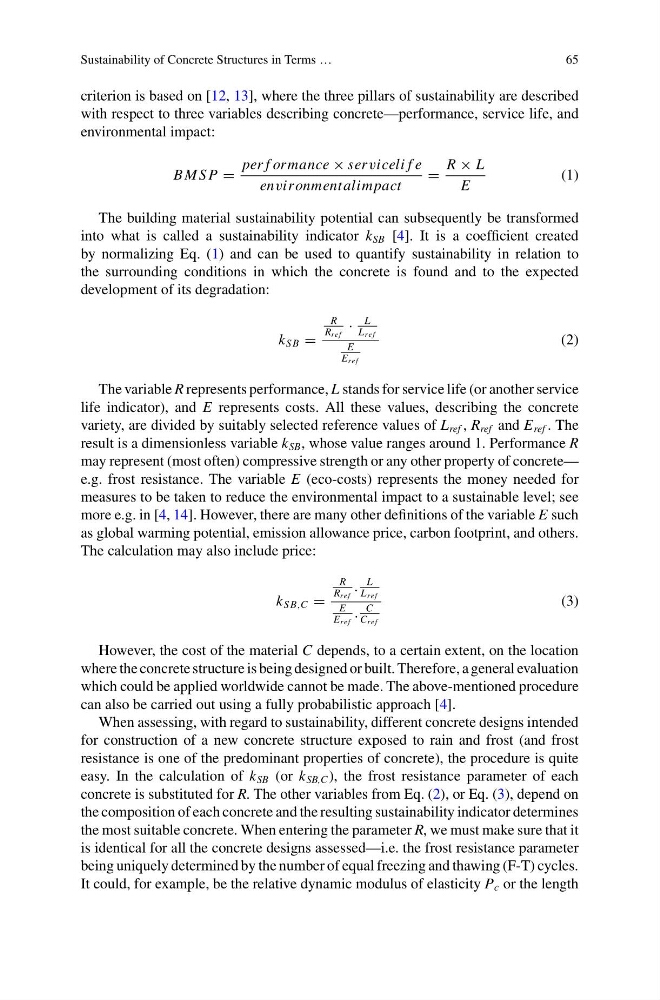
criterion is based on [12, 13], where the three pillars of sustainability are described
with respect to three variables describing concrete—performance, service life, and
environmental impact:
B M S P =
per f ormance × serviceli f e
environmentalimpact
=
R × L
E
(1)
The building material sustainability potential can subsequently be transformed
into what is called a sustainability indicator k SB [4]. It is a coefficient created
by normalizing Eq. (1) and can be used to quantify sustainability in relation to
the surrounding conditions in which the concrete is found and to the expected
development of its degradation:
k S B =
R
R re f
·
L
L ref
E
E ref
(2)
The variable R represents performance, L stands for service life (or another service
life indicator), and E represents costs. All these values, describing the concrete
variety, are divided by suitably selected reference values of L ref , R ref and E ref . The
result is a dimensionless variable k SB , whose value ranges around 1. Performance R
may represent (most often) compressive strength or any other property of concrete—
e.g. frost resistance. The variable E (eco-costs) represents the money needed for
measures to be taken to reduce the environmental impact to a sustainable level; see
more e.g. in [4, 14]. However, there are many other definitions of the variable E such
as global warming potential, emission allowance price, carbon footprint, and others.
The calculation may also include price:
k S B,C =
R
R ref
.
L
L ref
E
E ref
.
C
C ref
(3)
However, the cost of the material C depends, to a certain extent, on the location
where the concrete structure is being designed or built. Therefore, a general evaluation
which could be applied worldwide cannot be made. The above-mentioned procedure
can also be carried out using a fully probabilistic approach [4].
When assessing, with regard to sustainability, different concrete designs intended
for construction of a new concrete structure exposed to rain and frost (and frost
resistance is one of the predominant properties of concrete), the procedure is quite
easy. In the calculation of k SB (or k SB,C ), the frost resistance parameter of each
concrete is substituted for R. The other variables from Eq. (2), or Eq. (3), depend on
the composition of each concrete and the resulting sustainability indicator determines
the most suitable concrete. When entering the parameter R, we must make sure that it
is identical for all the concrete designs assessed—i.e. the frost resistance parameter
being uniquely determined by the number of equal freezing and thawing (F-T) cycles.
It could, for example, be the relative dynamic modulus of elasticity P c or the length
65
criterion is based on [12, 13], where the three pillars of sustainability are described
with respect to three variables describing concrete—performance, service life, and
environmental impact:
B M S P =
per f ormance × serviceli f e
environmentalimpact
=
R × L
E
(1)
The building material sustainability potential can subsequently be transformed
into what is called a sustainability indicator k SB [4]. It is a coefficient created
by normalizing Eq. (1) and can be used to quantify sustainability in relation to
the surrounding conditions in which the concrete is found and to the expected
development of its degradation:
k S B =
R
R re f
·
L
L ref
E
E ref
(2)
The variable R represents performance, L stands for service life (or another service
life indicator), and E represents costs. All these values, describing the concrete
variety, are divided by suitably selected reference values of L ref , R ref and E ref . The
result is a dimensionless variable k SB , whose value ranges around 1. Performance R
may represent (most often) compressive strength or any other property of concrete—
e.g. frost resistance. The variable E (eco-costs) represents the money needed for
measures to be taken to reduce the environmental impact to a sustainable level; see
more e.g. in [4, 14]. However, there are many other definitions of the variable E such
as global warming potential, emission allowance price, carbon footprint, and others.
The calculation may also include price:
k S B,C =
R
R ref
.
L
L ref
E
E ref
.
C
C ref
(3)
However, the cost of the material C depends, to a certain extent, on the location
where the concrete structure is being designed or built. Therefore, a general evaluation
which could be applied worldwide cannot be made. The above-mentioned procedure
can also be carried out using a fully probabilistic approach [4].
When assessing, with regard to sustainability, different concrete designs intended
for construction of a new concrete structure exposed to rain and frost (and frost
resistance is one of the predominant properties of concrete), the procedure is quite
easy. In the calculation of k SB (or k SB,C ), the frost resistance parameter of each
concrete is substituted for R. The other variables from Eq. (2), or Eq. (3), depend on
the composition of each concrete and the resulting sustainability indicator determines
the most suitable concrete. When entering the parameter R, we must make sure that it
is identical for all the concrete designs assessed—i.e. the frost resistance parameter
being uniquely determined by the number of equal freezing and thawing (F-T) cycles.
It could, for example, be the relative dynamic modulus of elasticity P c or the length