

46
D. Tomaszewicz et al.
1 Introduction
The tested concrete block elements represent fragments of an external layer of a wall
of traditional large-panel residential buildings where it is not desirable to check the
carrying capacity by pull-out tests. Studies on multilayered walls are important, i.e.
where the outer layer is not sufficiently load—bearing to transfer the load from the
anchor or the outer layer has to be supported by the internal one. The tests described
here were undertaken to preliminary inspect the behavior of such structures. The
results were generally verified using simplified computational simulations, which
also can be treated as a proposition for the future low-cost theoretical assessment of
the load capacity of multilayered walls connections. Numerical modeling of bonded
anchorages in concrete is done by many authors [1–9], as well as in wood [10].
Some cases relate to testing the reinforcement load capacity [11, 12]. All numerical
analyzes are preceded by more or less complex experimental studies [13–17]. The
authors of this article have included in the numerical calculations the special feature
function defined for the threaded connection of a screw anchor. Due to this parameter,
it was not necessary to model the actual geometry of the anchor.
2 The Description of the Experiment
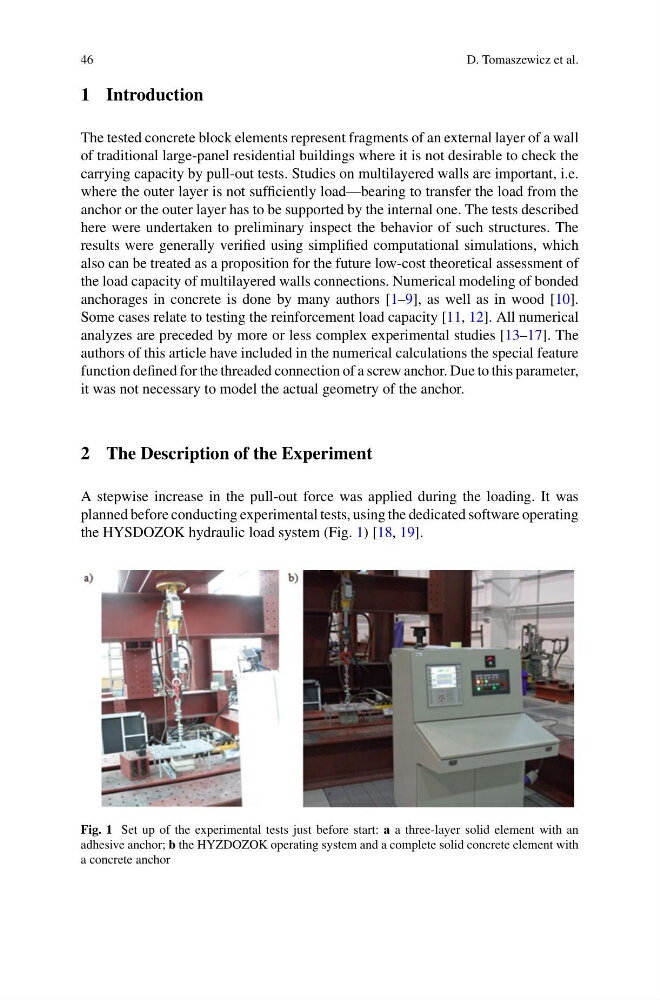
A stepwise increase in the pull-out force was applied during the loading. It was
planned before conducting experimental tests, using the dedicated software operating
the HYSDOZOK hydraulic load system (Fig. 1) [18, 19].
Fig. 1 Set up of the experimental tests just before start: a a three-layer solid element with an
adhesive anchor; b the HYZDOZOK operating system and a complete solid concrete element with
a concrete anchor
D. Tomaszewicz et al.
1 Introduction
The tested concrete block elements represent fragments of an external layer of a wall
of traditional large-panel residential buildings where it is not desirable to check the
carrying capacity by pull-out tests. Studies on multilayered walls are important, i.e.
where the outer layer is not sufficiently load—bearing to transfer the load from the
anchor or the outer layer has to be supported by the internal one. The tests described
here were undertaken to preliminary inspect the behavior of such structures. The
results were generally verified using simplified computational simulations, which
also can be treated as a proposition for the future low-cost theoretical assessment of
the load capacity of multilayered walls connections. Numerical modeling of bonded
anchorages in concrete is done by many authors [1–9], as well as in wood [10].
Some cases relate to testing the reinforcement load capacity [11, 12]. All numerical
analyzes are preceded by more or less complex experimental studies [13–17]. The
authors of this article have included in the numerical calculations the special feature
function defined for the threaded connection of a screw anchor. Due to this parameter,
it was not necessary to model the actual geometry of the anchor.
2 The Description of the Experiment
A stepwise increase in the pull-out force was applied during the loading. It was
planned before conducting experimental tests, using the dedicated software operating
the HYSDOZOK hydraulic load system (Fig. 1) [18, 19].
Fig. 1 Set up of the experimental tests just before start: a a three-layer solid element with an
adhesive anchor; b the HYZDOZOK operating system and a complete solid concrete element with
a concrete anchor