

Peculiarities of Reconstruction Work …
27
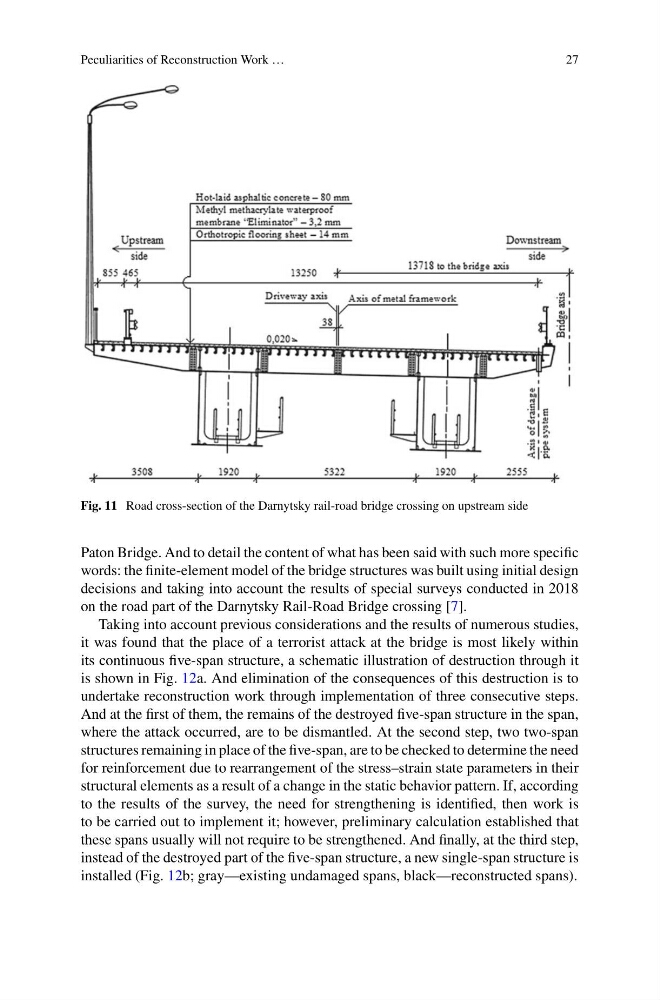
Fig. 11 Road cross-section of the Darnytsky rail-road bridge crossing on upstream side
Paton Bridge. And to detail the content of what has been said with such more specific
words: the finite-element model of the bridge structures was built using initial design
decisions and taking into account the results of special surveys conducted in 2018
on the road part of the Darnytsky Rail-Road Bridge crossing [7].
Taking into account previous considerations and the results of numerous studies,
it was found that the place of a terrorist attack at the bridge is most likely within
its continuous five-span structure, a schematic illustration of destruction through it
is shown in Fig. 12a. And elimination of the consequences of this destruction is to
undertake reconstruction work through implementation of three consecutive steps.
And at the first of them, the remains of the destroyed five-span structure in the span,
where the attack occurred, are to be dismantled. At the second step, two two-span
structures remaining in place of the five-span, are to be checked to determine the need
for reinforcement due to rearrangement of the stress–strain state parameters in their
structural elements as a result of a change in the static behavior pattern. If, according
to the results of the survey, the need for strengthening is identified, then work is
to be carried out to implement it; however, preliminary calculation established that
these spans usually will not require to be strengthened. And finally, at the third step,
instead of the destroyed part of the five-span structure, a new single-span structure is
installed (Fig. 12b; gray—existing undamaged spans, black—reconstructed spans).
27
Fig. 11 Road cross-section of the Darnytsky rail-road bridge crossing on upstream side
Paton Bridge. And to detail the content of what has been said with such more specific
words: the finite-element model of the bridge structures was built using initial design
decisions and taking into account the results of special surveys conducted in 2018
on the road part of the Darnytsky Rail-Road Bridge crossing [7].
Taking into account previous considerations and the results of numerous studies,
it was found that the place of a terrorist attack at the bridge is most likely within
its continuous five-span structure, a schematic illustration of destruction through it
is shown in Fig. 12a. And elimination of the consequences of this destruction is to
undertake reconstruction work through implementation of three consecutive steps.
And at the first of them, the remains of the destroyed five-span structure in the span,
where the attack occurred, are to be dismantled. At the second step, two two-span
structures remaining in place of the five-span, are to be checked to determine the need
for reinforcement due to rearrangement of the stress–strain state parameters in their
structural elements as a result of a change in the static behavior pattern. If, according
to the results of the survey, the need for strengthening is identified, then work is
to be carried out to implement it; however, preliminary calculation established that
these spans usually will not require to be strengthened. And finally, at the third step,
instead of the destroyed part of the five-span structure, a new single-span structure is
installed (Fig. 12b; gray—existing undamaged spans, black—reconstructed spans).