

Innovative Bridge Concept
7
be properly designed to reduce the possible accumulation of hydrostatic pressure,
to control erosion of the roadway embankment, and to reduce the possibility of soil
liquefaction.
2 Types of Bridge Structures on Higher Speed Lines
2.1 Simply Supported Bridges for Small and Medium Spans
Simply supported bridges are the most commonly constructed superstructures on
the retrofitted high speed lines. One important reason for the popularity of simply
supported structural systems was that they could be replaced easily and rapidly
without disturbing the substructure and adjacent structures.
Filler concrete beam deck bridges with encased rolled or welded I or H-shaped
section are still the most typical and widely used type of bridge structure on the actually modernised network [5]. Additionally, some studies consider also untraditional
shape of the pieces, particularly the upside-down T-sections. Especially for small
overpasses, typical span lengths of these encased steel beams are from 8 to 16 m.
The effectiveness follows from the favourable properties of basic materials, stiffness
and strength of concrete in compression and great strength of steel in tension. Particularly from the viewpoint of more strict criteria limiting deformations and improving
dynamic behaviour. Small structural depth represents another significant advantage
of the filer-beam deck bridge. The current global analysis of the bridge structures
is usually simplified to the calculation of single beam model. Besides space three
dimensional finite analyses can be actually applied. A plate model of deck with steel
beams approximated by ribs encased into the deck may provide the improved load
redistribution resulting in more accurate internal forces and deflections.
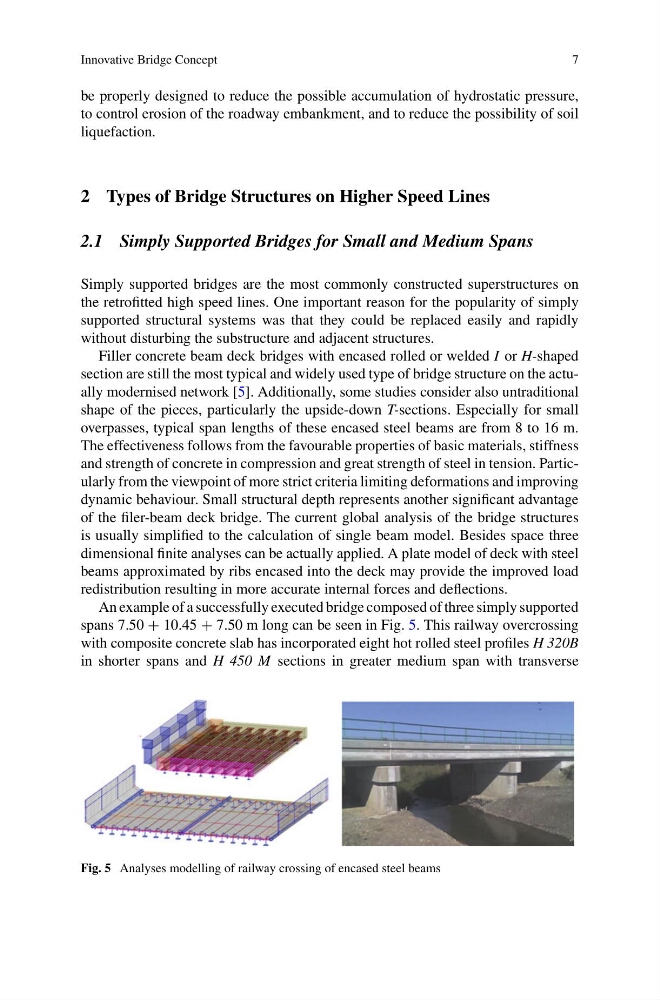
An example of a successfully executed bridge composed of three simply supported
spans 7.50 + 10.45 + 7.50 m long can be seen in Fig. 5. This railway overcrossing
with composite concrete slab has incorporated eight hot rolled steel profiles H 320B
in shorter spans and H 450 M sections in greater medium span with transverse
Fig. 5 Analyses modelling of railway crossing of encased steel beams
7
be properly designed to reduce the possible accumulation of hydrostatic pressure,
to control erosion of the roadway embankment, and to reduce the possibility of soil
liquefaction.
2 Types of Bridge Structures on Higher Speed Lines
2.1 Simply Supported Bridges for Small and Medium Spans
Simply supported bridges are the most commonly constructed superstructures on
the retrofitted high speed lines. One important reason for the popularity of simply
supported structural systems was that they could be replaced easily and rapidly
without disturbing the substructure and adjacent structures.
Filler concrete beam deck bridges with encased rolled or welded I or H-shaped
section are still the most typical and widely used type of bridge structure on the actually modernised network [5]. Additionally, some studies consider also untraditional
shape of the pieces, particularly the upside-down T-sections. Especially for small
overpasses, typical span lengths of these encased steel beams are from 8 to 16 m.
The effectiveness follows from the favourable properties of basic materials, stiffness
and strength of concrete in compression and great strength of steel in tension. Particularly from the viewpoint of more strict criteria limiting deformations and improving
dynamic behaviour. Small structural depth represents another significant advantage
of the filer-beam deck bridge. The current global analysis of the bridge structures
is usually simplified to the calculation of single beam model. Besides space three
dimensional finite analyses can be actually applied. A plate model of deck with steel
beams approximated by ribs encased into the deck may provide the improved load
redistribution resulting in more accurate internal forces and deflections.
An example of a successfully executed bridge composed of three simply supported
spans 7.50 + 10.45 + 7.50 m long can be seen in Fig. 5. This railway overcrossing
with composite concrete slab has incorporated eight hot rolled steel profiles H 320B
in shorter spans and H 450 M sections in greater medium span with transverse
Fig. 5 Analyses modelling of railway crossing of encased steel beams