

Representing Built Environments with Digital Tools …
175
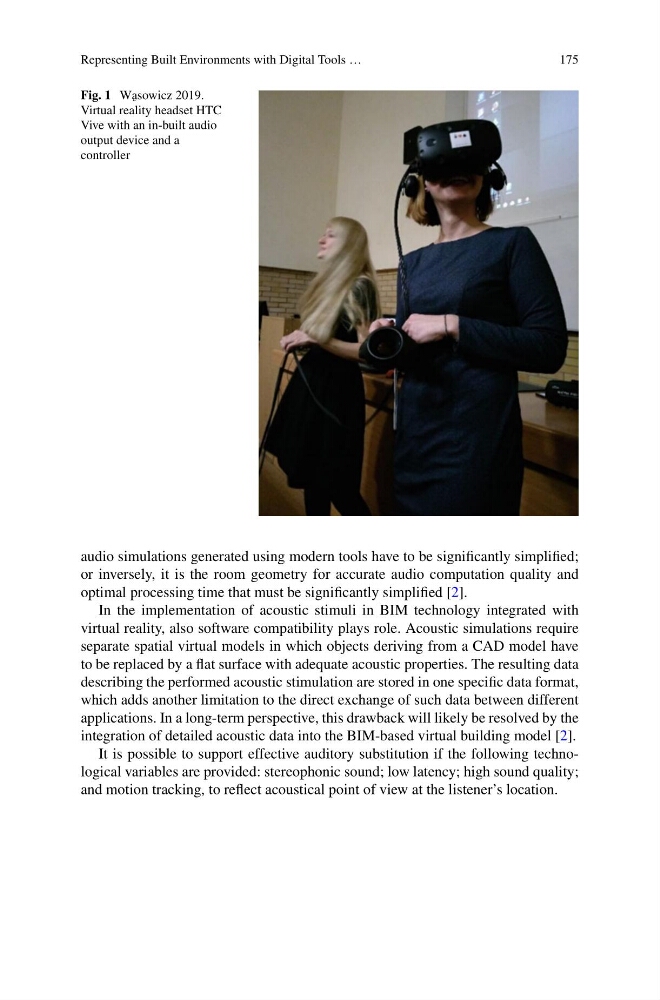
Fig. 1 W˛ asowicz 2019.
Virtual reality headset HTC
Vive with an in-built audio
output device and a
controller
audio simulations generated using modern tools have to be significantly simplified;
or inversely, it is the room geometry for accurate audio computation quality and
optimal processing time that must be significantly simplified [2].
In the implementation of acoustic stimuli in BIM technology integrated with
virtual reality, also software compatibility plays role. Acoustic simulations require
separate spatial virtual models in which objects deriving from a CAD model have
to be replaced by a flat surface with adequate acoustic properties. The resulting data
describing the performed acoustic stimulation are stored in one specific data format,
which adds another limitation to the direct exchange of such data between different
applications. In a long-term perspective, this drawback will likely be resolved by the
integration of detailed acoustic data into the BIM-based virtual building model [2].
It is possible to support effective auditory substitution if the following technological variables are provided: stereophonic sound; low latency; high sound quality;
and motion tracking, to reflect acoustical point of view at the listener’s location.
175
Fig. 1 W˛ asowicz 2019.
Virtual reality headset HTC
Vive with an in-built audio
output device and a
controller
audio simulations generated using modern tools have to be significantly simplified;
or inversely, it is the room geometry for accurate audio computation quality and
optimal processing time that must be significantly simplified [2].
In the implementation of acoustic stimuli in BIM technology integrated with
virtual reality, also software compatibility plays role. Acoustic simulations require
separate spatial virtual models in which objects deriving from a CAD model have
to be replaced by a flat surface with adequate acoustic properties. The resulting data
describing the performed acoustic stimulation are stored in one specific data format,
which adds another limitation to the direct exchange of such data between different
applications. In a long-term perspective, this drawback will likely be resolved by the
integration of detailed acoustic data into the BIM-based virtual building model [2].
It is possible to support effective auditory substitution if the following technological variables are provided: stereophonic sound; low latency; high sound quality;
and motion tracking, to reflect acoustical point of view at the listener’s location.