

The Influence of Grinding Method on the Particle Size …
143
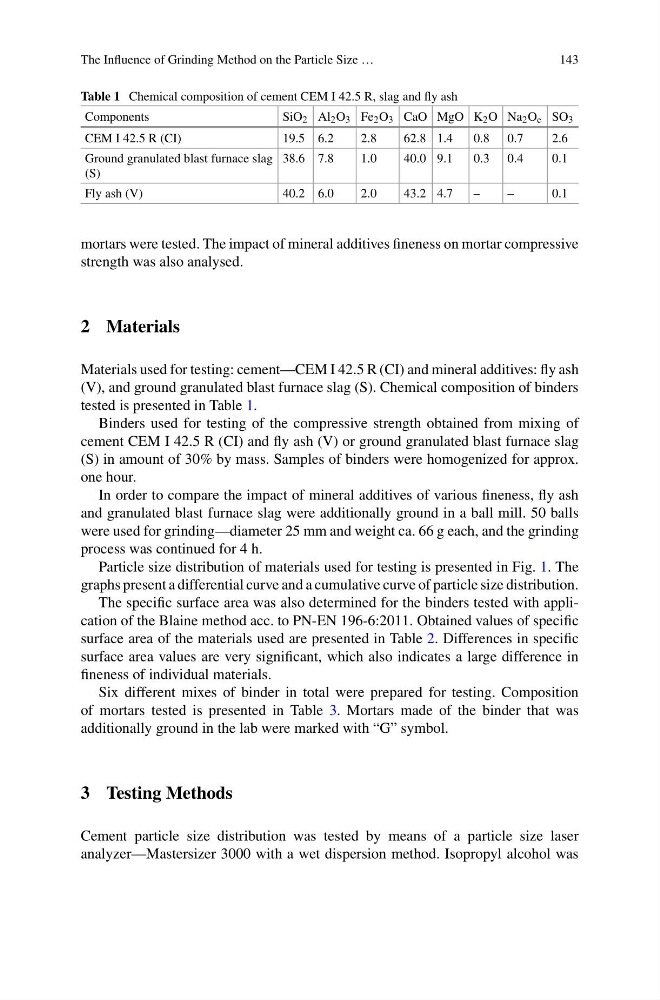
Table 1 Chemical composition of cement CEM I 42.5 R, slag and fly ash
Components
SiO 2 Al 2 O 3 Fe 2 O 3 CaO MgO K 2 O Na 2 O e SO 3
CEM I 42.5 R (CI)
19.5 6.2
2.8
62.8 1.4
0.8 0.7
2.6
Ground granulated blast furnace slag
(S)
38.6 7.8
1.0
40.0 9.1
0.3 0.4
0.1
Fly ash (V)
40.2 6.0
2.0
43.2 4.7
–
–
0.1
mortars were tested. The impact of mineral additives fineness on mortar compressive
strength was also analysed.
2 Materials
Materials used for testing: cement—CEM I 42.5 R (CI) and mineral additives: fly ash
(V), and ground granulated blast furnace slag (S). Chemical composition of binders
tested is presented in Table 1.
Binders used for testing of the compressive strength obtained from mixing of
cement CEM I 42.5 R (CI) and fly ash (V) or ground granulated blast furnace slag
(S) in amount of 30% by mass. Samples of binders were homogenized for approx.
one hour.
In order to compare the impact of mineral additives of various fineness, fly ash
and granulated blast furnace slag were additionally ground in a ball mill. 50 balls
were used for grinding—diameter 25 mm and weight ca. 66 g each, and the grinding
process was continued for 4 h.
Particle size distribution of materials used for testing is presented in Fig. 1. The
graphs present a differential curve and a cumulative curve of particle size distribution.
The specific surface area was also determined for the binders tested with application of the Blaine method acc. to PN-EN 196-6:2011. Obtained values of specific
surface area of the materials used are presented in Table 2. Differences in specific
surface area values are very significant, which also indicates a large difference in
fineness of individual materials.
Six different mixes of binder in total were prepared for testing. Composition
of mortars tested is presented in Table 3. Mortars made of the binder that was
additionally ground in the lab were marked with “G” symbol.
3 Testing Methods
Cement particle size distribution was tested by means of a particle size laser
analyzer—Mastersizer 3000 with a wet dispersion method. Isopropyl alcohol was
143
Table 1 Chemical composition of cement CEM I 42.5 R, slag and fly ash
Components
SiO 2 Al 2 O 3 Fe 2 O 3 CaO MgO K 2 O Na 2 O e SO 3
CEM I 42.5 R (CI)
19.5 6.2
2.8
62.8 1.4
0.8 0.7
2.6
Ground granulated blast furnace slag
(S)
38.6 7.8
1.0
40.0 9.1
0.3 0.4
0.1
Fly ash (V)
40.2 6.0
2.0
43.2 4.7
–
–
0.1
mortars were tested. The impact of mineral additives fineness on mortar compressive
strength was also analysed.
2 Materials
Materials used for testing: cement—CEM I 42.5 R (CI) and mineral additives: fly ash
(V), and ground granulated blast furnace slag (S). Chemical composition of binders
tested is presented in Table 1.
Binders used for testing of the compressive strength obtained from mixing of
cement CEM I 42.5 R (CI) and fly ash (V) or ground granulated blast furnace slag
(S) in amount of 30% by mass. Samples of binders were homogenized for approx.
one hour.
In order to compare the impact of mineral additives of various fineness, fly ash
and granulated blast furnace slag were additionally ground in a ball mill. 50 balls
were used for grinding—diameter 25 mm and weight ca. 66 g each, and the grinding
process was continued for 4 h.
Particle size distribution of materials used for testing is presented in Fig. 1. The
graphs present a differential curve and a cumulative curve of particle size distribution.
The specific surface area was also determined for the binders tested with application of the Blaine method acc. to PN-EN 196-6:2011. Obtained values of specific
surface area of the materials used are presented in Table 2. Differences in specific
surface area values are very significant, which also indicates a large difference in
fineness of individual materials.
Six different mixes of binder in total were prepared for testing. Composition
of mortars tested is presented in Table 3. Mortars made of the binder that was
additionally ground in the lab were marked with “G” symbol.
3 Testing Methods
Cement particle size distribution was tested by means of a particle size laser
analyzer—Mastersizer 3000 with a wet dispersion method. Isopropyl alcohol was