

112
S. M. Kalinovi´ c et al.
Table 3 Characteristics of the wall materials
Material
ρ (kg/m 3 )
c (J/kg K)
λ (W/m K)
Extension lime mortar
1700
1050
0.850
Concrete with stone aggregates
2200
960
1.510
Full brick
1400
920
0.58
Lightweight concrete blocks
1000
840
0.47
Thermal insulation-stone wool
30
840
0.038
Synthetic board made of multilayer polyester
1400
1590
0.190
Softwood panels
110
1880
0.14
Ivy
533
2.8
0.4
0.392
0.339
603
0.392
0.316
443
0.392
0.309
363
0.607
0.281
711
0.607
0.265
581
0.607
0.260
471
thickness
heat conduction coefficient
specisic mass
wall 1
wall 2
wall 3
wall 4
wall 5
wall 6
U [W/m 2 K]
[kg/m 2 ]
[m]
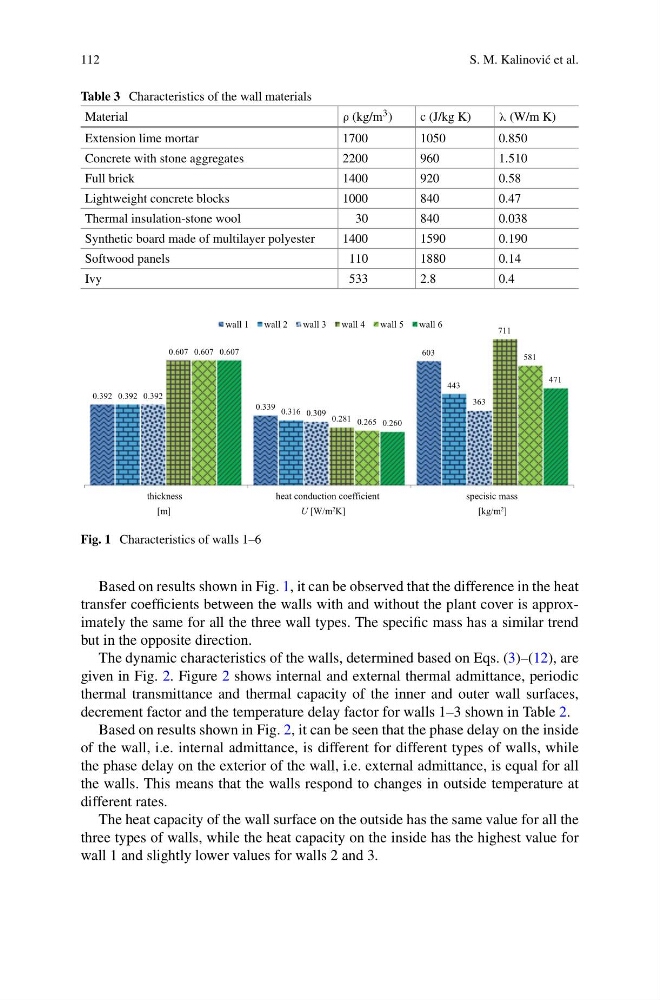
Fig. 1 Characteristics of walls 1–6
Based on results shown in Fig. 1, it can be observed that the difference in the heat
transfer coefficients between the walls with and without the plant cover is approximately the same for all the three wall types. The specific mass has a similar trend
but in the opposite direction.
The dynamic characteristics of the walls, determined based on Eqs. (3)–(12), are
given in Fig. 2. Figure 2 shows internal and external thermal admittance, periodic
thermal transmittance and thermal capacity of the inner and outer wall surfaces,
decrement factor and the temperature delay factor for walls 1–3 shown in Table 2.
Based on results shown in Fig. 2, it can be seen that the phase delay on the inside
of the wall, i.e. internal admittance, is different for different types of walls, while
the phase delay on the exterior of the wall, i.e. external admittance, is equal for all
the walls. This means that the walls respond to changes in outside temperature at
different rates.
The heat capacity of the wall surface on the outside has the same value for all the
three types of walls, while the heat capacity on the inside has the highest value for
wall 1 and slightly lower values for walls 2 and 3.
S. M. Kalinovi´ c et al.
Table 3 Characteristics of the wall materials
Material
ρ (kg/m 3 )
c (J/kg K)
λ (W/m K)
Extension lime mortar
1700
1050
0.850
Concrete with stone aggregates
2200
960
1.510
Full brick
1400
920
0.58
Lightweight concrete blocks
1000
840
0.47
Thermal insulation-stone wool
30
840
0.038
Synthetic board made of multilayer polyester
1400
1590
0.190
Softwood panels
110
1880
0.14
Ivy
533
2.8
0.4
0.392
0.339
603
0.392
0.316
443
0.392
0.309
363
0.607
0.281
711
0.607
0.265
581
0.607
0.260
471
thickness
heat conduction coefficient
specisic mass
wall 1
wall 2
wall 3
wall 4
wall 5
wall 6
U [W/m 2 K]
[kg/m 2 ]
[m]
Fig. 1 Characteristics of walls 1–6
Based on results shown in Fig. 1, it can be observed that the difference in the heat
transfer coefficients between the walls with and without the plant cover is approximately the same for all the three wall types. The specific mass has a similar trend
but in the opposite direction.
The dynamic characteristics of the walls, determined based on Eqs. (3)–(12), are
given in Fig. 2. Figure 2 shows internal and external thermal admittance, periodic
thermal transmittance and thermal capacity of the inner and outer wall surfaces,
decrement factor and the temperature delay factor for walls 1–3 shown in Table 2.
Based on results shown in Fig. 2, it can be seen that the phase delay on the inside
of the wall, i.e. internal admittance, is different for different types of walls, while
the phase delay on the exterior of the wall, i.e. external admittance, is equal for all
the walls. This means that the walls respond to changes in outside temperature at
different rates.
The heat capacity of the wall surface on the outside has the same value for all the
three types of walls, while the heat capacity on the inside has the highest value for
wall 1 and slightly lower values for walls 2 and 3.