

636
Practical MATLAB
® Applications for Engineers
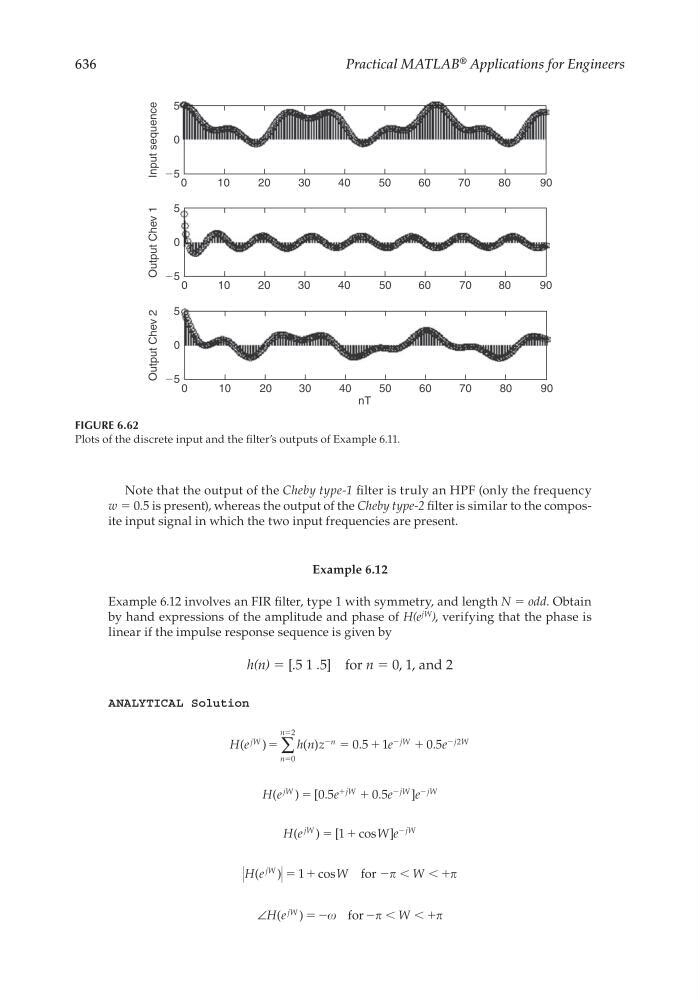
Note that the output of the Cheby type-1 fi lter is truly an HPF (only the frequency
w = 0.5 is present), whereas the output of the Cheby type-2 fi lter is similar to the composite input signal in which the two input frequencies are present.
Example 6.12
Example 6.12 involves an FIR fi lter, type 1 with symmetry, and length N = odd. Obtain
by hand expressions of the amplitude and phase of H(e
jW ), verifying that the phase is
linear if the impulse response sequence is given by
h(n) = [.5 1 .5] for n = 0, 1, and 2
ANALYTICAL Solution
H e
h n z
e
e
jW
n
n
n
j W
j W
( )
( )
.
.
ϭ
ϭ
ϩ
ϩ
ϭ
ϭ
Ϫ
Ϫ
Ϫ
0
2
2
0 5 1
0 5
∑
H e
e
e
e
jW
jW
jW
jW
( ) [ .
.
]
ϭ
ϩ
ϩ
Ϫ
Ϫ
0 5
0 5
H e
W e
jW
jW
( ) [
cos ]
ϭ ϩ
Ϫ
1
H e
W
W
jW
( )
cos
ϭ ϩ
Ϫ
ϩ
1
f o r
Ͻ Ͻ
∠H e
W
jW
( )ϭ Ϫ
Ϫ
for
Ͻ Ͻϩ
FIGURE 6.62
Plots of the discrete input and the fi lter’s outputs of Example 6.11.
5
Ϫ5
0
Input sequence
0
1 0
2 0
3 0
4 0
5 0
6 0
7 0
8 0
9 0
5
Ϫ5
0
Output Chev 1
0
1 0
2 0
3 0
4 0
5 0
6 0
7 0
8 0
9 0
5
Ϫ5
0
Output Chev 2
nT
0
1 0
2 0
3 0
4 0
5 0
6 0
7 0
8 0
9 0
CRC_47760_CH006.indd 636
CRC_47760_CH006.indd 636
7/23/2008 2:26:55 PM
7/23/2008 2:26:55 PM