

Analog and Digital Filters
587
(transformations used for the case of complex poles of H(s)).
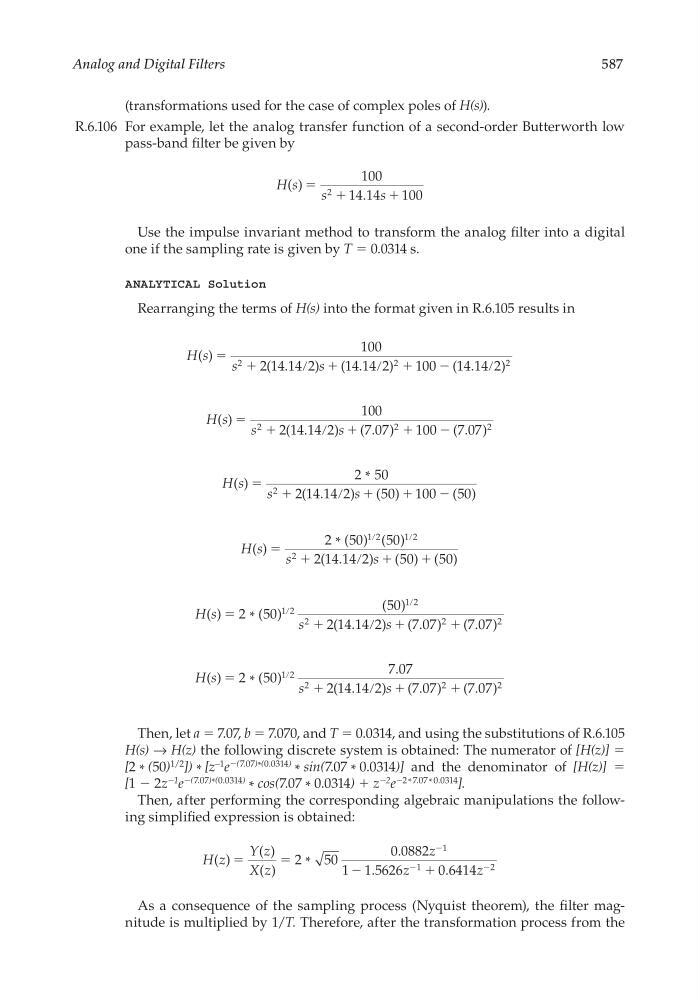
R.6.106 For example, let the analog transfer function of a second-order Butterworth low
pass-band fi lter be given by
H s
s
s
( )
.
ϭ ϩ
ϩ
100
14 14
100
2
Use the impulse invariant method to transform the analog fi lter into a digital
one if the sampling rate is given by T = 0.0314 s.
ANALYTICAL Solution
Rearranging the terms of H(s) into the format given in R.6.105 results in
H s
s
s
( )
( .
)
( .
)
( .
)
ϭ ϩ
ր ϩ
ր ϩ
Ϫ
ր
100
2 14 14 2
14 14 2
100 14 14 2
2
2
2
H s
s
s
( )
( .
)
( . )
( . )
ϭ ϩ
ր ϩ
ϩ
Ϫ
100
2 14 14 2
7 07
100 7 07
2
2
2
H s
s
s
( )
*
( .
)
( )
( )
ϭ ϩ
ր ϩ
ϩ
Ϫ
2 50
2 14 14 2
50 100
50
2
H s
s
s
( )
* ( ) ( )
( .
)
( ) ( )
ϭ ϩ
ր ϩ
ϩ
ր
ր
2 50
50
2 14 14 2
50
50
1 2
1 2
2
H s
s
s
( )
* ( )
( )
( .
)
( . )
( . )
ϭ
ϩ
ր ϩ
ϩ
ր
ր
2 50
50
2 14 14 2
7 07
7 07
1 2
1 2
2
2
2
H s
s
s
( )
* ( )
.
( .
)
( . )
( . )
ϭ
ϩ
ր ϩ
ϩ
ր
2 50
7 07
2 14 14 2
7 07
7 07
1 2
2
2
2
Then, let a = 7.07, b = 7.070, and T = 0.0314, and using the substitutions of R.6.105
H(s) → H(z) the following discrete system is obtained: The numerator of [H(z)] =
[2 * (50)
1/2
]) * [z
–1 e
−(7.07) * (0.0314) * sin(7.07 * 0.0314)] and the denominator of [H(z)] =
[1 − 2z
−1
e
−(7.07) * (0.0314) * cos(7.07 * 0.0314) + z
−2 e
−2 * 7.07 * 0.0314
].
Then, after performing the corresponding algebraic manipulations the following simplifi ed expression is obtained:
H z
Y z
X z
z
z
z
( )
( )
( )
.
.
.
ϭ
ϭ
Ϫ
ϩ
Ϫ
Ϫ
Ϫ
2
50
0 0882
1 1 5626
0 6414
1
1
2
*
As a consequence of the sampling process (Nyquist theorem), the fi lter magnitude is multiplied by 1/T. Therefore, after the transformation process from the
CRC_47760_CH006.indd 587
CRC_47760_CH006.indd 587
7/23/2008 2:26:37 PM
7/23/2008 2:26:37 PM