

550
Practical MATLAB
® Applications for Engineers
The partial fraction expansion is:
Fz =
(5/6-1/426*i*3723311^(1/2))/(z-7/20-1/20*i*71^(1/2))+
(5/6+1/426*i*3723311^(1/2))/(z-7/20+1/20*i*71^(1/2))+10/3
The impulse response h(n) is:
hn =
127/9*charfcn[0](n)-97/18*(-6/(i*71^(1/2)-7))^n-979/1278*i*(-6/(i*71^
(1/2)-7))^n*71^(1/2)97/18*6^n*(1/(7+i*71^(1/2)))^n+979/1278*i*6^n*(1/(7+i*71^
(1/2)))^n*71^(1/2)
^^^^^^^^^^^^^^^^^^^^^^^^^^^^^^^^^^^^^^^^^^^^^^^^^^^^^^^^^^^^^^^^^^^^^^^^
Pole and zero plot of H(z)
1
0.8
0.6
0.4
0.2
0
−0.2
−0.4
−0.6
−0.8
−1
−1
−0.5
0
Real Part
Imaginary Part
0.5
1
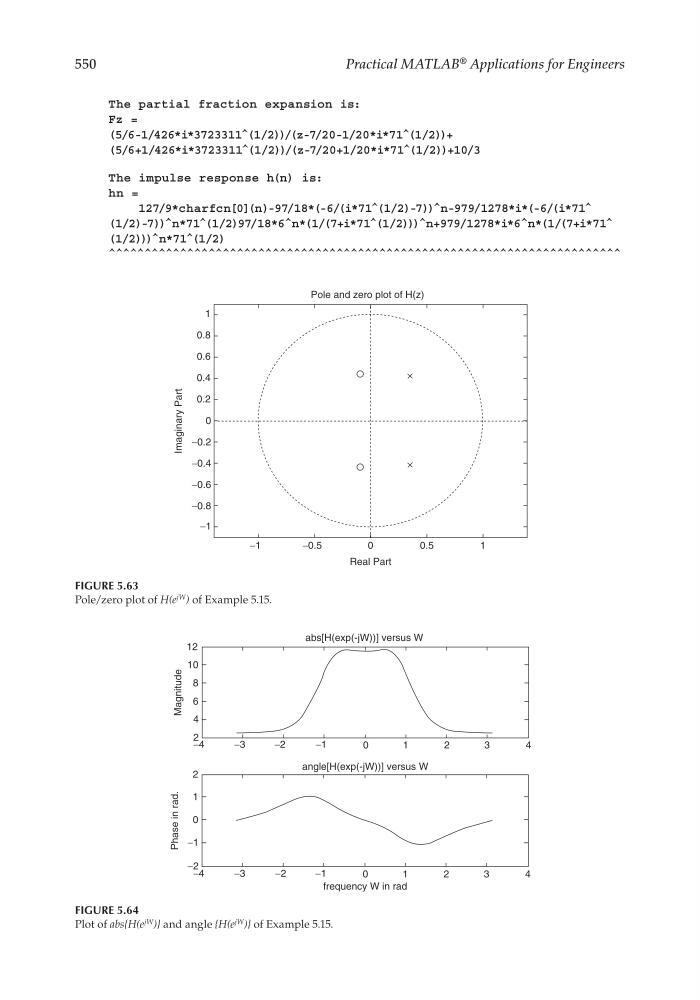
FIGURE 5.63
Pole/zero plot of H(e
jW ) of Example 5.15.
FIGURE 5.64
Plot of abs{H(e
jW )} and angle {H(e
jW )} of Example 5.15.
−4
−3
−2
−1
0
1
2
3
4
12
10
8
6
4
Magnitude
2
−4
−3
−2
−1
0
frequency W in rad
1
2
3
4
2
Phase in rad.
1
0
−1
−2
abs[H(exp(-jW))] versus W
angle[H(exp(-jW))] versus W
CRC_47760_CH005.indd 550
CRC_47760_CH005.indd 550
7/23/2008 1:47:42 PM
7/23/2008 1:47:42 PM