

Time Domain Representation of Continuous and Discrete Signals
43
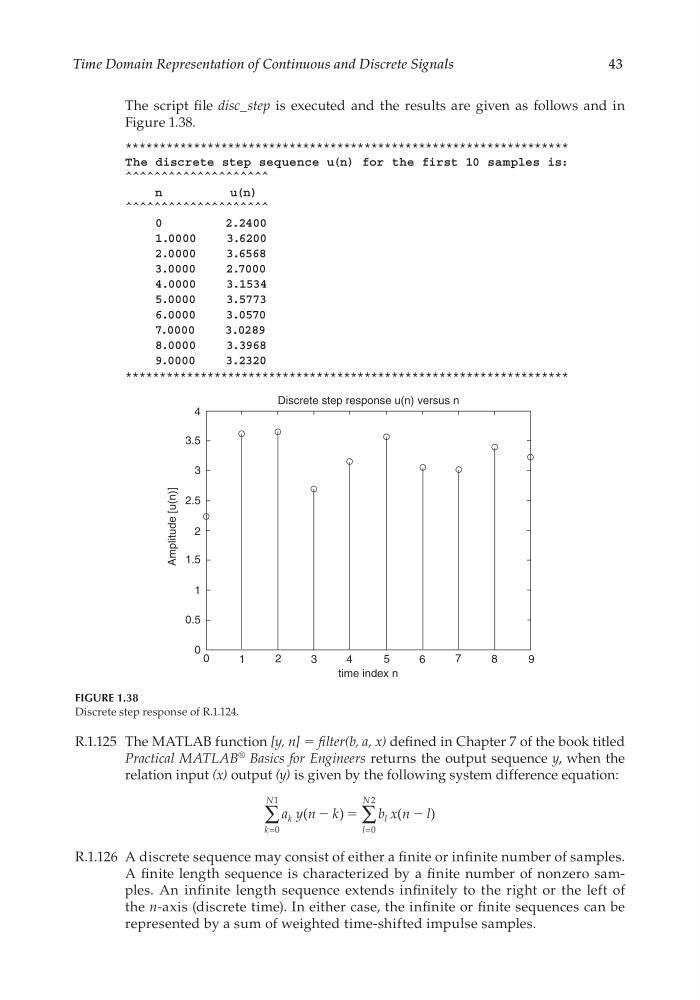
The script fi le disc_step is executed and the results are given as follows and in
Figure 1.38.
*****************************************************************
The discrete step sequence u(n) for the first 10 samples is:
^^^^^^^^^^^^^^^^^^^^
n
u(n)
^^^^^^^^^^^^^^^^^^^^
0
2.2400
1.0000
3.6200
2.0000
3.6568
3.0000
2.7000
4.0000
3.1534
5.0000
3.5773
6.0000
3.0570
7.0000
3.0289
8.0000
3.3968
9.0000
3.2320
*****************************************************************
R.1.125 The MATLAB function [y, n] = fi lter(b, a, x) defi ned in Chapter 7 of the book titled
Practical MATLAB
® Basics for Engineers returns the output sequence y, when the
relation input (x) output (y) is given by the following system difference equation:
a y n k
b x n l
k
k
N
l
l
N
=
=
∑
∑
0
1
0
2
(
)
(
)
Ϫ
Ϫ
ϭ
R.1.126 A discrete sequence may consist of either a fi nite or infi nite number of samples.
A fi nite length sequence is characterized by a fi nite number of nonzero samples. An infi nite length sequence extends infi nitely to the right or the left of
the n-axis (discrete time). In either case, the infi nite or fi nite sequences can be
represented by a sum of weighted time-shifted impulse samples.
Discrete step response u(n) versus n
4
3.5
2.5
2
1.5
0.5
0
0
1
2
3
4
5
6
7
8
9
1
3
time index n
Amplitude [u(n)]
FIGURE 1.38
Discrete step response of R.1.124.
CRC_47760_CH001.indd 43
CRC_47760_CH001.indd 43
7/25/2008 4:16:18 PM
7/25/2008 4:16:18 PM
43
The script fi le disc_step is executed and the results are given as follows and in
Figure 1.38.
*****************************************************************
The discrete step sequence u(n) for the first 10 samples is:
^^^^^^^^^^^^^^^^^^^^
n
u(n)
^^^^^^^^^^^^^^^^^^^^
0
2.2400
1.0000
3.6200
2.0000
3.6568
3.0000
2.7000
4.0000
3.1534
5.0000
3.5773
6.0000
3.0570
7.0000
3.0289
8.0000
3.3968
9.0000
3.2320
*****************************************************************
R.1.125 The MATLAB function [y, n] = fi lter(b, a, x) defi ned in Chapter 7 of the book titled
Practical MATLAB
® Basics for Engineers returns the output sequence y, when the
relation input (x) output (y) is given by the following system difference equation:
a y n k
b x n l
k
k
N
l
l
N
=
=
∑
∑
0
1
0
2
(
)
(
)
Ϫ
Ϫ
ϭ
R.1.126 A discrete sequence may consist of either a fi nite or infi nite number of samples.
A fi nite length sequence is characterized by a fi nite number of nonzero samples. An infi nite length sequence extends infi nitely to the right or the left of
the n-axis (discrete time). In either case, the infi nite or fi nite sequences can be
represented by a sum of weighted time-shifted impulse samples.
Discrete step response u(n) versus n
4
3.5
2.5
2
1.5
0.5
0
0
1
2
3
4
5
6
7
8
9
1
3
time index n
Amplitude [u(n)]
FIGURE 1.38
Discrete step response of R.1.124.
CRC_47760_CH001.indd 43
CRC_47760_CH001.indd 43
7/25/2008 4:16:18 PM
7/25/2008 4:16:18 PM