

DTFT, DFT, ZT, and FFT
525
Example 5.9
Verify the linearity property of DFT that states, in short, the following:
The sum of DFT[f 1 (n)] + DFT[f 2 (n)] + DFT[f 3 (n)] … is equal to the DFT of the sums of
(f 1 (n) + f 2 (n) + f 3 (n) …), for the following specifi c case:
DFT u n
DFT
u n
DFT
n u n
n
[ ( )]
( )
cos
( )
ϩ
ϩ
1
3
7
3
ϭ
ϩ
ϩ
DFT u n
u n
n u n
n
n
( )
( )
cos
( )
1
3
1
7
3
for
Յ Յ
Յ 16
where
f 1 (n) = u(n)
f n
u n
n
2 ( )
( )
ϭ
1
3
f n
n u n
3 ( )
cos
( )
ϭ 7
3
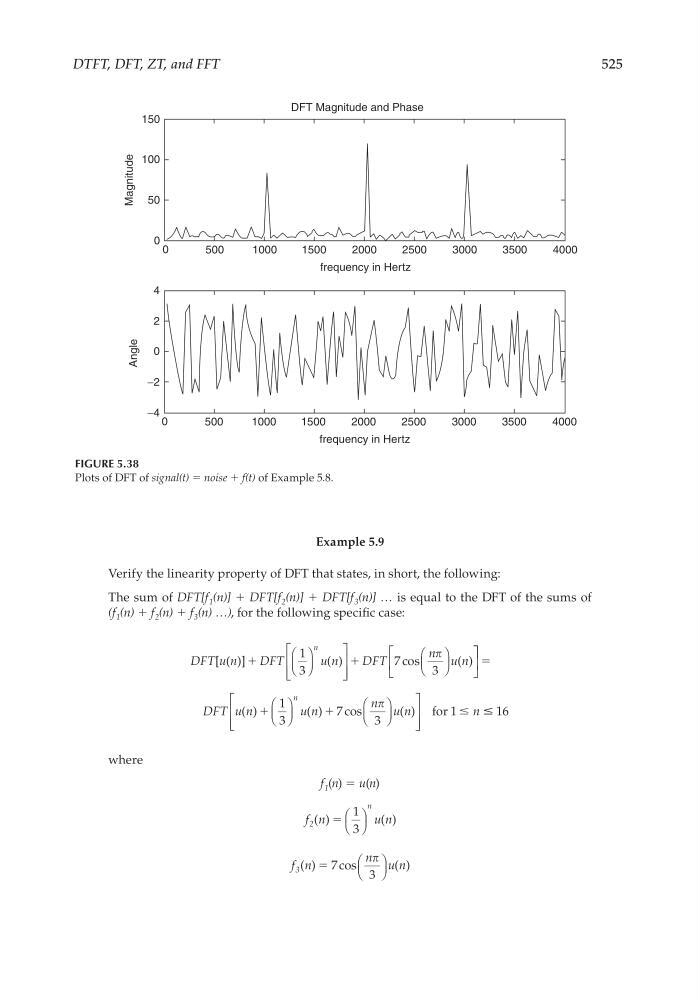
FIGURE 5.38
Plots of DFT of signal(t) = noise + f(t) of Example 5.8.
0
−4
−2
0
Angle
2
4
500
1000
1500
2000
frequency in Hertz
2500
3000
3500
4000
0
0
50
100
Magnitude
150
500
1000
1500
2000
DFT Magnitude and Phase
frequency in Hertz
2500
3000
3500
4000
CRC_47760_CH005.indd 525
CRC_47760_CH005.indd 525
7/23/2008 1:47:35 PM
7/23/2008 1:47:35 PM
525
Example 5.9
Verify the linearity property of DFT that states, in short, the following:
The sum of DFT[f 1 (n)] + DFT[f 2 (n)] + DFT[f 3 (n)] … is equal to the DFT of the sums of
(f 1 (n) + f 2 (n) + f 3 (n) …), for the following specifi c case:
DFT u n
DFT
u n
DFT
n u n
n
[ ( )]
( )
cos
( )
ϩ
ϩ
1
3
7
3
ϭ
ϩ
ϩ
DFT u n
u n
n u n
n
n
( )
( )
cos
( )
1
3
1
7
3
for
Յ Յ
Յ 16
where
f 1 (n) = u(n)
f n
u n
n
2 ( )
( )
ϭ
1
3
f n
n u n
3 ( )
cos
( )
ϭ 7
3
FIGURE 5.38
Plots of DFT of signal(t) = noise + f(t) of Example 5.8.
0
−4
−2
0
Angle
2
4
500
1000
1500
2000
frequency in Hertz
2500
3000
3500
4000
0
0
50
100
Magnitude
150
500
1000
1500
2000
DFT Magnitude and Phase
frequency in Hertz
2500
3000
3500
4000
CRC_47760_CH005.indd 525
CRC_47760_CH005.indd 525
7/23/2008 1:47:35 PM
7/23/2008 1:47:35 PM