

DTFT, DFT, ZT, and FFT
479
G z
g n z
n
n
( )
( )
ϭ
Ϫ
ϭϪϱ
ϩϱ
∑
G z
F z H z
( )
( ) . ( )
ϭ
H z
G z
F z
( )
( )
( )
ϭ
and recall that
g n
f k h n k
k
( )
( ) (
)
ϭ
Ϫ
ϭ
ϩϱ
0
∑
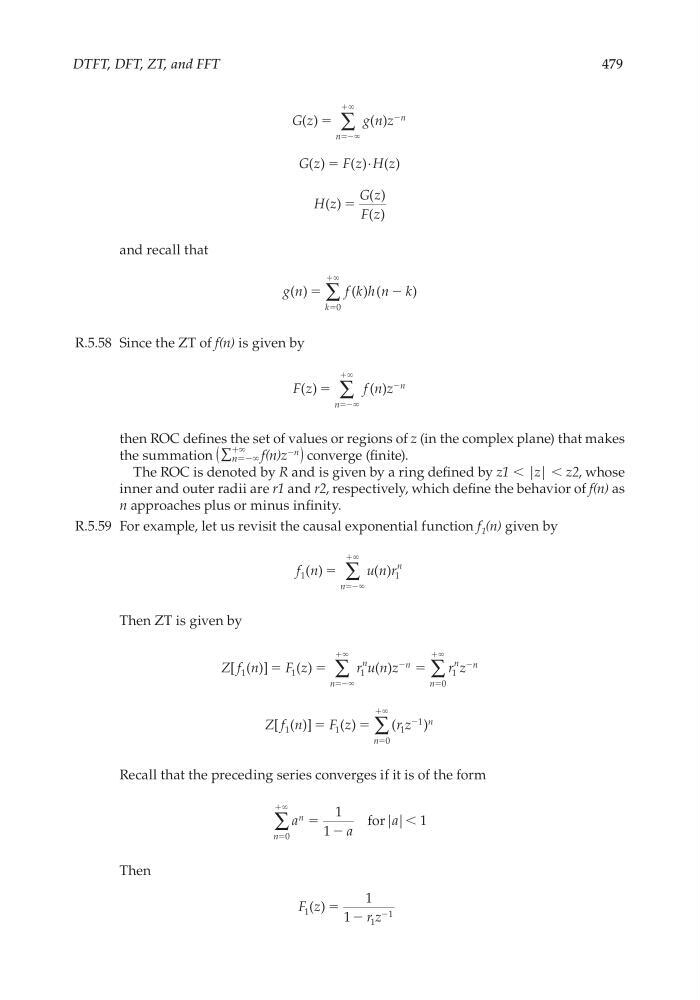
R.5.58 Since the ZT of f(n) is given by
F z
f n z
n
n
( )
( )
ϭ
Ϫ
ϭϪϱ
ϩϱ
∑
then ROC defi nes the set of values or regions of z (in the complex plane) that makes
the summation ( ∑ n=−∞
+∞
f(n)z
−n
) converge (fi nite).
The ROC is denoted by R and is given by a ring defi ned by z1 < |z| < z2, whose
inner and outer radii are r1 and r2, respectively, which defi ne the behavior of f(n) as
n approaches plus or minus infi nity.
R.5.59 For example, let us revisit the causal exponential function f 1 (n) given by
f n
u n r
n
n
1
1
( )
( )
ϭ
ϭϪϱ
ϩϱ
∑
Then ZT is given by
Z f n
F z
r u n z
r z
n
n
n
n
n
n
[ ( )]
( )
( )
1
1
1
1
0
ϭ
ϭ
ϭ
Ϫ
ϭϪϱ
ϩϱ
ϭ
ϩϱ
Ϫ
∑
∑
Z f n
F z
r z
n
n
[ ( )]
( )
(
)
1
1
1
1
0
ϭ
ϭ
Ϫ
ϭ
ϩϱ
∑
Recall that the preceding series converges if it is of the form
a
a
n
nϭ
ϩϱ
ϭ Ϫ
0
1
1
1
∑
for| |
a Ͻ
Then
F z
r z
1
1
1
1
1
( ) ϭ Ϫ
Ϫ
CRC_47760_CH005.indd 479
CRC_47760_CH005.indd 479
7/23/2008 1:47:22 PM
7/23/2008 1:47:22 PM
479
G z
g n z
n
n
( )
( )
ϭ
Ϫ
ϭϪϱ
ϩϱ
∑
G z
F z H z
( )
( ) . ( )
ϭ
H z
G z
F z
( )
( )
( )
ϭ
and recall that
g n
f k h n k
k
( )
( ) (
)
ϭ
Ϫ
ϭ
ϩϱ
0
∑
R.5.58 Since the ZT of f(n) is given by
F z
f n z
n
n
( )
( )
ϭ
Ϫ
ϭϪϱ
ϩϱ
∑
then ROC defi nes the set of values or regions of z (in the complex plane) that makes
the summation ( ∑ n=−∞
+∞
f(n)z
−n
) converge (fi nite).
The ROC is denoted by R and is given by a ring defi ned by z1 < |z| < z2, whose
inner and outer radii are r1 and r2, respectively, which defi ne the behavior of f(n) as
n approaches plus or minus infi nity.
R.5.59 For example, let us revisit the causal exponential function f 1 (n) given by
f n
u n r
n
n
1
1
( )
( )
ϭ
ϭϪϱ
ϩϱ
∑
Then ZT is given by
Z f n
F z
r u n z
r z
n
n
n
n
n
n
[ ( )]
( )
( )
1
1
1
1
0
ϭ
ϭ
ϭ
Ϫ
ϭϪϱ
ϩϱ
ϭ
ϩϱ
Ϫ
∑
∑
Z f n
F z
r z
n
n
[ ( )]
( )
(
)
1
1
1
1
0
ϭ
ϭ
Ϫ
ϭ
ϩϱ
∑
Recall that the preceding series converges if it is of the form
a
a
n
nϭ
ϩϱ
ϭ Ϫ
0
1
1
1
∑
for| |
a Ͻ
Then
F z
r z
1
1
1
1
1
( ) ϭ Ϫ
Ϫ
CRC_47760_CH005.indd 479
CRC_47760_CH005.indd 479
7/23/2008 1:47:22 PM
7/23/2008 1:47:22 PM