

DTFT, DFT, ZT, and FFT
461
R.5.6 Time invariant linear systems are completely characterized by its impulse response.
If the impulse response is known, then the output sequence g(n) can easily be evaluated for any arbitrary input sequence f(n) (similar to the continuous case).
R.5.7 The notation h(n) is reserved to denote the impulse {f(n) = δ(n)} system response
{h(n) = g(n) = L[δ(n)]} (analogous to the continuous case h(t)).
R.5.8 When the discrete system is both linear and time invariant (LTI), a number of
techniques can be used to transform the linear difference equations that relate the
system input to the system output, using the time and frequency domains. A particular useful transform from the time into the frequency domain and vice versa
from the frequency into the time domain is the Z transform (ZT).
R.5.9 Before introducing more concepts, let us gain some insight and experience by
analyzing some discrete systems. For example, analyze if the following systems,
excited by a real input sequence f(n) and producing an output g i (n), for i = 1, 2, 3 are
LTI.
The systems are
a. g 1 (n) = f(n)
b. g 2 (n) = nf(n)
c. g 3 (n) = f
2
(n)
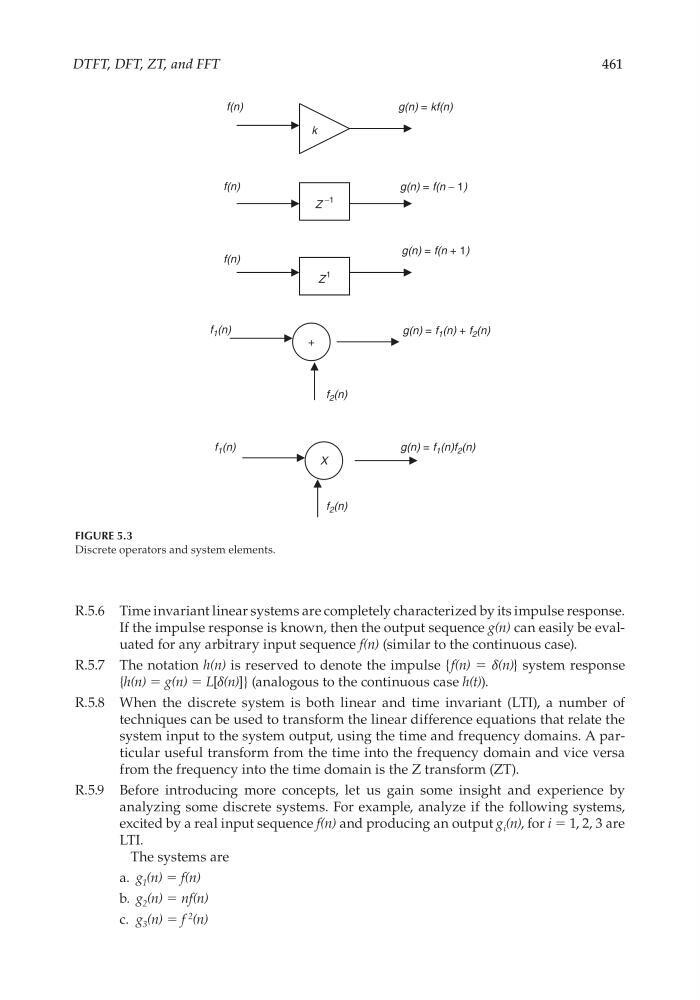
FIGURE 5.3
Discrete operators and system elements.
g(n) = kf(n)
g(n) = f(n − 1)
g(n) = f(n + 1)
g(n) = f 1 (n) + f 2 (n)
f 2 (n)
g(n) = f 1 (n)f 2 (n)
f 2 (n)
Z
1
Z
−1
+
X
k
f 1 (n)
f 1 (n)
f(n)
f(n)
f(n)
CRC_47760_CH005.indd 461
CRC_47760_CH005.indd 461
7/23/2008 1:47:16 PM
7/23/2008 1:47:16 PM
461
R.5.6 Time invariant linear systems are completely characterized by its impulse response.
If the impulse response is known, then the output sequence g(n) can easily be evaluated for any arbitrary input sequence f(n) (similar to the continuous case).
R.5.7 The notation h(n) is reserved to denote the impulse {f(n) = δ(n)} system response
{h(n) = g(n) = L[δ(n)]} (analogous to the continuous case h(t)).
R.5.8 When the discrete system is both linear and time invariant (LTI), a number of
techniques can be used to transform the linear difference equations that relate the
system input to the system output, using the time and frequency domains. A particular useful transform from the time into the frequency domain and vice versa
from the frequency into the time domain is the Z transform (ZT).
R.5.9 Before introducing more concepts, let us gain some insight and experience by
analyzing some discrete systems. For example, analyze if the following systems,
excited by a real input sequence f(n) and producing an output g i (n), for i = 1, 2, 3 are
LTI.
The systems are
a. g 1 (n) = f(n)
b. g 2 (n) = nf(n)
c. g 3 (n) = f
2
(n)
FIGURE 5.3
Discrete operators and system elements.
g(n) = kf(n)
g(n) = f(n − 1)
g(n) = f(n + 1)
g(n) = f 1 (n) + f 2 (n)
f 2 (n)
g(n) = f 1 (n)f 2 (n)
f 2 (n)
Z
1
Z
−1
+
X
k
f 1 (n)
f 1 (n)
f(n)
f(n)
f(n)
CRC_47760_CH005.indd 461
CRC_47760_CH005.indd 461
7/23/2008 1:47:16 PM
7/23/2008 1:47:16 PM