

Fourier and Laplace
335
or the more general relation given by
( ) ( )
( )
Ϫjt f t
d F w
dw
n
n
n
↔
h. Time integration
f d
jw
F w
F
w
t
( )
( )
( ) ( )
↔
∞
∫
1
0
Ϫ
ϩ
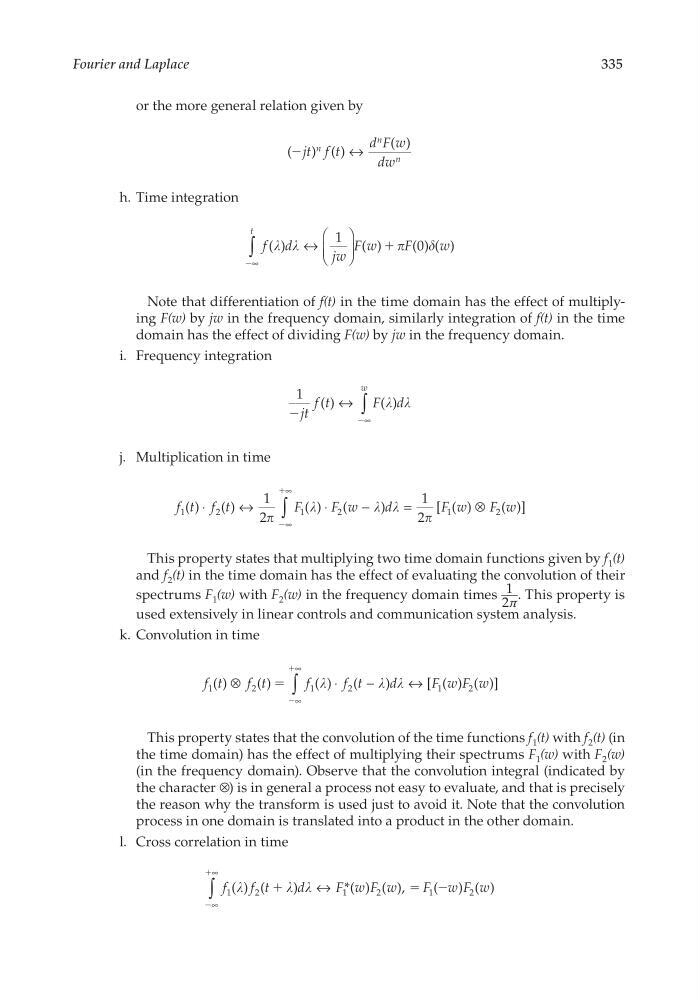
Note that differentiation of f(t) in the time domain has the effect of multiplying F(w) by jw in the frequency domain, similarly integration of f(t) in the time
domain has the effect of dividing F(w) by jw in the frequency domain.
i. Frequency integration
1
Ϫ
Ϫ
jt
f t
F d
w
( )
( )
↔
∞
∫
j. Multiplication in time
f t f t
F
F w
d
F w
F w
1
2
1
2
1
2
1
2
1
2
( )
( )
( )
(
)
[ ( )
( )]
⋅
↔
⋅
−
=
⊗
∞
∞
∫
Ϫ
ϩ
This property states that multiplying two time domain functions given by f 1 (t)
and f 2 (t) in the time domain has the effect of evaluating the convolution of their
spectrums F 1 (w) with F 2 (w) in the frequency domain times 1
___
2π
. This property is
used extensively in linear controls and communication system analysis.
k. Convolution in time
f t
f t
f
f t
d
F w F w
1
2
1
2
1
2
( )
( )
( )
(
)
[ ( ) ( )]
⊗
⋅
−
↔
∞
∞
∫
ϭ
Ϫ
ϩ
This property states that the convolution of the time functions f 1 (t) with f 2 (t) (in
the time domain) has the effect of multiplying their spectrums F 1 (w) with F 2 (w)
(in the frequency domain). Observe that the convolution integral (indicated by
the character ⊗) is in general a process not easy to evaluate, and that is precisely
the reason why the transform is used just to avoid it. Note that the convolution
process in one domain is translated into a product in the other domain.
l. Cross correlation in time
f
f t
d
F w F w
F w F w
1
2
1
2
1
2
( ) (
)
*( ) ( ),
( ) ( )
ϩ
Ϫ
Ϫ
ϩ
∞
∞
∫
↔
ϭ
CRC_47760_CH004.indd 335
CRC_47760_CH004.indd 335
7/28/2008 12:25:54 PM
7/28/2008 12:25:54 PM
335
or the more general relation given by
( ) ( )
( )
Ϫjt f t
d F w
dw
n
n
n
↔
h. Time integration
f d
jw
F w
F
w
t
( )
( )
( ) ( )
↔
∞
∫
1
0
Ϫ
ϩ
Note that differentiation of f(t) in the time domain has the effect of multiplying F(w) by jw in the frequency domain, similarly integration of f(t) in the time
domain has the effect of dividing F(w) by jw in the frequency domain.
i. Frequency integration
1
Ϫ
Ϫ
jt
f t
F d
w
( )
( )
↔
∞
∫
j. Multiplication in time
f t f t
F
F w
d
F w
F w
1
2
1
2
1
2
1
2
1
2
( )
( )
( )
(
)
[ ( )
( )]
⋅
↔
⋅
−
=
⊗
∞
∞
∫
Ϫ
ϩ
This property states that multiplying two time domain functions given by f 1 (t)
and f 2 (t) in the time domain has the effect of evaluating the convolution of their
spectrums F 1 (w) with F 2 (w) in the frequency domain times 1
___
2π
. This property is
used extensively in linear controls and communication system analysis.
k. Convolution in time
f t
f t
f
f t
d
F w F w
1
2
1
2
1
2
( )
( )
( )
(
)
[ ( ) ( )]
⊗
⋅
−
↔
∞
∞
∫
ϭ
Ϫ
ϩ
This property states that the convolution of the time functions f 1 (t) with f 2 (t) (in
the time domain) has the effect of multiplying their spectrums F 1 (w) with F 2 (w)
(in the frequency domain). Observe that the convolution integral (indicated by
the character ⊗) is in general a process not easy to evaluate, and that is precisely
the reason why the transform is used just to avoid it. Note that the convolution
process in one domain is translated into a product in the other domain.
l. Cross correlation in time
f
f t
d
F w F w
F w F w
1
2
1
2
1
2
( ) (
)
*( ) ( ),
( ) ( )
ϩ
Ϫ
Ϫ
ϩ
∞
∞
∫
↔
ϭ
CRC_47760_CH004.indd 335
CRC_47760_CH004.indd 335
7/28/2008 12:25:54 PM
7/28/2008 12:25:54 PM