

Fourier and Laplace
325
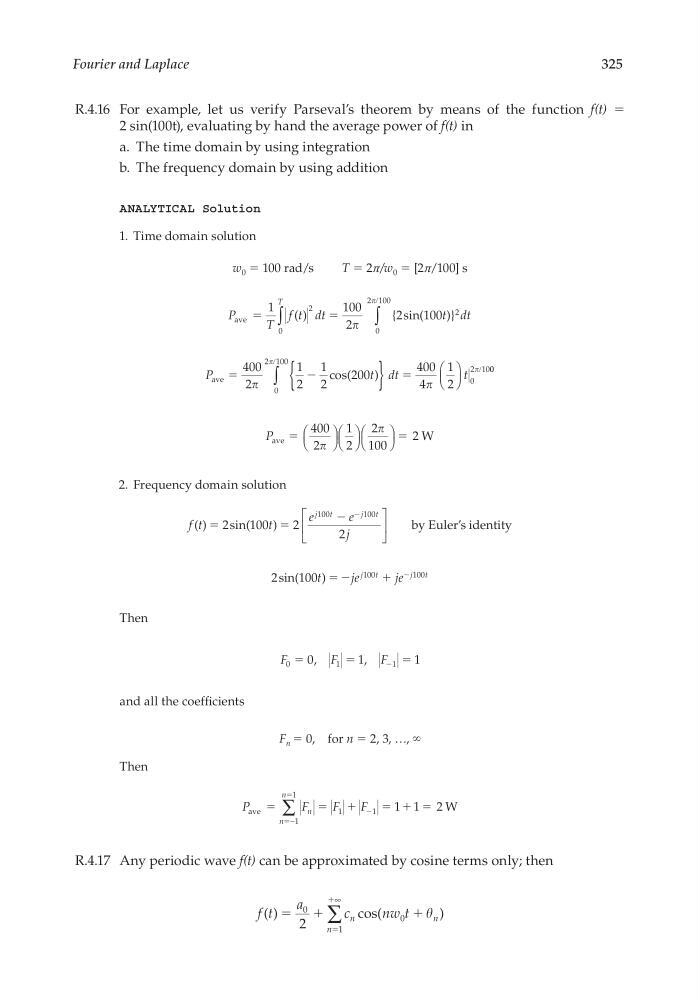
R.4.16 For example, let us verify Parseval’s theorem by means of the function f(t) =
2 sin(100t), evaluating by hand the average power of f(t) in
a. The time domain by using integration
b. The frequency domain by using addition
ANALYTICAL Solution
1. Time domain solution
w 0 = 100 rad/s
T = 2π/w 0 = [2π/100] s
P
T
f t dt
t dt
ave
2
2
0
2 100
100
2
2sin 100
ϭ
1
0
( )
{
(
)}
T
∫
∫
ϭ
ր
P
t dt
t
ave ϭ
ϭ
400
2
1
2
1
2
200
400
4
1
2
0
2 100
0
2 10
Ϫ
ր
ր
cos(
)
{
}
∫
0 0
P ave ϭ
ϭ
400
2
1
2
2
100
2
W
2. Frequency domain solution
f t
t
e
e
j
j
t
j
t
( )
sin(
)
ϭ
ϭ
2
100
2
2
100
100
Ϫ
Ϫ
by Euler’s identity
2
100
100
100
sin(
)
t
je
je
j
t
j
t
ϭ
ϩ
Ϫ
Ϫ
Then
F
F
F
0
1
1
0
1
1
ϭ
ϭ
ϭ
,
, Ϫ
and all the coeffi cients
F n = 0, for n = 2, 3, …, ∞
Then
P
F
F
F
n
n
n
ave
W
ϭ
ϭ ϩ
ϭ ϩ ϭ
ϭ
ϭ
−
∑
1
1
1
1
1 1 2
Ϫ
R.4.17 Any periodic wave f(t) can be approximated by cosine terms only; then
f t
a
c
nw t
n
n
n
( )
cos(
)
ϭ ϩ
ϩ
0
1
0
2
ϭ
ϩ∞
∑
CRC_47760_CH004.indd 325
CRC_47760_CH004.indd 325
7/28/2008 12:25:50 PM
7/28/2008 12:25:50 PM
325
R.4.16 For example, let us verify Parseval’s theorem by means of the function f(t) =
2 sin(100t), evaluating by hand the average power of f(t) in
a. The time domain by using integration
b. The frequency domain by using addition
ANALYTICAL Solution
1. Time domain solution
w 0 = 100 rad/s
T = 2π/w 0 = [2π/100] s
P
T
f t dt
t dt
ave
2
2
0
2 100
100
2
2sin 100
ϭ
1
0
( )
{
(
)}
T
∫
∫
ϭ
ր
P
t dt
t
ave ϭ
ϭ
400
2
1
2
1
2
200
400
4
1
2
0
2 100
0
2 10
Ϫ
ր
ր
cos(
)
{
}
∫
0 0
P ave ϭ
ϭ
400
2
1
2
2
100
2
W
2. Frequency domain solution
f t
t
e
e
j
j
t
j
t
( )
sin(
)
ϭ
ϭ
2
100
2
2
100
100
Ϫ
Ϫ
by Euler’s identity
2
100
100
100
sin(
)
t
je
je
j
t
j
t
ϭ
ϩ
Ϫ
Ϫ
Then
F
F
F
0
1
1
0
1
1
ϭ
ϭ
ϭ
,
, Ϫ
and all the coeffi cients
F n = 0, for n = 2, 3, …, ∞
Then
P
F
F
F
n
n
n
ave
W
ϭ
ϭ ϩ
ϭ ϩ ϭ
ϭ
ϭ
−
∑
1
1
1
1
1 1 2
Ϫ
R.4.17 Any periodic wave f(t) can be approximated by cosine terms only; then
f t
a
c
nw t
n
n
n
( )
cos(
)
ϭ ϩ
ϩ
0
1
0
2
ϭ
ϩ∞
∑
CRC_47760_CH004.indd 325
CRC_47760_CH004.indd 325
7/28/2008 12:25:50 PM
7/28/2008 12:25:50 PM