

16
Practical MATLAB
® Applications for Engineers
R.1.38 A real exponential discrete sequence is defi ned by the equation of the form
f(n) = ac
n
where a and c are real constants.
Observe that the sequence given by f(n) can converge or diverge depending on
the value of c (less than or greater than one).
R.1.39 Recall that the general sinusoidal (analog) function is given by
f(t) = A cos(t + )
where A represents its amplitude (real value); ω is referred as the angular frequency
and is given in radian/second; ω = 2πf, where f is its frequency in hertz, or cycles
per second ( f = 1/T); and α is referred as the phase shift in radians or degrees
(2π rad = 360°) (see Chapter 4 of the book titled Practical MATLAB
® Basics for Engineers for additional details).
R.1.40 Recall that sinusoidal and exponential functions are related by Euler’s identities;
introduced and discussed in Chapter 4 of the book titled Practical MATLAB
® Basics
for Engineers, and repeated as follows:
e
jwt
= cos(wt) + j sin(wt)
R.1.41 A sinusoidal discrete sequence is defi ned by the following equation:
f(n) = A cos(2n/N + )
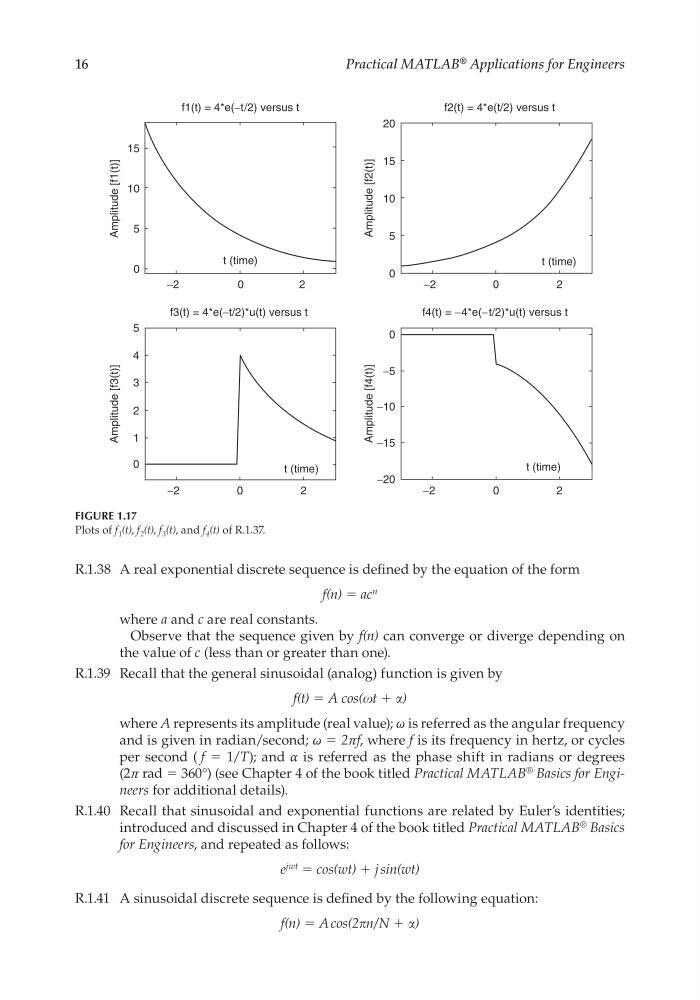
f1(t) = 4*e(−t/2) versus t
f3(t) = 4*e(−t/2)*u(t) versus t
f4(t) = −4*e(−t/2)*u(t) versus t
f2(t) = 4*e(t/2) versus t
15
20
15
10
5
0
10
5
−2
−2
0
0
2
2
0
t (time)
t (time)
Amplitude [f1(t)]
Amplitude [f2(t)]
5
−5
−10
−15
−20
−2
0
2
4
3
2
−2
0
2
1
0
Amplitude [f3(t)]
Amplitude [f4(t)]
t (time)
0
t (time)
FIGURE 1.17
Plots of f 1 (t), f 2 (t), f 3 (t), and f 4 (t) of R.1.37.
CRC_47760_CH001.indd 16
CRC_47760_CH001.indd 16
7/25/2008 4:16:13 PM
7/25/2008 4:16:13 PM
Practical MATLAB
® Applications for Engineers
R.1.38 A real exponential discrete sequence is defi ned by the equation of the form
f(n) = ac
n
where a and c are real constants.
Observe that the sequence given by f(n) can converge or diverge depending on
the value of c (less than or greater than one).
R.1.39 Recall that the general sinusoidal (analog) function is given by
f(t) = A cos(t + )
where A represents its amplitude (real value); ω is referred as the angular frequency
and is given in radian/second; ω = 2πf, where f is its frequency in hertz, or cycles
per second ( f = 1/T); and α is referred as the phase shift in radians or degrees
(2π rad = 360°) (see Chapter 4 of the book titled Practical MATLAB
® Basics for Engineers for additional details).
R.1.40 Recall that sinusoidal and exponential functions are related by Euler’s identities;
introduced and discussed in Chapter 4 of the book titled Practical MATLAB
® Basics
for Engineers, and repeated as follows:
e
jwt
= cos(wt) + j sin(wt)
R.1.41 A sinusoidal discrete sequence is defi ned by the following equation:
f(n) = A cos(2n/N + )
f1(t) = 4*e(−t/2) versus t
f3(t) = 4*e(−t/2)*u(t) versus t
f4(t) = −4*e(−t/2)*u(t) versus t
f2(t) = 4*e(t/2) versus t
15
20
15
10
5
0
10
5
−2
−2
0
0
2
2
0
t (time)
t (time)
Amplitude [f1(t)]
Amplitude [f2(t)]
5
−5
−10
−15
−20
−2
0
2
4
3
2
−2
0
2
1
0
Amplitude [f3(t)]
Amplitude [f4(t)]
t (time)
0
t (time)
FIGURE 1.17
Plots of f 1 (t), f 2 (t), f 3 (t), and f 4 (t) of R.1.37.
CRC_47760_CH001.indd 16
CRC_47760_CH001.indd 16
7/25/2008 4:16:13 PM
7/25/2008 4:16:13 PM