

12
Practical MATLAB
® Applications for Engineers
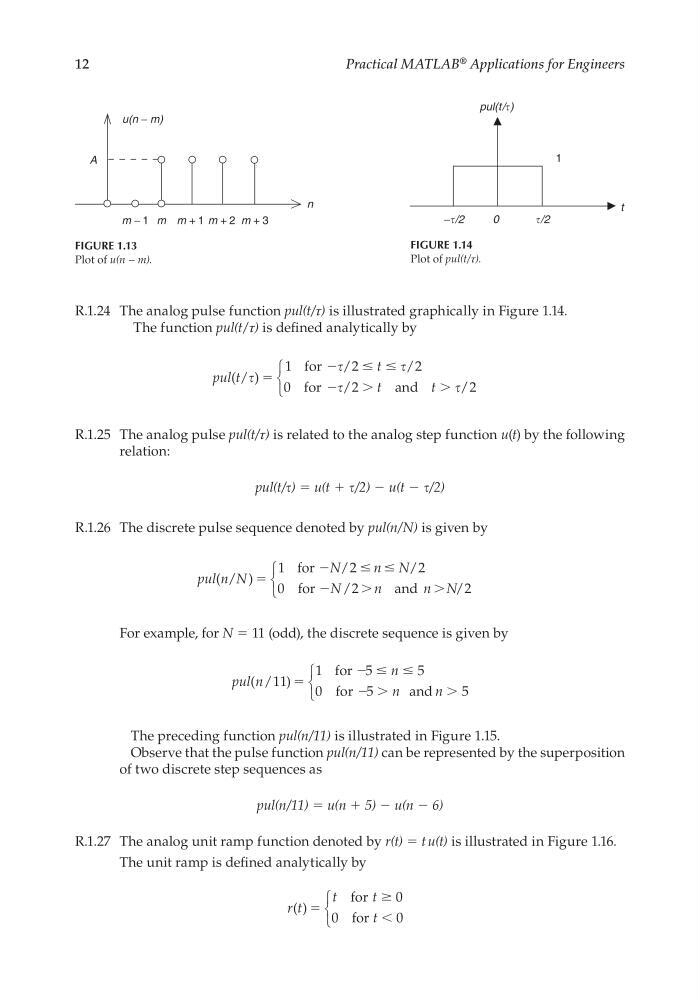
R.1.24 The analog pulse function pul(t/τ) is illustrated graphically in Figure 1.14.
The function pul(t/τ) is defi ned analytically by
pul t
t
t
t
( / )
/
/
/
/
ϭ
Յ Յ
1 for
for
and
Ϫ
Ϫ
Ͼ
Ͼ
2
2
0
2
2
R.1.25 The analog pulse pul(t/τ) is related to the analog step function u(t) by the following
relation:
pul(t/) = u(t + /2) − u(t − /2)
R.1.26 The discrete pulse sequence denoted by pul(n/N) is given by
pul n N
N
n
N
n
n
( / )
/
/
/
/
ϭ
Յ Յ
1 for
for
and
Ϫ
Ϫ
Ͼ
Ͼ
2
2
0
2
2
N
N
For example, for N = 11 (odd), the discrete sequence is given by
pul n
n
n
n
( / )
11
1
5
5
0
5
5
ϭ
Ϫ
Ϫ
for
for
Յ Յ
Ͼ
Ͼ
and
The preceding function pul(n/11) is illustrated in Figure 1.15.
Observe that the pulse function pul(n/11) can be represented by the superposition
of two discrete step sequences as
pul(n/11) = u(n + 5) − u(n − 6)
R.1.27 The analog unit ramp function denoted by r(t) = t u(t) is illustrated in Figure 1.16.
The unit ramp is defi ned analytically by
r t
t
t
t
( ) ϭ
for
for
Ն
Ͻ
0
0
0
A
u(n − m)
m − 1 m m + 1 m + 2 m + 3
n
FIGURE 1.13
Plot of u(n − m).
pul(t/)
t
−/2
0
/2
1
FIGURE 1.14
Plot of pul(t/τ).
CRC_47760_CH001.indd 12
CRC_47760_CH001.indd 12
7/25/2008 4:16:12 PM
7/25/2008 4:16:12 PM
Practical MATLAB
® Applications for Engineers
R.1.24 The analog pulse function pul(t/τ) is illustrated graphically in Figure 1.14.
The function pul(t/τ) is defi ned analytically by
pul t
t
t
t
( / )
/
/
/
/
ϭ
Յ Յ
1 for
for
and
Ϫ
Ϫ
Ͼ
Ͼ
2
2
0
2
2
R.1.25 The analog pulse pul(t/τ) is related to the analog step function u(t) by the following
relation:
pul(t/) = u(t + /2) − u(t − /2)
R.1.26 The discrete pulse sequence denoted by pul(n/N) is given by
pul n N
N
n
N
n
n
( / )
/
/
/
/
ϭ
Յ Յ
1 for
for
and
Ϫ
Ϫ
Ͼ
Ͼ
2
2
0
2
2
N
N
For example, for N = 11 (odd), the discrete sequence is given by
pul n
n
n
n
( / )
11
1
5
5
0
5
5
ϭ
Ϫ
Ϫ
for
for
Յ Յ
Ͼ
Ͼ
and
The preceding function pul(n/11) is illustrated in Figure 1.15.
Observe that the pulse function pul(n/11) can be represented by the superposition
of two discrete step sequences as
pul(n/11) = u(n + 5) − u(n − 6)
R.1.27 The analog unit ramp function denoted by r(t) = t u(t) is illustrated in Figure 1.16.
The unit ramp is defi ned analytically by
r t
t
t
t
( ) ϭ
for
for
Ն
Ͻ
0
0
0
A
u(n − m)
m − 1 m m + 1 m + 2 m + 3
n
FIGURE 1.13
Plot of u(n − m).
pul(t/)
t
−/2
0
/2
1
FIGURE 1.14
Plot of pul(t/τ).
CRC_47760_CH001.indd 12
CRC_47760_CH001.indd 12
7/25/2008 4:16:12 PM
7/25/2008 4:16:12 PM